Blog
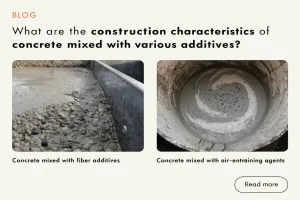
What are the construction characteristics of concrete mixed with various additives?
Blog What are the constru
Blog
Polycarboxylate superplasticizer (PCE) is the core component of modern high-performance concrete, highly favored for its excellent water-reduction efficiency and slump retention. However, in construction projects, concrete often needs to have multiple functions, such as adjusting setting time, improving frost resistance, or accelerating early strength development. It isn’t easy to fully meet the requirements with only PCE as a single additive. This raises a key question: can polycarboxylate superplasticizers be mixed with other additives for use?
The answer is “yes”, but polycarboxylate superplasticizer mixed with other additives is not as simple as pouring them all into the same tank. Incompatibility can lead to performance degradation and even complete failure of the entire concrete batch. This guide provides a clear, detailed explanation of which additives are compatible, which are incompatible, and best practices to ensure successful mixing.
Before delving into the details, let’s first establish the “golden rule”: the performance of a mixed admixture system depends on the chemical and physical compatibility of its components.
Good compatibility: Concrete additives can act alone or synergistically to achieve the desired concrete performance without producing any adverse side effects.
Poor compatibility: Adverse reactions or competition for the adsorption sites of cement particles occur between additives. This can lead to a rapid decrease in slump, severe blockage, unstable gas content, and even complete loss of plasticizing effect.
The most important approach is to conduct laboratory or on-site trial mixing before mass production. Do not assume material compatibility without prior verification.
The primary function of PCE superplasticizer is dispersion. They wrap around cement particles, creating a substantial steric hindrance that prevents them from approaching one another. This releases trapped water, significantly increasing fluidity (slump/flowability) or considerably reducing water usage.
However, PCE cannot control all aspects of concrete performance. We mix it with other additives to obtain a multifunctional concrete mixture. For example:
Concrete pouring in hot weather: We need to slow down the setting time.
Cold-weather concrete construction: We need to accelerate the setting time and strength growth.
Durable concrete: We need to introduce a stable pore system to resist freeze-thaw effects.
Self-compacting concrete (SCC): We may need to increase viscosity to prevent segregation.
Not all concrete additives can be well adapted to PCE, but the mixed application of the following types of additives is already very mature and has significant synergistic effects:
Function: Delay the setting time of concrete and solve the problem of rapid setting during long-distance transportation, high-temperature construction, or complex formwork pouring.
Compatibility with PCE: Highly compatible. The water-reducing effect of PCE can lower the heat of hydration (excessive heat of hydration can accelerate condensation). At the same time, the retarder can further prolong workability without affecting the final strength.
Application scenario: Commercial concrete that requires 1-2 hours of transportation to the site; Large volume pouring (such as dam foundations) is prone to the accumulation of hydration heat in such projects, and cracking should be avoided.
Attention: Avoid excessive use of retarders, as it may delay the development of strength.
Function: Introduce small and stable bubbles (diameter 0.1-1mm) to enhance the frost resistance of concrete and reduce bleeding.
Compatibility with PCE: Compatible with reasonable dosage. PCE itself may introduce a small amount of air (about 1% -2%), so the air-entraining agent needs to be added at a low dose to achieve the target gas content (usually 4% -6% in anti-freezing and thawing environments).
Application scenarios: Roads, bridges, or parking lots in cold regions; concrete structures exposed to de-icing salts.
Attention: Excessive use of air-entraining agent will reduce compressive strength, and the air content should always be tested after mixing.
Function: Accelerate the development of early strength (7-day strength) of concrete, achieve rapid demoulding, low-temperature construction, or emergency repair.
Compatibility with PCE: Conditional compatibility. The water-reducing effect of PCE can enhance early strength by compacting the matrix, while early-strength agents further accelerate hydration.
Application scenario: Winter construction at 0-10 ℃; A precast concrete plant that requires rapid turnover.
Attention: The common early-strength agent, calcium chloride, can corrode steel bars.
Function: Reduce excessive air bubbles introduced by PCE or other additives (such as partial retarders) to prevent a decrease in concrete strength.
Compatibility with PCE: Highly compatible. Defoamers mainly target large, unstable bubbles and do not affect PCE dispersion.
Application scenario: C60 and above high-strength concrete; Prefabricated beams, columns, and other precision components.
Attention: Defoamers should be used sparingly, as excessive use may cause concrete segregation.
Function: Improve concrete durability, reduce cement usage, and lower carbon emissions. Although not classified as a ‘chemical additive’, it is often mixed with PCE to optimize performance.
Compatibility with PCE: Excellent. The dispersing effect of PCE can break the agglomeration of mineral admixtures, ensure uniform mixing, and fully utilize the volcanic ash’s reaction (improving strength and impermeability).
Application scenario: Green buildings using recycled fly ash; Marine engineering (slag powder can enhance resistance to chloride ion erosion); High-strength concrete (silica fume can enhance compressive strength).
Attention: When the mineral admixture content is high, increase the PCE content. Some PCE will be adsorbed by the admixture, reducing the adequate concentration.
Polycarboxylate ether (PCE) and sulfonated naphthalene (SNF) are highly incompatible.
When liquid polyvinyl chloride (PCE) and Portland cement (SNF) are mixed or added successively to concrete, serious chemical conflicts can occur. Both are anionic polymers, but their molecular structures and charge densities are different. They will compete for space on the surface of cement particles, leading to dispersion, followed by rapid flocculation.
Result: The concrete will experience catastrophic, rapid slump loss. Within a few minutes, it will become stiff, sticky, and completely unusable for construction.
Do not mix PCE and SNF in advance: Do not mix PCE and SNF in the same storage or distribution tank.
Equipment cleaning: Before introducing tetrachloroethylene (PCE), it is necessary to thoroughly clean the batching plant’s feeders, pipelines, and truck hoppers to ensure they do not contain any non-gas residues; vice versa. Even a small amount of pollutants can lead to the scrapping of the entire batch of products.
To ensure success every time, please follow the following basic best practices:
Trial mixing is necessary: all mix proportions must be tested in the laboratory before on-site construction. Measure slump/flowability, slump/flowability retention, air content, and setting time.
Please consult the manufacturer and read the Technical Data Sheet (TDS) for each admixture. Manufacturers usually provide specific compatibility information. If you have any questions, please call their technical service department.
Using an independent ingredient system: This is the most critical rule for ingredient factories. Each liquid additive must be stored in its own storage tank and added to the mixer through its own independent pump and pipeline. This can prevent accidental premixing and contamination.
Control the order of addition: The order in which additives are added to the mixer affects concrete performance. A common and effective method is to add polyvinyl chloride (PCE) along with the final mixing water after wetting the cement and aggregate. The order of adding all additives should be consistent and verified.
Polycarboxylate superplasticizer can be mixed with other additives, and this mixing is a key means to meet the multiple performance requirements of modern concrete. When used with retarders, air-entraining agents, mineral admixtures, etc., it can significantly improve the workability, durability, and economy of concrete.
By understanding the principles of compatibility, conducting rigorous testing and mixing, and following best practices such as individual formulation, you can confidently utilize the full potential of PCE in combination with other admixtures to design concrete that meets any performance specification.
What are the construction characteristics of concrete mixed with various additives?
Blog What are the constru
Product information, specifications & applications — sent directly to your email.
*Your information is kept confidential and will only be used to contact you regarding our products.