
Blog
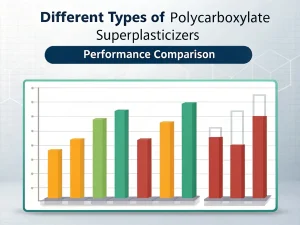
Different Types Of Polycarboxylate Superplasticizers Performance Comparison
Blog Different Types Of P
Blog
In modern architecture, the abrasion resistant of concrete surfaces is the core indicator that determines their service life and safety, whether on the industrial plant floor that carries heavy machinery, the parking ramp where cars come and go, or the water conservancy dam subject to water flow erosion. Although traditional concrete is strong, it will gradually wear, be exposed to sand, and be subjected to high-intensity friction, impact, and erosion, ultimately leading to structural damage.
The addition of abrasion resistant concrete admixtures can significantly enhance concrete’s abrasion resistant by optimizing its internal structure and increasing its surface hardness. This article will systematically categorize the main types of abrasion resistant concrete admixtures, analyze the core functions and applicable scenarios of various admixtures, and share selection criteria to help you accurately match them to engineering needs and create high-wear-resistant, long-lasting concrete projects.
Before delving deeper into additives, we must clarify the meaning of “abrasion resistant ”. It mainly refers to the ability of concrete to resist the following three forms of damage:
Abrasion: The wear and tear caused by traffic, pedestrians, or machinery dragging or rubbing on a surface.
Impact: Surface breakage and peeling caused by heavy objects falling or vehicle impact.
Erosion: Surface erosion caused by high-speed water flow or water flow carrying sand and gravel.
The essence of improving abrasion resistant is to make concrete denser, harder, and more resilient. Admixtures achieve these goals through different means.
Abrasion resistant concrete admixtures are a type of chemical or mineral additive that can improve the abrasion resistant of concrete, acting through two core mechanisms:
Optimize internal structure: reduce internal pores in concrete, improve bonding between aggregates and cementitious materials, and reduce the likelihood of particle detachment during wear.
Enhance surface performance: Form a high-hardness protective layer on concrete surfaces, or promote the formation of hydration products (such as hydrated calcium silicate), thereby directly improving surface scratch and impact resistance.
This type of admixture is usually used in combination with ordinary concrete, without changing the original construction process, to reduce the abrasion resistant coefficient (wear amount) of concrete by 30% to 60%, while also considering comprehensive performance such as compression resistance and impermeability.
Core components: Mainly composed of organic or inorganic chemicals; common types include polycarboxylate superplasticizer (compound type), amino sulfonic acid superplasticizer, nano silica sol, ferric chloride (early-strength type), etc.
Working principle:
Improving workability and compactness: Polycarboxylate superplasticizers can reduce water consumption (lower water-cement ratio) while ensuring concrete fluidity, reducing internal pores, and enhancing compactness.
Accelerated hydration and interface strengthening: Nano-silica sol can act as a “crystal nucleus” to promote cement hydration and enhance interfacial adhesion between hydration products and aggregates; Ferric chloride can accelerate early strength development and shorten the curing period of abrasion resistant concrete.
Applicable scenarios:
High-strength abrasion resistant concrete that requires control of water-cement ratio and improvement of strength, such as airport runways and highway toll stations (high load+high-frequency wear);
Projects with tight schedules, such as temporary factory buildings and emergency road surface repairs (requiring rapid abrasion resistant ).
Although strictly speaking, they are ‘admixtures’ rather than’additives’, they must be mentioned when discussing abrasion resistant . They greatly optimize the pore structure of concrete through physical filling and secondary hydration reactions.
Silica Fume: the undisputed “king of abrasion resistant ”. The silica fume particles are extremely small (100 times smaller than the cement particles), allowing them to be packed into the voids between the cement particles (microfilling effect). At the same time, it has extremely strong pozzolanic activity, which can react with the cement hydration product, calcium hydroxide, twice to form a more stable, high-strength calcium silicate hydrate gel (C-S-H).
Effect: Significantly improve the early and later strength, density, and interfacial bonding strength with aggregates of concrete, and its abrasion resistant can be improved several times.
Fly Ash and Slag Powder: These two common mineral admixtures can also improve concrete workability, reduce hydration heat, and enhance later strength and density through the volcanic ash effect and morphology effect, thereby improving abrasion resistant .
Core components: According to the material, they can be divided into steel fiber, polypropylene fiber, basalt fiber, and carbon fiber. Among them, steel fiber and polypropylene fiber are the most widely used in abrasion resistant concrete.
Working principle:
Bridging cracks: Fibers form a three-dimensional network within concrete, effectively suppressing the propagation of microcracks caused by drying shrinkage or loading and preventing cracks from becoming a “breakthrough point” for wear and tear.
Enhance toughness:Improve concrete’s impact resistance, reduce surface peeling caused by heavy objects such as forklifts and equipment, and is especially suitable for dynamic wear scenarios.
Applicable scenarios:
Steel fiber: high-frequency impact, heavy load wear scenarios, such as the ground of heavy machinery factories, logistics and warehousing centers (carrying forklifts weighing over 5 tons), and port terminal yards;
Polypropylene fiber: light load and cost control scenarios, such as commercial parking lots, light factories, and sidewalks;
Basalt fiber: wear-resistant engineering with corrosion resistance requirements, such as chemical workshop floors and marine engineering platforms.
Key points for use: The steel fiber content is usually 0.8%~2% (volume fraction), and it is necessary to ensure uniform mixing and avoid clumping; The polypropylene fiber content is 0.1%~0.3%, and products with a length-to-diameter ratio of 300~500 are preferred.
Core components:
Mainly made of high-hardness inorganic powders; common types include diamond powder, quartz sand powder, alumina powder, and silicon carbide powder. Among them, diamond powder is the most commonly used. Working principle:
Surface strengthening:
After pouring the concrete and before initial setting, the hard powder is evenly spread on the surface, and it is fused with the concrete surface by troweling to form a high-hardness (Mohs hardness ≥ 7) wear-resistant layer.
Scratch resistance:
The hardness of hard powders is much higher than that of ordinary aggregates (such as limestone with a Mohs hardness of 3-4), which can directly resist the scratching and wear of objects such as metals and sand.
Applicable scenarios:
Scenarios that require extremely high surface abrasion resistant , such as clean floors in electronic factories, food processing workshops (requiring frequent cleaning and scraping), and supermarket floors.
To balance the aesthetics of the ground engineering, some colored diamond powder can be mixed to achieve different color schemes to meet decoration needs.
When choosing abrasion resistant concrete admixtures, it is necessary to avoid unthinkingly pursuing high hardness and to make a comprehensive judgment based on the engineering scenario, cost budget, and construction conditions. The following three key points should be paid attention to:
The wear and tear forms vary greatly in different scenarios, and targeted selection is needed:
Static friction and wear (such as pedestrian walking, small carts): Priority should be given to mineral admixtures (such as ground slag powder) or low content polypropylene fibers, balancing economy and basic abrasion resistant.
Dynamic impact wear (such as forklift crushing or equipment impact): Fiber-based (e.g., steel fiber) or composite additives must be selected to ensure the concrete has sufficient toughness.
Surface scratching and wear (such as metal tool scratching and sand-and-gravel friction): Priority should be given to hard powders (such as diamond powder) to enhance surface hardness directly.
Ordinary strength concrete (C30~C40): suitable for combination with mineral admixtures or low dosage composite admixtures to avoid uneven internal stress of concrete caused by high strength of admixtures.
High-strength concrete (C50 and above): chemical-modified materials (such as nano-silica sol) or high-hardness composite additives can be selected to enhance abrasion resistant further.
Plain concrete/reinforced concrete: Plain concrete can use early-strength chemical additives such as ferric chloride; reinforced concrete should avoid additives containing chlorine or sulfur (such as calcium chloride) to prevent steel corrosion.
Cost-sensitive projects (such as ordinary parking lots and temporary factories): Priority should be given to mineral admixtures (such as ultra-fine fly ash, which is low-cost and easy to obtain) or polypropylene fibers.
High-budget, high-demand projects (such as precision workshops and large logistics centers): Steel fibers, diamond powder, or composite additives can be selected to ensure long-term service life.
Scenarios with limited construction conditions (such as high and low temperature environments): Avoid using amino sulfonic acid-based water reducers at high temperatures, and choose composite additives containing early strength components (such as “ground slag powder+calcium chloride”, which need to be confirmed to have no risk of steel corrosion) at low temperatures.
There are various types of abrasion resistant concrete admixtures, ranging from basic mineral admixtures to efficient composite admixtures, each with its own applicable scenarios. There is no “best”, only “most suitable”. In practical engineering, it is necessary first to clarify the type of wear, concrete strength, and construction conditions, and then select a single or composite admixture. If required, it can be verified through trial mixing (e.g., testing the concrete’s abrasion resistant coefficient, surface hardness, and impact resistance) to ensure that the final project meets both abrasion resistant requirements and economic and construction feasibility.
We provide high-quality polycarboxylate superplasticizers. If you need them, please feel free to contact us!
Different Types Of Polycarboxylate Superplasticizers Performance Comparison
Blog Different Types Of P

Super Early Strength Polycarboxylate Superplasticizer For Sleeve Grouting Material
Blog Super Early Strength