
Blog
Study on the Effects of Water Reducing Agents and Expanding Agents on Concrete Shrinkage
Blog Study on the Effects
Blog
Polycarboxylate superplasticizer is the latest generation of concrete admixture, known as the third-generation high-performance water reducer. Compared to the previous generation of naphthalene-based water-reducing agents polycarboxylate superplasticizers, polycarboxylate superplasticizers exhibit higher water-reduction rates and better cement adaptability. At the same time, the production process of polycarboxylate superplasticizer generates no process wastewater or waste gas, making it a green, environmentally friendly material.
Polycarboxylate Superplasticizer is a high molecular weight polymer with amphiphilic properties, usually synthesized by copolymerization of polyoxyethylene ether monomers with terminal double bonds and unsaturated carboxylic acid small molecule monomers under the action of initiators. The terminal vinyl groups of the large and small monomers are copolymerized to form sub-main chains, while the polyethylene glycol segments of the polyether monomers form structural side chains. The entire molecular structure is shown in Figure 1.
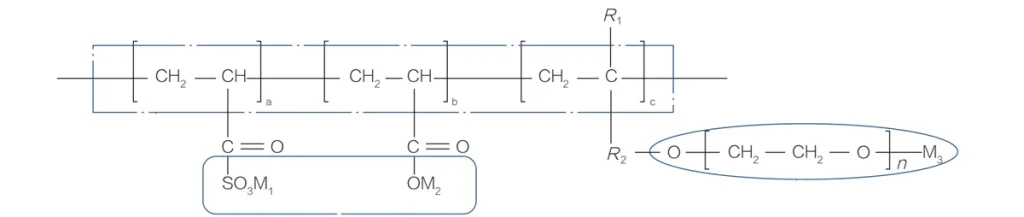
Compared with traditional ordinary water-reducing agents, the significant feature of polycarboxylate water-reducing agents is their designability in molecular structure. In water-reducing agents, unsaturated double bonds at the end groups of macromonomers are polymerized to form a polycarboxylate backbone. The – COO Na, – SO3 Na and other functional groups directly connected to the molecular backbone form “multi-point anchoring” and adsorb onto the surface of cement particles; The polyethylene glycol branch of the monomer forms a solvated polymer chain layer on the surface of cement particles through hydrogen bonding with water molecules, utilizing steric hindrance effect to disperse cement particles and achieve water reduction effect.
Therefore, the improvement of water reducing agents cannot be separated from the upgrading of macromonomers. Improving the molecular structure of macromonomers can significantly enhance the production process and product performance of polycarboxylate water-reducing agents.
Early polycarboxylate superplasticizers were ester products, with methoxy polyethylene glycol ether (MPEG) as the main monomer (Figure 2). When synthesizing polycarboxylate superplasticizers from such macromonomers, esterification and polymerization reactions are required, and the process is relatively complex. It has gradually been replaced by ether macromonomers.

Ether-based polycarboxylate superplasticizer macromonomers are currently the mainstream macromonomer products. These macromonomers are mainly synthesized via ethoxylation reactions of small-molecule unsaturated alcohol initiators with different structures, yielding polyethylene glycol ethers with terminal double bonds. According to the different molecular structures of the initiators, the synthesized macromonomers can be divided into three types: vinyl alcohol macromonomer, allyl polyethylene glycol ether APEG, isobutene-based polyethylene glycol ether HPEG, isopentenyl polyethylene glycol ether TPEG, and vinyl ether type 2+2 and 2+4 macromonomers (EPEG, VPEG).
Single-product structure: HPEG and TPEG together hold 96.6% of the market share, lacking functional diversity to meet specialized application needs (such as clay resistance and ultra-early-strength PCE).
Dependence on imported initiators: The key initiators for 5-carbon TPEG, such as isoprenol, are partially imported from Kuraray in Japan and BASF in Germany, leading to cost fluctuations and supply risks.
Poor adaptability of raw materials: Traditional HPEG/TPEG is highly sensitive to clay (e.g., montmorillonite) in aggregates, leading to a rapid decrease in slump and impaired concrete workability.
Low production efficiency: Traditional monomers require longer reaction times and strict temperature control, which increases energy consumption and production costs.
Develop targeted monomers for special PCE applications: anti-clay (EPEG/VPEG), ultra early strength, low shrinkage, and high-temperature resistant variants to meet the needs of UHPC, 3D printed concrete, and prefabricated components.
Expand the application scope from traditional concrete to emerging fields such as geopolymer materials and self-healing concrete.
Optimize the ethoxylation process (e.g., using continuous reaction technology) to reduce energy consumption and greenhouse gas emissions.
Promote environmentally friendly initiators (such as the acetylene ethylene glycol route of EPEG) to replace petrochemical-derived alternatives and promote sustainable development.
Accelerate the research and industrialization of domestic high-purity initiators (especially 5-carbon alcohols used for TPEG) to reduce dependence on imports, stabilize costs, and enhance supply chain security.
Customize macromolecular monomer chain lengths (2400-5000 MW) and functional groups to match specific PCE performance requirements – for example, longer chains for maintaining slump in long-distance pumping, and shorter chains for high water reduction in high-strength concrete.
Q1: Can EPEG completely replace HPEG/TPEG in all PCE applications?
A1: EPEG is suitable for low-quality aggregates (high clay content) and engineering projects that require efficient production. HPEG/TPEG is still cost-effective for general concrete. EPEG and HPEG are mixed in a 1:1 ratio, which can balance clay resistance and cost while improving concrete performance. Therefore, it is highly favored by many manufacturers.
Q2: How does the chain length of macromolecular monomers affect PCE performance?
A2: Longer chains (e.g., 5000 MW) can enhance steric hindrance and maintain collapse, while shorter chains (e.g., 2400 MW) prioritize reducing moisture. Compared to HPEG/TPEG, EPEG’s flexible side chains provide a wider range of chain length adaptability (2400-4000 MW), thereby offering greater formulation flexibility.
Q3: What cost savings can EPEG bring to PCE production?
A3: By shortening the reaction cycle (30 minutes compared to 2-3 hours) and eliminating the heating step, EPEG can reduce energy consumption by 30-40%. The simplified “one-pot method” process also reduces labor and equipment maintenance costs, thereby reducing overall production costs by 15-20%.
Q4: Is EPEG compatible with the existing PCE production line?
A4: Yes. EPEG does not require any modifications to existing reactors or equipment. Manufacturers only need to adjust the acrylic acid drip time and reaction temperature to switch from HPEG/TPEG to EPEG, thereby minimizing capital investment.
Polyether macromonomers are the core factor determining the performance of polycarboxylate ethers (PCE), and the industry is undergoing a critical transition from traditional HPEG/TPEG to innovative EPEG. Despite challenges such as a single-product structure and overcapacity in the current market, EPEG’s excellent reactivity, tolerance to clay, and green production processes make it an important driving force for industry transformation.
The future development of polyether macromonomers will focus on functional diversification, green and low-carbon production, and localization of raw materials. For manufacturers of polycarboxylate superplasticizers (PCE), using EPEG or mixed macromolecular monomer systems is a strategic choice to enhance product competitiveness and solve practical construction problems. With the increasing demand for high-performance, environmentally friendly concrete worldwide, EPEG is expected to become the mainstream macromolecular monomer, leading the polycarboxylate superplasticizer industry towards greater efficiency, sustainability, and innovation.
Study on the Effects of Water Reducing Agents and Expanding Agents on Concrete Shrinkage
Blog Study on the Effects

The main reasons and countermeasures for the unsuitability of concrete admixtures
Blog The main reasons and

How to choose antifreeze for a construction site when temperatures drop?
Blog How to choose antifr
Product information, specifications & applications — sent directly to your email.
*Your information is kept confidential and will only be used to contact you regarding our products.