Blog
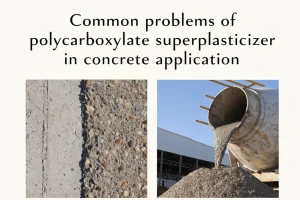
Common problems of polycarboxylate superplasticizer in concrete application
Blog Common problems of p
Blog
Concrete admixtures refer to chemical agents added to concrete before or during mixing, with a dosage generally not exceeding 5% of the cement mass (except for special admixtures). Their key feature is a small dosage and a large effect: they can improve concrete workability, adjust setting and hardening, and enhance durability without significantly changing the mix proportions. They are essential for pumping and high-strength concrete.
According to their functions, additives are mainly divided into five categories: improving workability (water-reducing agents), adjusting setting time (early strength agents, retarders), enhancing durability (air-entraining agents, rust inhibitors, waterproofing agents), improving volume stability (expansion agents, crack-resistance agents), and special functional categories (accelerators, coloring agents). Different categories correspond to different engineering scenarios.
C15-C25 for low-strength concrete based on strength grade, while ordinary/sodium naphthalene sulfonate are chosen to balance fluidity and cost; C30-C60 medium-high-strength concrete, with priority given to polycarboxylate superplasticizer; C65 and above ultra-high-strength concrete, using high water-reducing polycarboxylate products, combined with mineral admixtures to reduce the water-cement ratio and ensure compactness.
When winter temperatures are ≤ 5 ℃, select early-strength agents to accelerate early strength development and prevent freezing damage. Compound air-entraining agents to enhance frost resistance. When summer temperatures are≥ 30 ℃, use retarding components to suppress rapid slump loss; for pumping, prioritize retarding and slump-reducing water-reducing agents, balancing fluidity and setting time.
⚠️ Important reminder: The higher the dosage of additives, the better the effect. Excessive mixing can bring various quality hazards: excessive use of water-reducing agents can cause bleeding and segregation; excessive early-strength agent is prone to rapid solidification and shrinkage cracks; Excessive use of retarders can cause prolonged non-solidification and delay construction progress; Excessive use of air-entraining agents can directly cause a significant decrease in the compressive strength of concrete. All admixture dosages must strictly comply with the mix design.
Many construction sites overlook material-feeding details, resulting in abnormal additive performance.
❌ It is not recommended to directly add dry powder additives: dry powder is prone to clumping, uneven dispersion, and local additive enrichment, causing local rapid solidification or long-term non-solidification.
✅ Correct method: Prepare into an aqueous solution, accurately feed through the mixing station metering system, and control the metering error within ± 2%.
The feeding sequence is equally crucial:
The recommended post-blending method for polycarboxylate superplasticizer can improve the water reduction effect and reduce slump loss;
Early strength and retarder are suitable for the co-blending method to ensure uniform dispersion;
Use the intermediate mixing method for the air-entraining agent to ensure fine, uniform bubbles.
When conditions are limited, dissolve the additive in water first, then add the aggregate and cement, while extending the overall mixing time.
Common problems of polycarboxylate superplasticizer in concrete application
Blog Common problems of p