Blog
Raw materials are always changing; why should concrete admixtures dosages stay the same?
After staying in the mixing plant laboratory for a long time, a common problem can be found: many laboratory directors treat a certain concrete admixtures dosages as a fixed “ancestral formula” once it is finalized, wishing it could remain unchanged throughout the year.
When raw materials fluctuate, it is safer to add more water on site and replenish materials afterward than to adjust additive parameters actively.
On the surface, it may seem to strive for excellence and stability, but in reality, it quietly embeds quality risks into every aspect of concrete.
Batch replacement of sand and gravel, fine adjustment of cement formula, fluctuation of fly ash quality, temperature switching, accumulation of impurities in circulating water… Raw materials for production are never constant. Using a fixed dosage to adapt to dynamically changing raw materials is unstable; it is purely a gamble.
Many mixing plants have a misconception about solidification: for concrete of the same grade, the admixture dosage must be fixed. Once there is a small fluctuation, it is questioned as inaccurate test data and a problem with the additive product.
But in real on-site production, it is never a straight line. Variables run through the entire process: the residual of water-washed sand flocculant is relatively high, and for the same C30 concrete, the dosage of admixtures may increase by 0.2%- 0.4%; replacing with clean, high-purity sand and gravel, and the dosage can be reasonably reduced; Cement batch changes, changes in the content of C₃A, water consumption for standard consistency, and immediate changes in the flowability of the slurry.
The dosage must be adjusted synchronously; In summer, the high temperature causes rapid hydration and collapse, leading to increased consumption of components that maintain collapse; in winter, low temperatures are prone to slow setting, and the dosage range needs to be strictly tightened; Fluctuations in the water demand ratio and loss on ignition of fly ash can also directly affect the adsorption consumption of additives.
Fluctuating dosage is never scary; what is truly fatal is when raw materials change, parameters remain unchanged, and, in the end, workability can only be saved by adding water. Once the water-cement ratio is out of control, the strength, durability, and crack resistance of concrete are damaged at the same time, creating hidden quality hazards at stagnation.
Flexible adjustment of additives is the core ability of laboratory directors, but daring to adjust does not mean making arbitrary adjustments.
Randomly adding when the slump is too low and unthinkingly reducing when there is bleeding are based on experience and intuition. This is not a technical adjustment; it is a probabilistic gamble.
The core of professional adjustment logic is to establish a corresponding mechanism for “raw material changes – dosage adaptation adjustment”: understand each raw material’s characteristic changes, keep intervals in mind, use them as a basis for adjustment, and set boundaries for fluctuation.
Do not check the certificate of conformity; check the net slurry and consistency. When each batch of cement enters the site, do not only check the paper certificate of conformity; also conduct water consumption testing to verify the flowability and standard consistency of the net slurry.
Excellent slurry flowability indicates good compatibility with the admixture, and you can reduce the dosage; if the net slurry is too thick and requires a high amount of water, verify it through trial mixing and moderately increase the dosage.
Keep complete records: manufacturer, batch, standard consistency, net slurry expansion, and the suitable dosage range. Remember the safe floating range, not a rigid fixed number.
Adjust according to risk levels and reject a one-size-fits-all approach. Sand and gravel are the most volatile variables in concrete and also the most prone to problems. It is recommended to adapt to different levels:
✅ Clean sand, low MB value, and no risk of residual flocculants: the dosage is set at the lower limit to save costs reasonably;
✅ MB value increases and stone powder content increases: moderately increase the dosage to ensure stable workability;
✅ Excessive residue of water-washed sand flocculant and rapid collapse of mortar: Anti-mud formula is used to float based on trial mixing accurately.
Important reminder: There is a limit to adjusting coagulants for sand and gravel that exceed the standard. Blindly increasing the dosage can easily cause slow setting, bleeding, and later cracking. If you exceed the adjustment threshold, do not force it; prioritize compounding aggregates or rejecting raw materials.
Pay close attention to the water demand ratio, loss on ignition, low water demand ratio of fly ash, good particle state, and significant ball rolling effect. It is advisable to lower the additive dosage appropriately to reduce costs and increase efficiency; high water demand, high loss on ignition, high residual carbon content, and strong adsorption capacity will significantly increase additive consumption.
Many sites focus only on the unit price of fly ash but ignore its impact on additive use. This may save raw material costs, but in reality it increases overall production costs, which is not worth the loss.
Temperature and circulating water are key variables, and dosage logic varies greatly by season and operating conditions.
Summer high temperature: cement hydration accelerates, collapse accelerates, and the components and total dosage that can be moderately uplifted to prevent collapse can be increased;
Winter low temperature: strictly control the upper limit of the dosage to avoid problems such as low-temperature retardation and slow strength growth;
As the proportion of recycled water increases, impurities and flocculants will continue to accumulate, and comparative trials must be conducted to adjust the dosage as needed.
Flexible adjustments have boundaries, and you shouldn’t cover up risks unquestioningly.
Stop the dosing operation immediately if the following situations occur:
1. The dosage has reached the upper limit of the standard number, but the state of the mixture still does not meet the standard;
2. After adjustment, there are obvious abnormalities such as slow setting, bleeding, and bottom scraping;
3. The sand, gravel, clay, and flocculants severely exceed the standard, and the raw materials themselves have hard damage.
Concrete admixtures are not a universal cure. Relying on admixtures to overcome raw material defects gambles with engineering quality and creates potential risks later. The correct approach is to mix aggregates, replace raw materials, and return them according to regulations to solve the problem at the source.
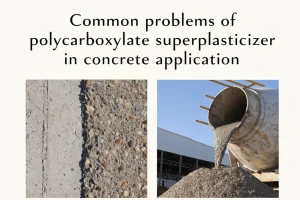
Common problems of polycarboxylate superplasticizer in concrete application
Blog Common problems of p