
Blog
The main reasons and countermeasures for the unsuitability of concrete admixtures
Blog The main reasons and
Blog
After a period of use, some early reinforced concrete bridges in China gradually began to experience problems such as concrete spalling and cracking of the bridge deck structure. Moreover, for technical reasons, some bridges developed obvious structural damage within less than 20 years of use. For example, the Beijing Xizhimen Overpass was declared scrapped 19 years after its completion due to severe steel corrosion, erosion, and other issues.
It can be seen that further exploring the durability of concrete bridges and taking measures to improve the crack resistance of bridge concrete have significant practical value. Accordingly, this article analyzes the effects of different dosages of water-reducing agents and air-entraining agents on the drying shrinkage performance of bridge concrete to improve bridge concrete durability and extend the service life of highway bridges.
According to the mix proportion design, prepare each concrete mixture group separately, then place it in a standard prism mold (100mm × 100mm × 400mm) for vibration molding. Three specimens are formed for each concrete group, one of which is used to test water evaporation within 7 days of curing, and the remaining specimens are used to test the deformation of concrete due to drying and water loss within 7 days of curing.
Firstly, make concrete specimens and cure them for 1 day under standard curing conditions at 20 ℃. During the curing process, cover the surface of the specimens with plastic film to control the rate of water evaporation. After the curing is completed, take out the concrete specimens and conduct tests under constant temperature and humidity conditions. During the first 3 days, conduct quality tests every 2 hours, then every 4 hours. Record the free shrinkage of each group of concrete and compare them horizontally.
Adding high-efficiency retarding and water-reducing agents during concrete preparation can disperse the cementitious matrix, destroying its coagulation structure. As a result, free moisture in the concrete structure increases, creating many small pores within the formed concrete. These pores significantly affect early drying shrinkage.
The moisture evaporation and shrinkage values of each group of concrete were tested, and the results are shown in Figures 1 and 2.
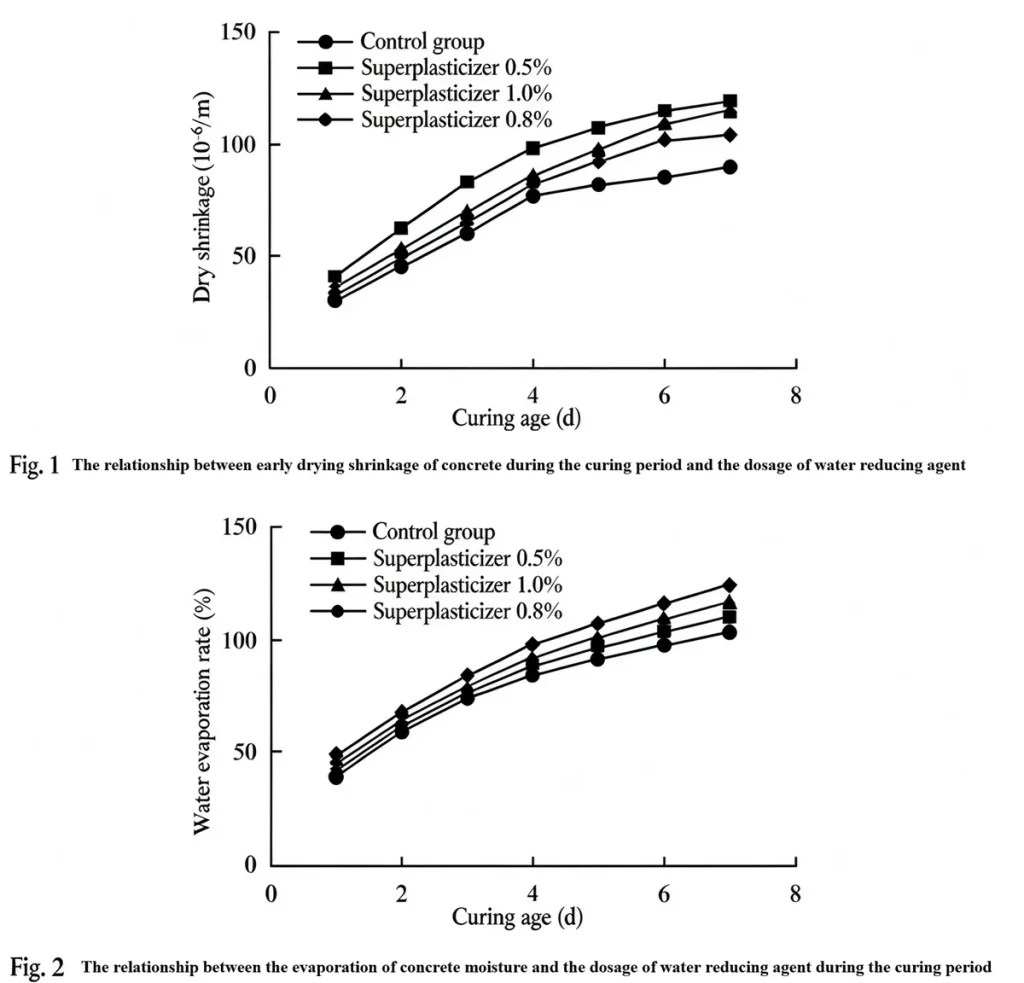
Based on Figure 1 and Figure 2, it can be seen that when the water-cement ratio of fixed concrete remains constant, there are significant differences in the water evaporation rate and early drying shrinkage value of concrete with the increase in high-efficiency water-reducing agent dosage. If the maintenance age is fixed at a certain number of days, the concrete water evaporation rate increases with increasing water-reducing agent dosage compared with the benchmark group. The drying shrinkage deformation amplitude of concrete is relatively small when 0.8% water reducer is added, at only 92.7% of that of concrete with 1.0% water reducer and 88.5% of that of concrete with 0.5% water reducer.
Adding water-reducing agents can effectively improve concrete workability, reduce slump loss, and improve pumpability when mixing concrete under low-temperature conditions. By reducing the water-cement ratio, water-reducing agents can control drying shrinkage and improve the structure’s early strength and crack resistance. Water-reducing agents help refine the pore distribution of cement in concrete structures, reduce the surface tension of internal moisture, and slow shrinkage. These effects can reduce drying shrinkage deformation.
Air-entraining agents can form many independent, stable bubbles in the concrete system. These bubbles not only hinder the formation and development of small pores in the concrete structure, but also act as a “buffer valve” to alleviate problems such as cracking and damage caused by component expansion from physical and chemical reactions. The water evaporation and shrinkage deformation of each group of concrete were tested under different air-entraining agent dosages, and the results are shown in Figures 3 and 4.
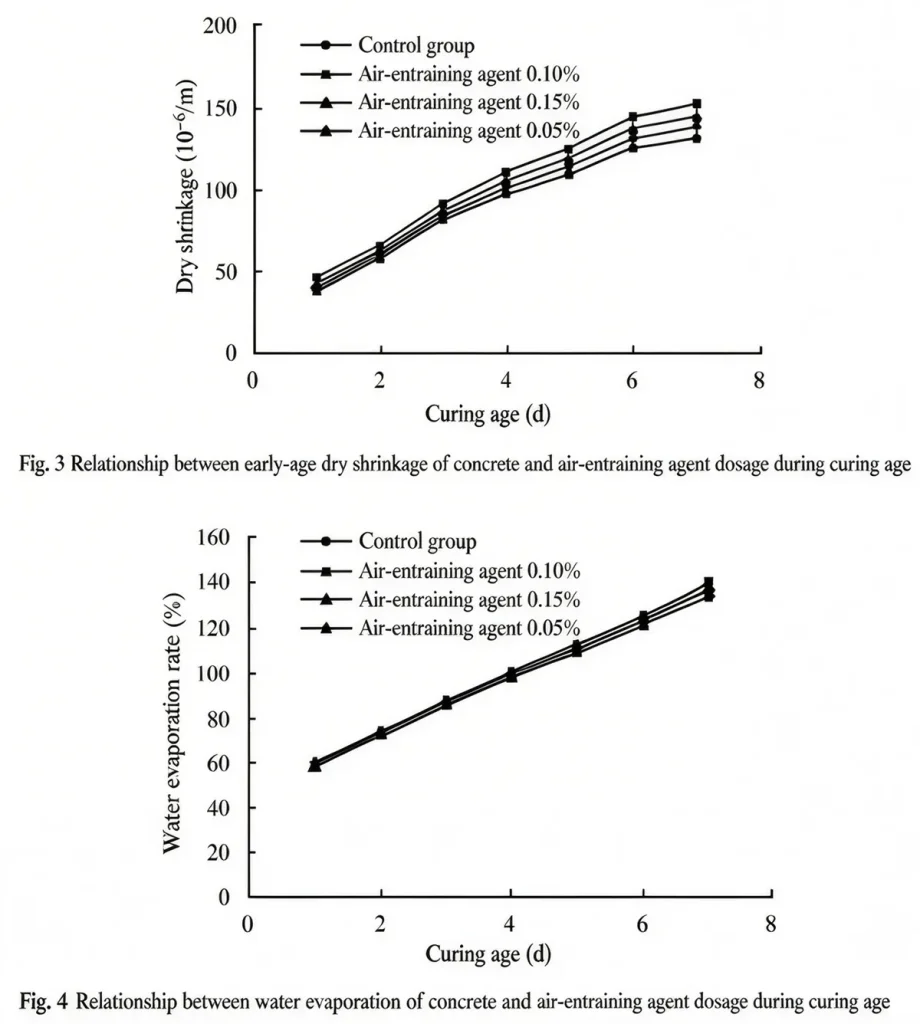
Based on Figures 3 and 4, it can be seen that the flowability and workability of bridge concrete are significantly improved after adding an air-entraining agent. With the addition of an air-entraining agent, the drying shrinkage value of concrete increases rapidly in the early stage and slows in the later stage. Among these, adding 0.05% air-entraining agent results in water evaporation and drying shrinkage values closest to the benchmark group and at a relatively low level.
From this, it can be seen that adding too much or too little air-entraining agent to bridge concrete may result in poor effectiveness. Therefore, it is recommended to design and test the optimal air-entraining agent dosage for concrete in engineering practice. However, regardless of the air-entraining agent dosage, the water evaporation rate did not differ significantly among the concrete groups.The results indicate that adding an appropriate amount of air-entraining agent improves concrete drying shrinkage. However, the amount of air-entraining agent did not significantly affect water evaporation in concrete.
The reason for the above phenomenon is that after the air-entraining agent is added, a large number of mutually independent stable bubbles can be formed in the concrete system, and the bubbles have good sealing properties. By blocking the formation and development of small gaps, the air-entraining agent can play the role of a buffer valve and reduce salt crystallization and water crystallization, and then reduce the free water that can be frozen inside the concrete, so that more free water can be adsorbed in the gel pores or capillary channels, which ultimately shows the improvement of concrete crack resistance.
By analyzing changes in drying shrinkage and water evaporation before and after adding air-entraining and water-reducing agents, and by adjusting their dosages, the performance changes of concrete at different dosages were compared horizontally. The conclusions are as follows:
The main reasons and countermeasures for the unsuitability of concrete admixtures
Blog The main reasons and

How to choose antifreeze for a construction site when temperatures drop?
Blog How to choose antifr
Application of different dosages of expansion agents in large volume concrete
Blog Application of diffe
Product information, specifications & applications — sent directly to your email.
*Your information is kept confidential and will only be used to contact you regarding our products.