Blog
Polycarboxylate ether (PCE) superplasticizers are now the leading concrete admixture worldwide. The key raw material for making PCE is the polyether macromonomer, and its properties directly affect how well the final superplasticizer performs. Over the years, we’ve gone from early types like MPEG 750 and APEG to the current workhorses HPEG 2400 and TPEG 2400, and more recently to six‑carbon newcomers like EPEG 3000 and VPEG 2400. This article gives you a clear, side‑by‑side look at the main macromonomers on the market, so you can understand their features and where each one works best.
Based on the starter molecule, PCE macromonomers fall into three main groups.
The first group is vinyl alcohol type three‑carbon macromonomers, with APEG as the main example. These were among the earliest ether‑type macromonomers.
The second group is vinyl alcohol type four‑carbon and five‑carbon macromonomers, which include HPEG (four carbon) and TPEG (five carbon). HPEG stands for methallyl polyoxyethylene ether (also called isobutenyl polyethylene glycol ether). TPEG stands for isopentenyl polyoxyethylene ether (also called isopentenyl polyethylene glycol ether). These two are currently the most widely used products on the market.
The third group is vinyl ether type macromonomers, which include the six‑carbon EPEG and VPEG. EPEG uses ethylene glycol monovinyl ether as the starter and has a 2+2 structure. VPEG uses 4‑hydroxybutyl vinyl ether as the starter and has a 2+4 structure. Both have high polymerization activity and a simpler production process, so they’re seen as the next‑generation direction.
There’s also an older ester‑type macromonomer, MPEG (methoxy polyethylene glycol ether). It has a more complicated process and less stable product quality, so it has largely been replaced by ether‑type macromonomers.
The rest of the article goes through each type in order, from oldest to newest.
MPEG was used in early PCEs. It’s an ester‑type product. Making PCE from MPEG requires two steps – esterification and then polymerization – which is quite complex. The esterification temperature is usually 50–70°C, and the dissolution step takes 5–10 hours. High temperature and long processing times can cause local polymerization of the monomer, which hurts the final product’s performance.
MPEG‑based PCEs have ester bonds in the molecule. In the alkaline environment of cement, those ester bonds tend to hydrolyze, so the dispersing ability and slump retention drop noticeably over time. MPEG was widely used for a while, but it has now been mostly replaced by better‑performing ether‑type macromonomers. Today you mainly see it in specialty or custom formulations.
APEG is a three‑carbon vinyl alcohol type macromonomer, made by ethoxylating allyl alcohol. The reaction to make PCE from APEG is straightforward – you just do solution polymerization with the starting monomers.
But APEG has a clear downside: poor polymerization activity. Like MPEG, it leaves a fair amount of unreacted residue, and the resulting PCE performance isn’t very stable. That’s why production volumes have been dropping year by year. APEG has pretty much left the mainstream market, though you still see it once in a while in low‑spec applications or certain old formulations.
Typical use for MPEG and APEG: They were used in early‑stage PCE production. Their market share has shrunk a lot, and they’re basically obsolete technologies now.
HPEG is the most widely used PCE macromonomer on the market today. It’s a four‑carbon unsaturated isomeric alcohol polyether, made by ethoxylating methallyl alcohol. The molecule has reactive groups that can copolymerize with double‑bond compounds like acrylic acid and maleic anhydride.
HPEG’s main strength is high reactivity and high double‑bond retention. When made with high‑activity catalysts and a specialized process, HPEG has a narrow molecular weight distribution, low ethylene glycol content, and high double‑bond retention – all of which greatly improve polymerization activity. The product is non‑toxic, non‑irritating, dissolves easily in water and many organic solvents, and is chemically stable.
PCE made from HPEG gives high water reduction, lower cement usage, good strength gain, good durability, and is environmentally friendly. Different molecular weights suit different needs. For example, HPEG with a molecular weight around 6000 gives good early strength – one study showed 1‑day strength of 24.5 MPa and 28‑day strength around 64.2 MPa. Ultra‑high molecular weight HPEG (like HPEG8000) can be used to make highly effective anti‑clay PCE.
To make PCE from HPEG, you typically polymerize at room temperature or with mild heating – around 60°C – for 3 to 5 hours.
Typical use for HPEG: Widely used for high‑water‑reducing PCE. It has a clear cost advantage in large‑scale commercial concrete and precast concrete production, and is the most cost‑effective macromonomer available.
TPEG is a five‑carbon unsaturated isomeric alcohol polyether, made by ethoxylating isopentenyl alcohol. The five‑carbon backbone gives it slightly different polymerization behavior and PCE performance compared to HPEG.
TPEG has good water solubility and chemical stability, a narrow molecular weight distribution, and high double‑bond retention. PCE made from TPEG has high active content and good overall performance. TPEG is often used to make PCE with decent slump retention and specific functions – it works especially well in retarding and slump‑keeping formulations. Studies show that changing the monomer ratios can significantly affect the product’s properties; TPEG can be copolymerized with acrylic acid, acrylamide, and other functional monomers to make retarding, slump‑retaining PCE.
TPEG and HPEG are the two most widely used polyether macromonomers today. In many cases you can swap one for the other, but the choice depends on the formulation and performance targets. Water reduction is roughly similar between the two. TPEG has a slight edge in slump retention, while HPEG is better at reducing viscosity.
Typical use for TPEG: Used for functional PCE, especially where you need some slump retention or special properties, as well as for high‑grade concrete and precast elements.
EPEG is a vinyl ether type six‑carbon macromonomer that has developed quickly in recent years. It’s made by ethoxylating ethylene glycol monovinyl ether and has a 2+2 structure.
EPEG’s most notable feature is high double‑bond activity. Compared to conventional HPEG and TPEG, EPEG’s side chains swing more freely and cover a larger range. The PCE made from EPEG has better adaptability, lower sensitivity, and better slump retention. In the copolymerization process, things like temperature, addition time, initiator system, and chain transfer agent all affect the final polymer’s properties. With good process control, you can take full advantage of EPEG’s high activity.
EPEG can meet the requirements for low‑temperature PCE synthesis. The starter production process has no pollution, and the whole manufacturing route follows green, low‑carbon, environmentally friendly principles. You can make high‑water‑reducing PCE by simply copolymerizing EPEG with acrylic acid in a free‑radical aqueous solution. Adding functional monomers like sodium methallyl sulfonate or acryloyloxyethyl trimethyl ammonium chloride gives you anti‑clay PCE.
The reaction conditions for EPEG‑based PCE are relatively mild – you can polymerize at low temperatures, with short reaction time and low energy consumption.
Typical use for EPEG: Good for applications that demand high slump retention and are sensitive to clay‑bearing aggregates, as well as for high‑performance concrete and high‑strength projects.
VPEG is another vinyl ether type six‑carbon macromonomer, made by ethoxylating 4‑hydroxybutyl vinyl ether. It has a 2+4 structure. VPEG and EPEG are both new‑generation vinyl ether macromonomers, but they differ in starter chain length, which gives them slightly different performance profiles.
VPEG also has high polymerization activity – you can run the reaction at 15–25°C, and the whole process takes only 1 to 1.5 hours, which cuts energy consumption significantly. PCE made from VPEG gives excellent slump retention, and the concrete has very good workability – it doesn’t easily bleed, segregate, or stick to the bottom. It’s also not very sensitive to changes in sand and clay content, which lowers the overall sensitivity of the admixture.
When it comes to early strength, VPEG‑based PCE stands out. By adjusting the acid‑to‑ether ratio and the amount of chain transfer agent, you can make VPEG‑based PCE that helps cement mortar gain early strength faster. VPEG macromonomers are designed to produce PCE with higher strength development than HPEG‑based high‑water‑reducing PCE, and their slump retention is better than TPEG‑based slump‑retaining PCE.
A study by Tianjin University’s Guo Jintang team showed that at low water‑to‑cement ratios, concrete with VPEG‑based PCE had the fastest flow and lowest viscosity, and it performed well across all water‑to‑cement ratios tested. VPEG‑based PCE also has good adaptability to different cements, which helps reduce the sensitivity and compatibility problems sometimes seen with PCE.
VPEG monomer production technology is still at an early stage. Only a few admixture manufacturers in China have mature production know‑how, though some international chemical companies have already launched VPEG‑based product lines.
Typical use for VPEG: Suitable for projects that need high slump retention (long‑distance transport, hot‑weather concreting), high‑strength and high‑performance concrete, early‑strength requirements, and tricky conditions where cement adaptability is a problem.
MPEG is an ester‑type macromonomer that requires two steps (esterification + polymerization). It’s mostly obsolete now. APEG is a three‑carbon vinyl alcohol type with poor polymerization activity and has largely left the mainstream market.
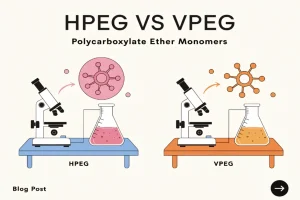
HPEG (four‑carbon) and TPEG (five‑carbon) are both vinyl alcohol types and currently the most widely used products. HPEG has a slight edge in water reduction and viscosity reduction, while TPEG performs a bit better in slump retention and functional design. HPEG’s production process is more mature and lower in cost, so it dominates large‑scale commercial applications. TPEG is more often used where specific slump retention is required.
EPEG (six‑carbon, 2+2 structure) and VPEG (six‑carbon, 2+4 structure) are new‑generation vinyl ether macromonomers. Both have much higher polymerization activity than conventional monomers. They allow low‑temperature, fast synthesis, cutting production time and energy use. EPEG stands out for its adaptability and low sensitivity. VPEG does better in early strength and viscosity reduction. Both fit the green chemistry trend and are strong candidates for the next mainstream generation. EPEG has a slight environmental edge because its starter production process generates no pollution, while VPEG’s longer carbon chain gives it unique advantages in slump retention and strength development.
MPEG requires two steps (esterification then polymerization) with heating – the most complex process. APEG is more direct but suffers from poor polymerization activity and unstable performance. HPEG and TPEG are usually polymerized at room temperature or with mild heating (around 60°C) for 3–5 hours. The process is mature and stable. EPEG and VPEG can be polymerized at low temperatures (15–25°C) in only 1–1.5 hours, saving energy and time, though the technology is still being refined.
Water reduction: HPEG is relatively high; APEG is in the middle; EPEG and VPEG are similar but focus more on slump retention.
Slump retention: VPEG and EPEG lead, TPEG follows, HPEG and APEG are weaker.
Strength development: VPEG gives the best early strength; high‑molecular‑weight HPEG also gives good early strength.
Cement adaptability: EPEG and VPEG adapt to a wider range of cements and aggregates, with lower sensitivity.
Viscosity reduction: HPEG beats TPEG; VPEG shows a clear advantage at low water‑to‑cement ratios.
Ease of processing: EPEG and VPEG are simpler because of their high reactivity and mild reaction conditions, but they demand tighter control over the formulation.
MPEG is mostly phased out. APEG volumes keep dropping. HPEG and TPEG are the current mainstream – mature technology, largest volumes. EPEG and VPEG are in rapid adoption and represent the next direction.
For large‑scale conventional concrete and cost‑sensitive projects, HPEG is still the most economical choice. The technology is mature and supply is stable.
For jobs that need good slump retention – long‑distance transport, hot‑weather concreting – TPEG is a reliable, mature option. EPEG and VPEG give even better performance but at a higher cost.
For high‑performance concrete (high‑strength, high‑flow, UHPC), EPEG and VPEG perform better, especially at low water‑to‑cement ratios, where they improve workability and strength development. VPEG has a clear advantage in early strength; EPEG does better in adaptability and anti‑clay performance.
For tricky conditions where cement adaptability is poor or aggregates have high clay content, the low sensitivity of EPEG and VPEG can solve compatibility issues between the admixture and the cement.
For low‑temperature, fast production and green processes, EPEG and VPEG’s high activity and low energy use are clear benefits.
PCE macromonomer have gone through several generations: MPEG, APEG, then HPEG and TPEG, and now EPEG and VPEG. Each new generation has made real progress in polymerization activity, synthesis process, and performance. HPEG and TPEG, as the current mainstream, will likely keep the largest market share for the foreseeable future because of their mature processes and reliable performance.
At the same time, the vinyl ether type six‑carbon macromonomers EPEG and VPEG – with their high activity, simpler synthesis, excellent PCE performance, and green credentials – represent an important direction for the technology. As the technology matures and production costs come down, these two newer monomers will likely replace older types in more and more applications. Looking ahead, the macromonomer market will probably see HPEG/TPEG and EPEG/VPEG develop side by side, with each type playing to its strengths in different applications, pushing PCE technology forward.