Blog
6 major challenges to be solved in the research of polycarboxylate superplasticizers
Blog 6 major challenges t
Blog
Polycarboxylate superplasticizers have excellent water-reducing and dispersing properties and can maintain the flowability of low-water-cement-ratio fresh concrete at a low dosage. Therefore, they are an important component of high-strength and high-flowability concrete admixtures. However, theoretical research and engineering applications have shown that polycarboxylate water reducers are incompatible with concrete composition materials. In some cases, polycarboxylate water reducers may have poor dispersion effects, rapid loss of concrete slump, and different effects on cement with different sulfate and alkali contents.
When sulfates are present in cement and mineral admixtures, the incompatibility problem of polycarboxylate superplasticizers becomes particularly prominent. In response to this “incompatibility”, the adsorption of polycarboxylate salts is affected by sulfate ions in the cementitious material, and the adsorption amount decreases with the increase in sulfate ion content, resulting in a “competitive adsorption”. When the soluble sulfate content increases, polycarboxylate salts will undergo a “desorption” effect, leading to a decrease in the fluidity of cement aggregates
Some scholars have discussed the effects of different types of sulfates on the competitive adsorption of polycarboxylates, but there is little research on the competitive adsorption of sulfate polycarboxylate superplasticizers by polymers with different structures. Given that the influence of water-reducing agents on the dispersibility of cement concrete mainly occurs by changing the rheological properties of the cement slurry, this paper investigates the effect of different types of sulfates on the dispersibility of polycarboxylate superplasticizers with different structures by adding different types of sulfates to fly ash and conducting experiments on the flowability, total organic carbon (TOC), and zeta potential of the slurry. The mechanism by which sulfates affect the dispersibility of polycarboxylate superplasticizers is also explored.
Beijing PO 42.5 cement; Grade III fly ash: loss on ignition 3.82%, water requirement ratio 102.3%, fineness 29.4%; Sika high-performance superplasticizer (modified polycarboxylate, hereinafter referred to as Sika modified polycarboxylate); ester-based polycarboxylate superplasticizer (methacrylate type) and ether-based polycarboxylate superplasticizer (allyl ether type); Sodium sulfate, calcium sulfate dihydrate, barium nitrate, etc.
The flowability of the cement slurry is tested according to GB8077-2000, “Test Method for Homogeneity of Concrete Admixtures.” The solid content of the polycarboxylate water reducer is 14%, and the dosage is 1.0% of the total cementitious material. Sodium sulfate and calcium sulfate were added to ordinary fly ash to study the influence of sulfate type and dosage on slurry flowability.
Instrument used for zeta potential measurement: JS94H microelectrophoresis produced by Shanghai Zhongchen Digital Technology Equipment Co., Ltd. Slurry preparation: ether polycarboxylate superplasticizer with a solid content of 14% and a dosage of 1.3% of the total amount of fly ash and sulfate. The slurry ratio is m (fly ash+sodium sulfate): m (external agent): m (water)=300:3.9:87.
The instrument used for measuring the adsorption capacity of organic carbon is a TOC analyzer produced by IONICS Corporation in the United States. 10g of fly ash and sodium sulfate are weighed and added to 20mL of ether water reducer with a solid content of 0.2%. The mixture is stirred for 3 minutes and then allowed to stand for 5 minutes to reach adsorption equilibrium. After that, it is centrifuged for 10 minutes (4000 r/min). The upper clear liquid is centrifuged again, diluted with deionized water, and the organic carbon content in the filtrate is measured.
The flowability test of cement slurry was conducted using cement and fly ash as cementitious materials, with a mass ratio of 7:3. Calcium sulfate dihydrate was added to fly ash to investigate the effect of insoluble sulfate content on the flowability of cement slurry with different types of polycarboxylate superplasticizers. The results are shown in Figure 1.
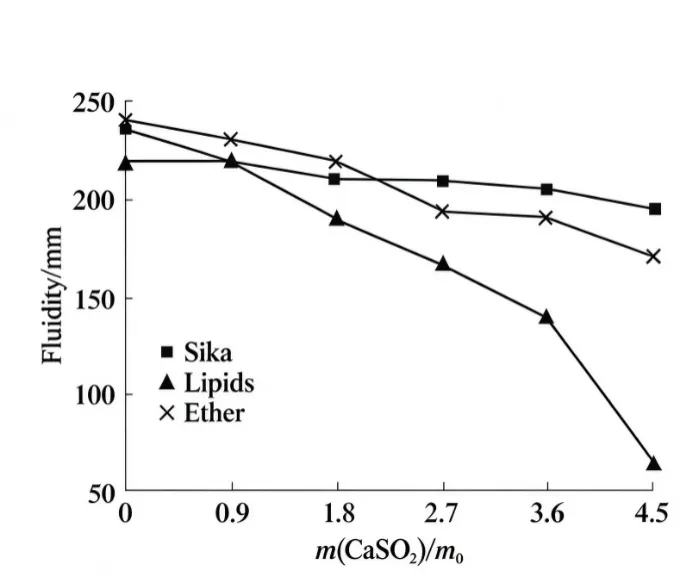
As shown in Figure 1, when the dosage of insoluble sulfate (calcium sulfate) m (CaSO4) increases from 0 to about 15% of the total amount of fly ash mFA and about 4.5% of the total amount of cementitious material mB, the modified polycarboxylate superplasticizer by Sika has little effect on the flowability of the slurry, and can reach over 200mm with good flowability; Ether based polycarboxylate superplasticizers have a slight impact on the flowability of clean pulp, with a slight decrease in flowability, while ester based polycarboxylate superplasticizers have a greater impact on the flowability of clean pulp, with a decrease in flowability from 220mm to 65mm.
In other words, the compatibility between Sika-modified polycarboxylate superplasticizer and calcium sulfate is the best, followed by ether polycarboxylate superplasticizer, while ester polycarboxylate superplasticizer is the worst. In summary, calcium sulfate has little effect on the adsorption performance of polycarboxylate superplasticizer on the surface of cement particles, and the reduction in slurry flowability is not significant. In addition, when the same flowability is achieved in the blank sample, the amount of modified polycarboxylate superplasticizer is the lowest, while the amount of ether polycarboxylate superplasticizer is the highest.
The net slurry flowability test was conducted using cement and fly ash as cementitious materials at a mass ratio of 7:3. Sodium sulfate was added to the fly ash to investigate the effect of soluble sulfate content on the flowability of cement slurry with different types of polycarboxylate superplasticizers. The results are shown in Figure 2.
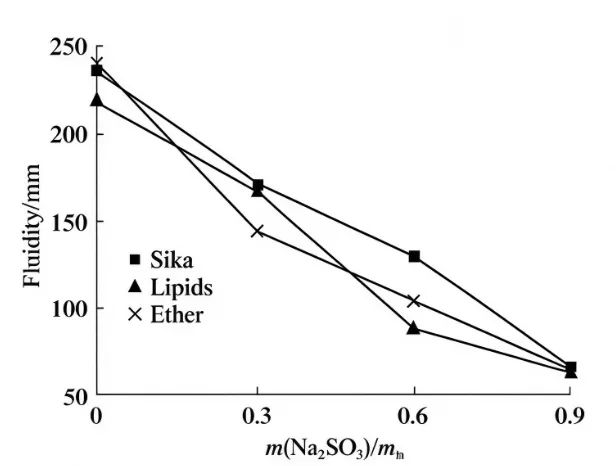
As shown in Figure 2, when the content of soluble sulfate (sodium sulfate) increases from 0 to about 3% of the total amount of fly ash (about 1% of the total amount of cementitious material), the three polycarboxylate superplasticizers mentioned above have a significant impact on the flowability of the clean slurry. When the content of sodium sulfate is 0.9% of the total amount of cementitious material, the flowability of the clean slurry is 65 mm, and the corresponding slurry has basically stopped flowing.
The dosage of sodium sulfate has a significant impact on the effectiveness of polycarboxylate superplasticizer. As the amount of soluble sulfate ions increases, the adsorption capacity and adsorption rate of polycarboxylate superplasticizer on cement particles gradually decrease. This is mainly due to the adsorption of sulfate ions on the surface of cement particles, which weakens the electrostatic repulsion and spatial hindrance, resulting in a sharp decrease in the water-reducing function of polycarboxylate superplasticizer when the content of soluble sulfate is high. Some people also believe that the presence of a large amount of sulfate ions will cause the EO chain in polycarboxylate superplasticizer to shrink, thereby weakening the volume repulsion effect of the EO chain.
The adsorption capacity of polycarboxylate superplasticizer increases with the extension of adsorption time, usually reaching adsorption equilibrium within 5-10 minutes. The TOC test results are shown in Figure 3.
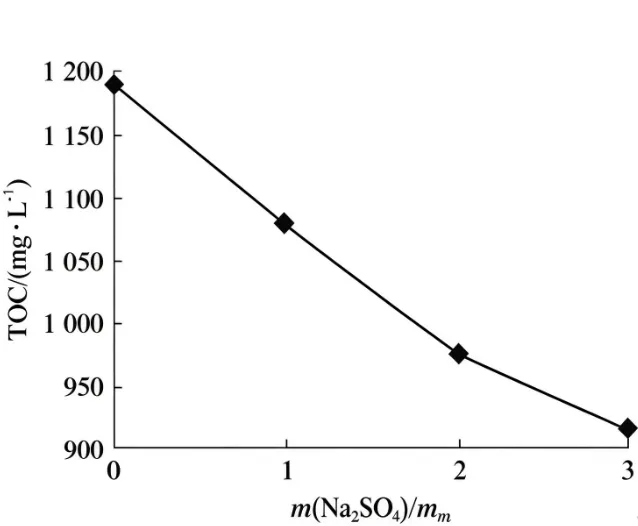
As shown in Figure 3, with the increase in sodium sulfate content in fly ash, the organic carbon content in the water-reducing agent solution gradually decreases. When the sodium sulfate content increases from 0 to 1%, 2%, and 3%, the organic carbon content in the water-reducing agent solution decreases from 1189mg/L to 1079976914mg/L, respectively, a decrease of 8%, 17%, and 23%. The cementitious material used in this experiment is fly ash, not cement. Therefore, it can be concluded that, in addition to the competitive adsorption between soluble sulfates and polycarboxylate water-reducing agents, sodium sulfate itself also has an adsorption effect on polycarboxylate water-reducing agents, manifested as a decrease in organic carbon content in the water-reducing agent solution when the sodium sulfate content increases.
There is a competitive adsorption relationship between sulfate ions and polycarboxylate water reducers because the concentration of sulfate ions affects adsorption rather than the type of ions. Therefore, different types of inorganic salts can be added to improve the adaptability between cement and polycarboxylate water reducers by changing the amount of sulfate ions.
Considering that the reaction between barium nitrate and soluble sulfate can generate insoluble barium sulfate, thereby reducing the concentration of sulfate, the method of adding barium nitrate to the slurry was adopted. The dosage of barium nitrate was twice that of sodium sulfate to study the effect of barium nitrate on the competitive adsorption of sulfate and polycarboxylate. As this experiment was not conducted on the same day as the experiment in Figure 2, the data fluctuated slightly, but the overall trend was consistent. The experimental results are shown in Figure 4.
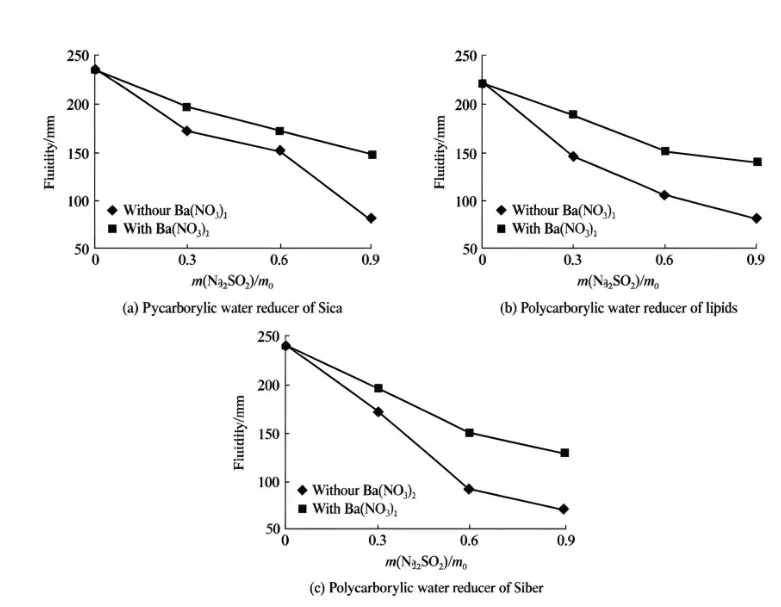
From Figure 4, it can be seen that the addition of barium nitrate increases the net slurry flowability of cementitious materials doped with Sika-modified polycarboxylate superplasticizer, ester polycarboxylate superplasticizer, and ether polycarboxylate superplasticizer to a certain extent. The net slurry flowability increases by 20- 65 mm, 45- 60 mm, and 25- 60 mm, respectively. That is to say, when the amount of soluble sulfate in the cementitious material exceeds a certain limit and affects its flowability, the addition of barium nitrate can reduce the concentration of soluble sulfate and relatively increase the amount of polycarboxylate polymer adsorbed on cementitious materials such as cement, thereby improving the flowability of the slurry.
Figure 5 shows the effect of barium nitrate on the adsorption capacity of sodium sulfate ether polycarboxylate superplasticizer.
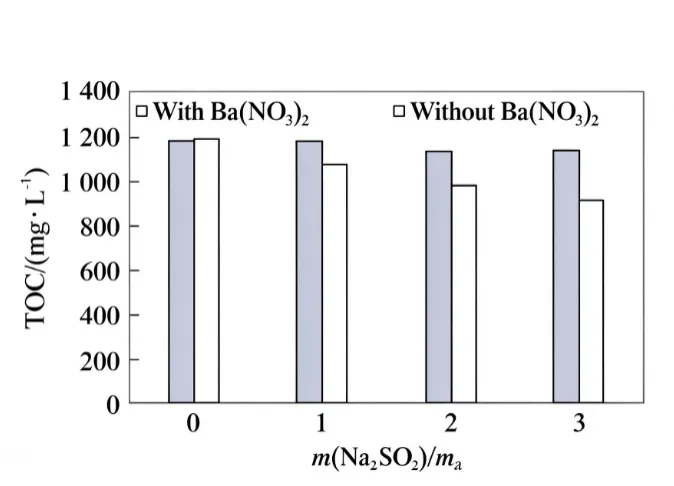
As shown in Figure 5, the addition of barium nitrate largely eliminates the incompatibility between sodium sulfate and polycarboxylate superplasticizer. When 2% barium nitrate is added at a sodium sulfate content of 1%, the organic carbon content in the superplasticizer solution increases from 1079mg/L to 1184mg/L; When adding 4% barium nitrate at a sodium sulfate dosage of 2%, the organic carbon content in the water reducing agent solution increased from 976mg/L to 1141mg/L; When adding 6% barium nitrate at a sodium sulfate content of 3%, the organic carbon content in the water reducing agent solution increased from 914 mg/L to 1142 mg/L. Adding barium nitrate restored the organic carbon content in the solution to the level without sodium sulfate.
The currently widely accepted mechanism of action for water-reducing agents is electrostatic repulsion and spatial hindrance. The theory of electrostatic repulsion suggests that the water-reducing effect of water-reducing agents on cement is mainly due to their adsorption on the surface of cement particles, which increases the absolute value of the zeta potential on the surface of cement particles, thereby increasing the electrostatic repulsion between cement particles and producing a dispersing effect. The theory of steric hindrance suggests that water-reducing agents adsorbed on the surface of cement particles will form a hydration film with a certain thickness. When cement particles approach each other and the hydration films begin to overlap, a three-dimensional repulsive force is generated between the particles, leading to dispersion.
At present, many research reports on polycarboxylate superplasticizers suggest that the dispersion mechanism of polycarboxylate superplasticizers is “steric hindrance”, and polycarboxylate has little effect on the zeta potential of cement particles, sometimes even positive. However, some scholars have also shown that polycarboxylate superplasticizers significantly affect the zeta potential of cement. For example, Wang Ziming showed, by studying the effect of PPA-based polycarboxylate superplasticizers on the zeta potential of cement, that electrostatic repulsion strongly affects the dispersion of PAA-based polycarboxylate superplasticizers, and that the increase in zeta potential is similar to that of naphthalene-based superplasticizers.
This experiment studied the mechanism of action of the ordinary fly ash water water water water reducing agent system by measuring the effect of increasing sodium sulfate content on the zeta potential of the slurry double layer. The water reducing agent used was ether polycarboxylate with a solid content of 14%. The experimental results are shown in Figure 6
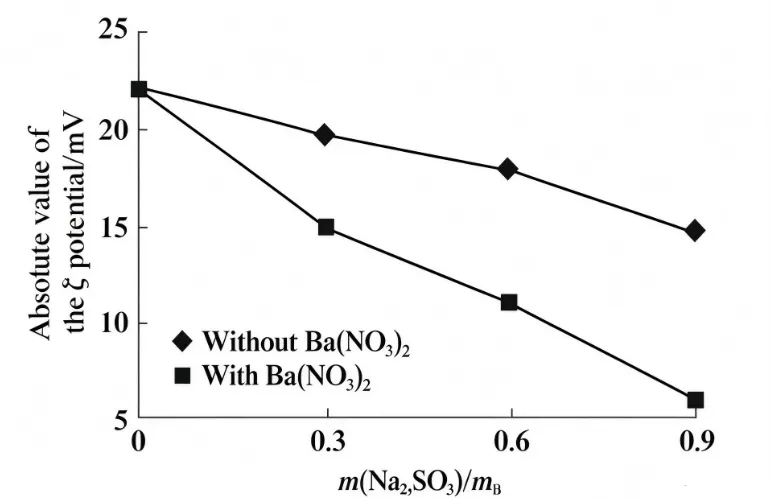
In solid-liquid dispersion systems, double electric layers are generated at particle interfaces. The presence of double electric layers causes particles with the same charge to repel each other, thereby increasing the stability of the dispersion system. As shown in Figure 6, when sodium sulfate is not added, the zeta potential in the fly ash water reducing agent system is -21mV, and the repulsive force between particles increases, resulting in better dispersion of the system; After adding about 0.3% sodium sulfate, the surface zeta potential of the particles was -14.91 mV, and the absolute value of the double layer zeta potential rapidly decreased. As the sodium sulfate content increased, the absolute value of the zeta potential continued to decrease.
From the zeta potential measurements above, it can be seen that the smaller the absolute value of the zeta potential, the worse the dispersion and stability of the system. This is consistent with the reduced fluidity of the cementitious material slurry. Therefore, the dispersion mechanism of polycarboxylate superplasticizers is not entirely due to the “steric hindrance” effect, and the water-reduction mechanism differs across different series of polycarboxylate superplasticizers.
When barium nitrate is added, the absolute value of the slurry zeta potential increases significantly. This is because barium nitrate reacts with soluble sodium sulfate to form insoluble barium sulfate, which reduces the concentration of sulfate ions and reduces the amount of sulfate adsorbed onto the polycarboxylate superplasticizer. The adsorption capacity of the polycarboxylate superplasticizer on the cementitious particles increases, improving the fluidity of the slurry.
(1) When the dosage of calcium sulfate dihydrate exceeds 3.6% of the total amount of cementitious material, it has a certain impact on the dispersibility of polycarboxylate superplasticizers with different structures. Calcium sulfate dihydrate has the best compatibility with Sika polycarboxylate superplasticizer and has little effect on slurry flowability;
(2) The dosage of soluble sodium sulfate has a significant impact on the flowability of the slurry of the three polycarboxylate superplasticizers. When the dosage of sodium sulfate is 0.9% of the total amount of cementitious material, the flowability of the slurry is 65mm, and the corresponding slurry is basically in a non-flowing state;
(3) The addition of barium nitrate reduces the concentration of soluble sulfates, resulting in a relative increase in the content of polycarboxylate polymers adsorbed on cementitious materials such as cement. The flowability of the slurry can be increased by up to 60 mm;
(4) The increase in sodium sulfate content reduces the organic carbon content in the solution. When the sodium sulfate content in the cementitious material is 3%, the organic carbon content in the solution decreases by 23%. However, the addition of barium nitrate restores the organic carbon content in the solution to the level without sodium sulfate;
(5) The addition of sodium sulfate has a significant impact on the zeta potential of the slurry. The more sodium sulfate is added, the smaller the absolute value of the zeta potential and the poorer the dispersibility. When barium nitrate is added, the absolute value of the zeta potential increases significantly.
6 major challenges to be solved in the research of polycarboxylate superplasticizers
Blog 6 major challenges t
Product information, specifications & applications — sent directly to your email.
*Your information is kept confidential and will only be used to contact you regarding our products.