Blog
The main reasons and countermeasures for the unsuitability of concrete admixtures
Blog The main reasons and
Blog
As a crucial building material in modern highway engineering, concrete’s performance has long drawn attention in engineering and academic communities, with ongoing efforts to optimize and improve it. In highway reconstruction projects, concrete shrinkage performance decisively affects the structure’s stability, durability, and lifespan.
With advances in engineering technology and stricter environmental standards, effectively controlling concrete shrinkage deformation has become a major issue that highway reconstruction projects must address urgently. Among them, water reducing agents and expansion agents are key concrete admixtures, and their use can significantly improve workability and mechanical properties. Water-reducing agents reduce the water-cement ratio, improve slurry fluidity and strength, and reduce shrinkage deformation. Expansion agents resist shrinkage deformation by expanding the material volume, improving concrete crack resistance and durability.
Therefore, in-depth research on the effects of water-reducing agents and expansion agents on concrete shrinkage has important theoretical and practical significance for optimizing concrete mix design and improving the quality of highway reconstruction projects.
The experiment is based on a national highway reconstruction project, and early shrinkage tests are conducted using the concrete raw materials and mix proportions provided at the construction site to determine the optimal types and dosages of water reducers and expansion agents, providing a practical engineering reference.
In the experiment, the first step is to select the experimental raw material: water is an important component of concrete. To ensure the construction quality of highway reconstruction projects, pure fresh water must be used. As a key binding material in concrete, cement directly determines the strength of concrete structures, so Portland cement of P • O.42.5 grade conforming to the national standard is selected. To improve the workability of concrete structures in highway reconstruction projects, fly ash is added, and wind-selected Type II fly ash is selected. Fine sand and crushed stone are concrete aggregates and significantly affect the concrete’s uniformity and stability. Grade II river sand and well-graded crushed stone were selected.
Finally, to improve concrete performance, a certain amount of admixtures must be added. Different types of water-reducing agents and expansion agents were mainly selected as admixtures in the experiment.
Before the concrete shrinkage test begins, determine the mix proportions of various raw materials for concrete based on the actual conditions of a national highway reconstruction project to produce the required test specimens.
Ensure all raw materials required for the experiment (water, cement, fly ash, fine sand, crushed stone, water-reducing agent, and expansion agent) are fully prepared and meet the specified quality standards. Ensure that the weighing accuracy meets the test requirements. Firstly, add the weighed water, water reducer, and expansion agent into the concrete mixer and mix evenly.
Next, add the weighed cement, fly ash, fine sand, and crushed stone to the mixer in sequence, and continue mixing until all materials are thoroughly combined. Based on testing requirements or the mixer manufacturer’s recommendations, determine the mixing time to ensure a uniform mix.
Next, prepare the trial mold by cleaning and inspecting it for damage, then apply a release agent to allow easy demolding in subsequent steps. Quickly and evenly pour the mixed concrete slurry into the test mold, then gently vibrate it with a vibrating rod to eliminate bubbles and ensure a dense interior. Place the poured specimens under appropriate curing conditions (such as a constant-temperature, humidity-controlled chamber) until the concrete approaches initial setting.
When the concrete specimen approaches initial setting, carefully remove it from the test mold and ensure it is not damaged. Fix the demolded specimen on the shrinkage tester, use the measuring head to measure the specimen’s initial length, and record the data. During the early shrinkage period (e.g., 7 days of age), fix the specimens on the shrinkage tester to prevent movement or deformation during measurement.
Measure the specimen length using the shrinkage tester’s measuring head within the set time interval and record the data. Using the measurement data, apply formula (1) to calculate the specimen’s shrinkage rate and analyze how various additives affect the specimen’s early shrinkage performance.

In the formula, ηt represents the shrinkage rate of the concrete specimen at the age of td; Lt and l0 respectively represent the effective length obtained by measuring the concrete specimen with a shrinkage meter at the age of td and at the initial stage; L represents the measurement gauge length of the concrete specimen on the shrinkage meter, which is the distance between the inner sides of the two measuring heads of the shrinkage meter.
Organize all measured data in a chart for subsequent analysis. Based on the experimental data, analyze the effects of different dosages of water-reducing agents and expansion agents on the early shrinkage performance of concrete, and compare performance differences among specimens. Based on the results, determine the optimal types and dosages of water-reducing agents and expansion agents and provide a practical engineering reference.
Add the raw materials to the concrete mixer in sequence, wait for each material to mix evenly, stop mixing, and fill the test mold with the concrete slurry. When the concrete specimen is close to initial setting, demold the specimen and fix it on the shrinkage tester. Measure the specimen’s initial length. Finally, during the early shrinkage period (usually 7 days), measure the specimen length again and calculate the shrinkage rate from the measurements.
In the concrete shrinkage test, the early shrinkage rate can be obtained from the specimen’s deformation value and used as an index to analyze how various additives affect the specimen’s early shrinkage performance.
Polycarboxylate superplasticizer is commonly used additives for preparing concrete in highway reconstruction projects. They are divided into three types: standard, retarding, and early strength. To select the best water reducer type, it is necessary to maintain the same dosage. Three concrete specimens were prepared with the type of water reducer as the variable: A2-1 ( polycarboxylate superplasticizer ), A2-2 (polycarboxylate-based retarding water reducer), and A2-3 (polycarboxylate-based early strength water reducer). During the early shrinkage of each specimen, we measured and calculated the shrinkage rate. The variation of shrinkage rate with age is shown in Figure 1.
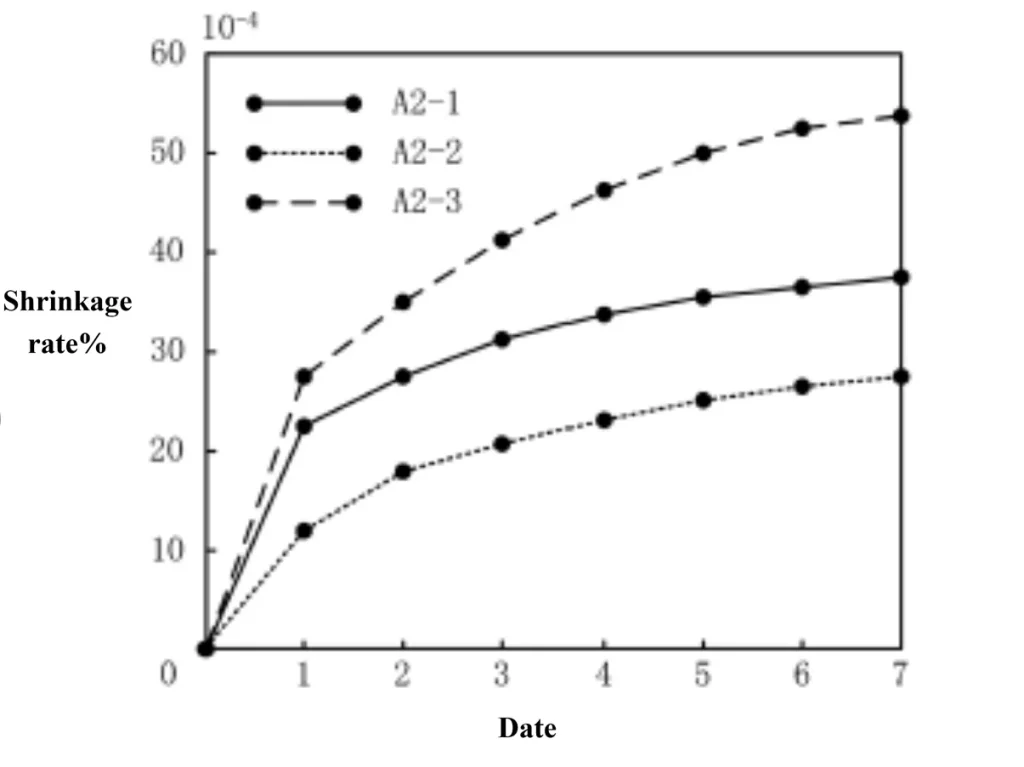
As shown in Figure 1, the application of A2-1 in concrete specimens exhibits relatively stable shrinkage performance, with a moderate shrinkage rate and a small fluctuation range;
A2-2 exhibits the lowest shrinkage rate in concrete specimens, mainly because A2-2 improves the moisture distribution and hardening process inside the concrete by delaying its setting time, thereby effectively suppressing the shrinkage deformation of the concrete;
The shrinkage rate of specimens mixed with A2-3 is the highest within 7 days of age, possibly because A2-3 improves early strength while also causing rapid moisture evaporation in the slurry, resulting in significant shrinkage deformation.
Therefore, the type of water-reducing agent significantly affects concrete shrinkage performance. In practice, select the water-reducing agent based on engineering requirements and the required concrete performance.
To determine the optimal dosage of water reducing agent, in the concrete shrinkage test, the type of water reducing agent was quantitatively selected (polycarboxylate standard water reducing agent was chosen), and the dosage of water reducing agent was set as a variable. Five concrete specimens were prepared: A1, A2, A3, A4, A5. During the early shrinkage process of each specimen, the shrinkage rate was measured and calculated as shown in Figure 2.
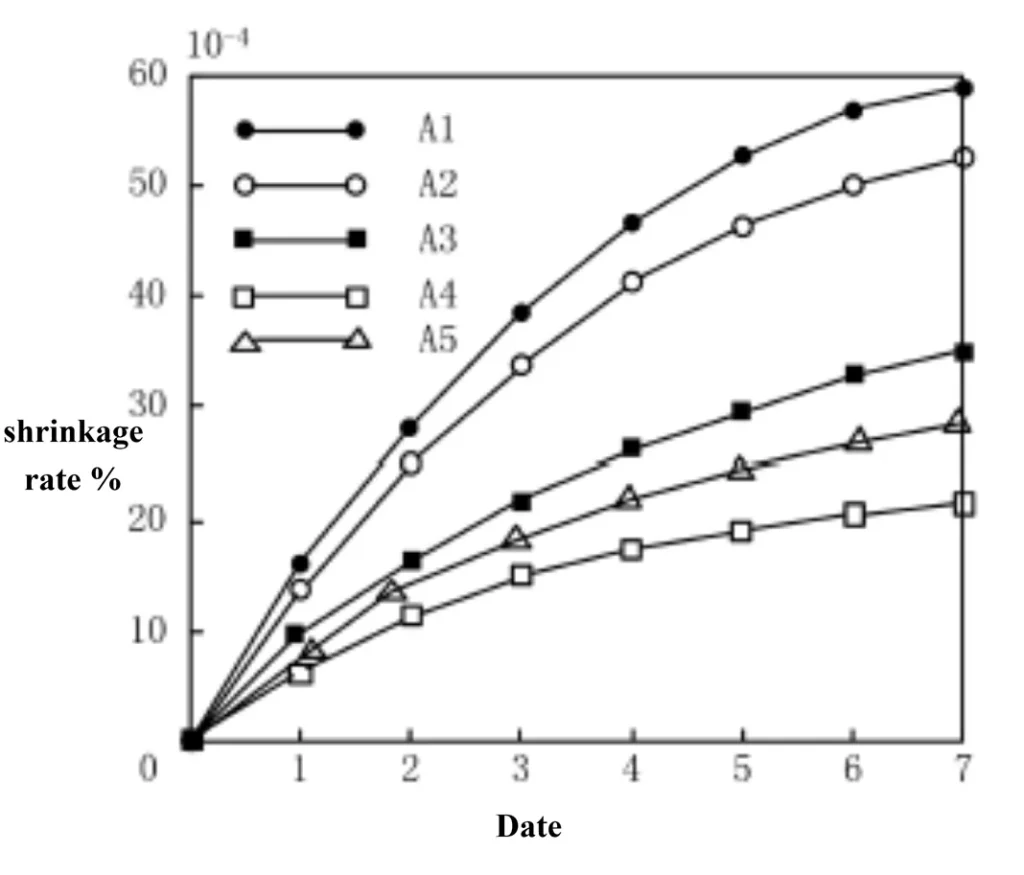
As shown in Figure 2, when no water reducing agent is added to the concrete (0% dosage), the specimen shrinkage rate is highest. After a 7-day early maturity period, the concrete specimen’s shrinkage rate can reach 58.3 × 10^-4 %. 3 × 10⁻⁴%. When the dosage of the polycarboxylate-based standard water-reducing agent is increased from 0% to 1%, the shrinkage rate of the concrete specimen decreases gradually, and at 1%. At 2%, after a 7-day early maturity period, the concrete specimen’s shrinkage rate is only 22.4 × 10^-4 %.
Water reducing agents disperse cement particles, improve hydration, enhance the compactness and strength of concrete structures, and suppress shrinkage deformation. However, it should be noted that the higher the dosage of water reducing agent, the better. Excessive dosage may reduce concrete workability and even adversely affect its strength. Therefore, in highway reconstruction projects, appropriately increasing the dosage of standard polycarboxylate-based water reducers can effectively suppress shrinkage deformation in concrete.
Expansion agents areagents are commonly used additives in concrete for highway reconstruction projects, mainly calcium oxide, calcium sulfoaluminate, and magnesium oxide. To select the best type of expansion agent, in the concrete shrinkage test, three concrete specimens were prepared with the expansion agent type as the variable, keeping the amount of expansion agent constant: B2-1 (calcium oxide expansion agent), B2-2 (calcium sulfoaluminate expansion agent), and B2-3 (magnesium oxide expansion agent). During the early shrinkage process of each specimen, the shrinkage rate was measured and calculated, and the change in shrinkage rate with age is shown in Figure 3.
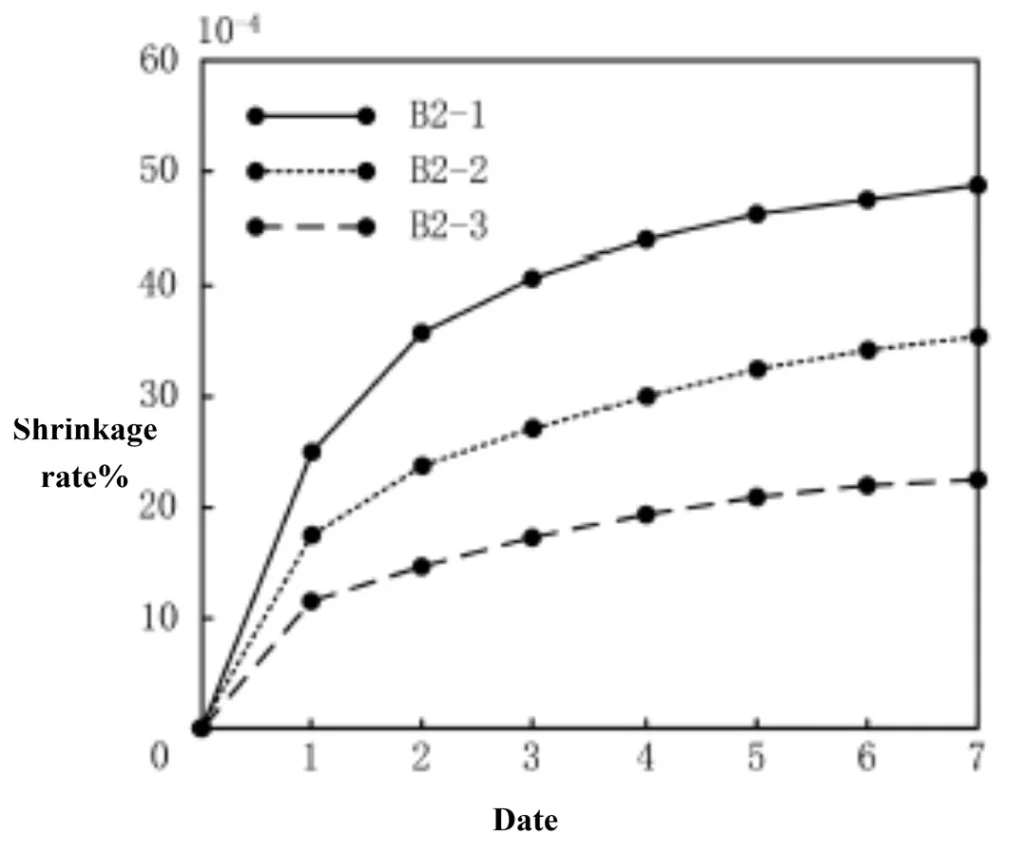
As shown in Figure 3, different expansion agents affect concrete shrinkage performance differently. Comparing the experimental results of various types of expansion agents, it was found that magnesium oxide-based expansion agents had the most significant effect on reducing the shrinkage rate of concrete specimens, followed by calcium aluminate-based expansion agents, and the modification effect of calcium oxide-based expansion agents was the worst. This is mainly because magnesium oxide-based expansion agents compensate for shrinkage in concrete specimens and provide a useful reference for concrete preparation in highway reconstruction projects.
To determine the optimal expansion agent dosage, the expansion agent type is fixed (calcium oxide expansion agent is selected), and the dosage is varied. Five concrete specimens are prepared: B1, B2, B3, B4, B5. During the early shrinkage process of each specimen, the shrinkage rate is measured and calculated. The variation of shrinkage rate with age is shown in Figure 4.
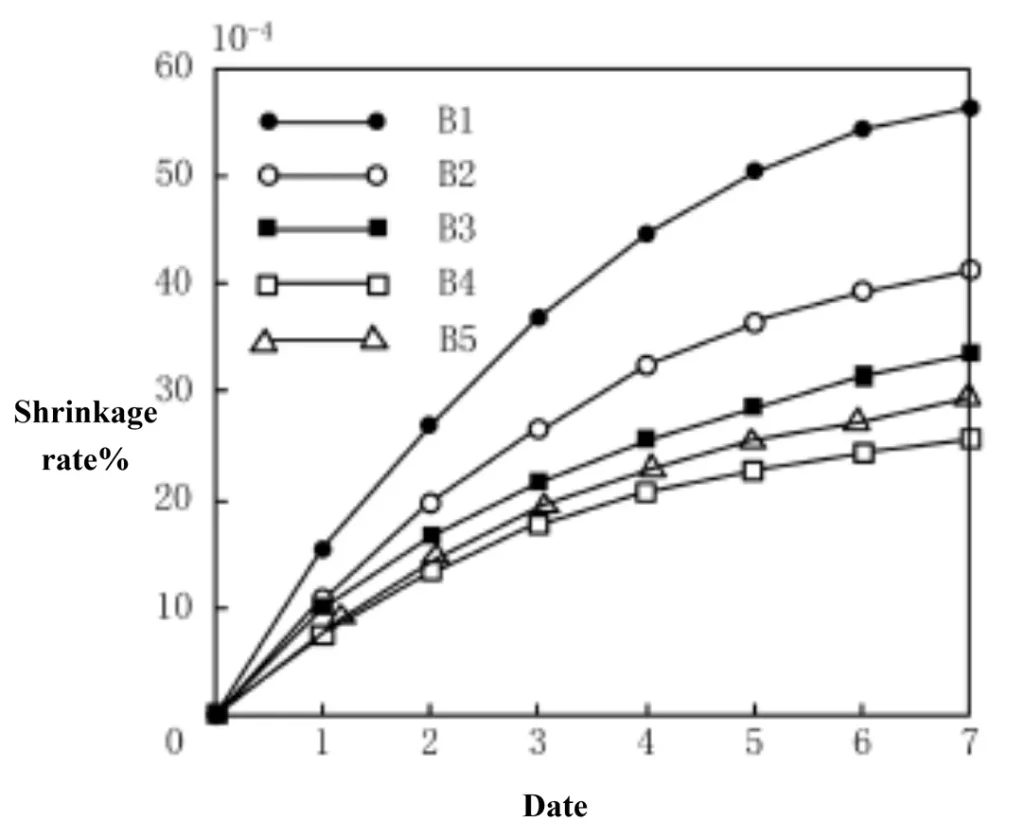
As shown in Figure 4, as the calcium oxide expansion-agent dosage increases, the 7-day shrinkage rate of the concrete specimens gradually decreases, indicating that expansion-agent dosage significantly affects the shrinkage performance of concrete. Specifically, when the expansion agent dosage increases from 0% to 4%, the shrinkage rate of the concrete specimens decreases significantly.
However, as the dosage continues to increase, the rate of shrinkage reduction slows. This indicates that increasing the expansion agent dosage within a certain range can effectively reduce the shrinkage rate of concrete. Therefore, in highway reconstruction projects, it is necessary to consider factors such as construction material costs and select an appropriate expansion-agent dosage to best suppress concrete shrinkage.
The influence of water reducing agents and expansion agents on concrete shrinkage in highway reconstruction projects was studied through experiments, and the influence of the types and dosages of water-reducing agents and expansion agents on concrete shrinkage performance was determined. Different types of water reducing agents and expansion agents significantly affect concrete modification, with polycarboxylate superplasticizer and magnesium oxide-based expansion agents having the greatest impact on concrete shrinkage performance.
As the dosage of water reducing agents and expansion agents increases, the shrinkage rate of concrete continues to decrease. However, excessive admixtures can also negatively affect concrete structures. Therefore, in practice, the admixture dosage should be set reasonably according to the specific project situation. In summary, concrete shrinkage test results can provide a theoretical basis for designing concrete mix proportions in highway reconstruction projects, helping optimise performance and improve engineering quality.
The main reasons and countermeasures for the unsuitability of concrete admixtures
Blog The main reasons and

How to choose antifreeze for a construction site when temperatures drop?
Blog How to choose antifr
Product information, specifications & applications — sent directly to your email.
*Your information is kept confidential and will only be used to contact you regarding our products.