Blog
The molecular weight of polycarboxylate superplasticizer mother liquor usually refers to the average molecular weight of its core molecules, which mainly depends on the selection of monomers and polymerization reaction conditions in the synthesis process.
The molecular structure of water reducing agents is a form between random copolymers and block copolymers. The molecular weight is approximately 30000-50000. The core lies in the fact that the molecular weight determines its adsorption conformation, adsorption rate, steric hindrance effect, and dispersion stability on the surface of cement particles.
The molecular weight of polycarboxylate superplasticizer mother liquor is directly related to its dispersibility.
This is the most significant and critical point where molecular weight has the most significant impact.
The sensitivity referred to here mainly refers to the sensitivity to changes in water consumption and dosage.
Positive effect: Low molecular weight means fast diffusion speed, which can quickly adsorb on the surface of cement particles and provide strong initial dispersion force.
Performance: The concrete has a high slump/expansion, good fluidity, low mixing resistance, and the mixture appears smoother and less viscous.
Negative effect: This is the most prominent defect in this molecular weight range! The steric hindrance layer formed by short molecular chains is thin and weak, making it difficult to resist particle flocculation caused by cement hydration effectively.
The adsorption of low-molecular-weight PCE on the surface of cement particles may not be strong enough, and it may be easily covered or desorbed by hydration products.
Performance: The fluidity of concrete may sharply decrease within 30-60 minutes (much faster than conventional molecular weight PCE).
Especially in high-grade (low water-cement ratio), high rubber material usage, and high-temperature environments, the loss rate is faster. There may be a phenomenon of “fast pouring, fast collapse”, a significant reduction in the construction window period, an increase in pumping pressure, and even pipe blockage.
Negative effects: Low-molecular-weight polymers contribute little to the viscosity of the slurry and have weak suspension stability.
Performance: The concrete surface is prone to obvious bleeding (a layer of clear water). Aggregates and slurries are prone to separation, especially when coarse aggregates sink, and the slurry floats (segregates), which affects homogeneity. More precise control of water consumption and sand ratio is needed; otherwise, poor workability may occur.
Positive: The mixture has low resistance, and the initial pumping stage may feel easier.
Negative: Insufficient cohesiveness of the slurry may result in poor encapsulation of the aggregate, especially when the sand content is low, or the grading is poor, making it easy to expose stones and grab the bottom.
Complex performance: Compared to high molecular weight PCE, the foam stabilization effect is weakened, and the amount of introduced bubbles may be relatively reduced or more unstable (prone to rupture). But if the molecular structure contains strong hydrophilic groups, it may also introduce more bubbles (specific formula analysis is required).
Usually used in conjunction with defoamers, but the stability of the bubble structure may not be as good as that of high molecular weight systems.
This is the most fundamental issue. Very small molecules are almost unable to form effective steric hindrance layers. It may provide very brief dispersion through electrostatic repulsion (if charged), but this dispersion effect collapses instantly after hydration begins. Concrete may experience severe slump loss or even “false setting” within a few minutes after being mixed out of the machine, becoming very dry and hard, making it impossible to construct.
Due to the lack of thickening and stabilizing effects of high molecular weight polymers on the slurry, the admixture itself cannot effectively encapsulate moisture and fine particles, resulting in a large amount of free water precipitation (severe bleeding), severe separation of aggregates from the slurry (segregation), and damage to the uniformity of the concrete structure.
Moderate to high molecular weight (usually in the tens of thousands) is key to achieving good initial dispersibility and an excellent slump-retention balance in polycarboxylate superplasticizers.
1. A molecular weight that is too low (below the lower limit of the conventional range) can lead to steric hindrance failure, rapid slump loss, and severe bleeding and segregation.
2. Excessive molecular weight may lead to problems such as high viscosity, excessive air entrainment, and increased costs.
3. Products with extremely small molecular weights (several thousand or lower) applied to concrete are basically unable to be used as effective water reducers, which can lead to catastrophic deterioration of the concrete state (rapid loss, bleeding, segregation, low strength).
Therefore, precise control of molecular weight and its distribution is one of the core technologies in the design and production of water-reducing agent mother liquor, to find the optimal molecular weight range in practical application scenarios (such as high collapse resistance requirements for prefabricated components, good fluidity and slow loss requirements for on-site pumping, etc.).
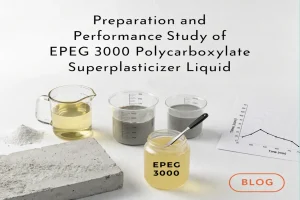
Preparation and Performance Study of EPEG 3000 Polycarboxylate Superplasticizer Liquid
Blog Preparation and Perf
Product information, specifications & applications — sent directly to your email.
*Your information is kept confidential and will only be used to contact you regarding our products.