Blog
Water reducing agents, as common concrete admixtures, are the fifth component of concrete. They can not only effectively reduce the water consumption of concrete, improve its fluidity and workability, but also significantly affect the shrinkage performance of concrete, which can easily cause non-structural cracks during construction.
Therefore, it is necessary to have a specific understanding of the impact and laws of action of high-efficiency water reducing agents on the shrinkage performance of concrete, to provide basic technical data for crack resistance design and planning.
This article designs a shrinkage test for ordinary concrete and studies the effects of three types of water reducers, namely carboxylic acid-based water reducers, naphthalene-based water reducers, and aminosulfonate salts, on the shrinkage of concrete without changing the concrete mix proportion. To ensure the reliability of the test results, it is necessary to screen the raw materials strictly. The specific situation is as follows:
1.Cement is the main binding material of concrete, and its properties have a direct impact on the strength, durability, and shrinkage performance of concrete. This experiment uses 42.5R grade ordinary Portland cement.
The density of this cement is 3.1g/cm3, which has high strength and good durability, and is suitable for the preparation of high-performance concrete.
2.Aggregates are an important component of concrete, including fine and coarse aggregates. The experimental fine aggregate adopts mechanism grade I medium sand with an apparent density of 2656kg/m3; the coarse aggregate is volcanic rock gravel with a particle size of 5-25 mm and an apparent density of 1520kg/m3.
3.The experimental use of admixtures includes fly ash and slag. The moisture content of the fly ash in this experiment is 0.18%, and the residue on the 45 μ m square hole sieve is 9.5%. The slag is selected as water-quenched ground slag with a density of 2.70g/cm3.
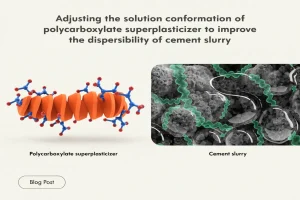
5.The high-efficiency water reducer is the key raw material for this experiment, and its mechanism of action mainly has three points, which can have a significant impact on the shrinkage performance of concrete:
Adsorb on the surface of cement particles, generate electrolysis, thereby reducing the negative potential of cement particles and dispersing them;
The polar groups on the main chain of water reducing agent molecules are prone to form hydrogen bonds with water molecules, hindering the agglomeration of cement particles;
It can introduce tiny bubbles, reduce the surface free energy of the system, and increase the mutual sliding ability between cement particles.
In the case of a fixed mix proportion, adding carboxylic acid-based water reducing agents according to the optimal dosage will continuously increase the early age shrinkage of concrete with the increase of age. The early shrinkage rate is relatively fast, especially within 24 hours after forming, and then gradually tends to be flat. The shrinkage at 1d age accounts for about 64.6% of that at 7d.
Compared with the benchmark group concrete without added water reducing agent, the concrete with added carboxylic acid water reducing agent showed an overall shrinkage increase of 40.1%, and the shrinkage reduction effect was significant.
In the case of a fixed mix proportion, adding a naphthalene-based water reducing agent according to the optimal dosage will continuously increase the early-age shrinkage of concrete with the increase of age, showing a characteristic of rapid shrinkage slowing down and stabilizing overall. The shrinkage at 1d age accounts for about 67.7% of that at 7d, and the shrinkage at 7d increased by 6.8% compared to the benchmark group of concrete without a water reducing agent added.
In the case of a fixed mix proportion, adding an amino sulfonic acid-based water reducing agent according to the optimal dosage will continuously increase the early-age shrinkage of concrete with the increase of age, and the overall change characteristics are consistent with the above-mentioned water reducing agent.
The shrinkage at 1d age accounts for about 58.9% of that at 7d, and the shrinkage at 7d of concrete is reduced by 36.8% compared to the benchmark group without water-reducing agent. This proves that the effect of this water-reducing agent on the shrinkage performance of concrete is relatively small, and it even has a shrinkage-reducing effect.
This article deeply explores the influence of different water reducing agents on the shrinkage performance of high-performance concrete through chemical experimental analysis. The research results indicate that the addition of different water reducing agents can, to some extent, affect the shrinkage deformation of high-performance concrete. However, the specific effect is directly affected by the type of water reducing agent. In the experiment, naphthalene-based water reducers increased the early shrinkage deformation of concrete, while amino sulfonic acid- and carboxylic acid-based water reducers reduced the shrinkage deformation of concrete.
Therefore, in actual engineering, the type of high-efficiency water reducing agent should be reasonably selected according to specific engineering conditions and requirements, and the optimal dosage should be determined to achieve the expected concrete shrinkage control effect, providing solid scientific support for the widespread application of concrete.

Preparation and Performance Study of EPEG 3000 Polycarboxylate Superplasticizer Liquid
Blog Preparation and Perf
Product information, specifications & applications — sent directly to your email.
*Your information is kept confidential and will only be used to contact you regarding our products.