Blog
Currently, common pain points in the concrete industry include high cement dosage per unit, poor admixture compatibility per unit, rapid loss of concrete slump, easy cracking, and significant waste loss. Coupled with the continuous rise in raw material and labor costs, enterprise profit margins are constantly being compressed.
The traditional single additive addition mode has a single function and cannot balance multiple properties such as high water reduction, long-term slump retention, and anti-sensitivity. It is prone to problems such as rapid loss of slump during summer construction, slow setting in winter, high hydration heat of high-strength concrete, and surface cracking of components, indirectly increasing the cost of rework, repair, and waste loss.
The dual admixture method achieves a performance gain of “1+1>2” through the synergistic combination of two complementary functional admixtures. While ensuring that the strength, durability, and construction performance of concrete meet standards, it effectively optimizes concrete workability, reduces the amount of cementitious materials used, and minimizes common quality problems. It is a core cost-reduction and efficiency-improvement technology for concrete mixing plants and engineering projects, with low cost, high return, and easy implementation.
At present, the industry generally adopts a single polycarboxylate water reducer or ordinary admixture addition mode, which has long had many cost and quality shortcomings, and is the core bottleneck for reducing costs and increasing efficiency in concrete:
Single performance and poor adaptability: Adding a single water-reducing agent can only achieve water-reduction effects and cannot balance slump retention, crack resistance, defoaming, and retarding. During high-temperature construction in summer, slump loss exceeds the standard for 1-2 hours, and the concrete cannot be pumped to the site; low-temperature concrete reaction in winter can cause pump blockage during construction.
High material costs: In the single mixing mode, the control ability of admixtures on concrete is limited. To ensure strength and workability, it is necessary to increase the amount of cement and cementitious materials, resulting in a high cost per cubic meter of concrete.
Common quality problems occur frequently: poor workability of concrete, easy segregation and bleeding, excessive surface bubbles, and later shrinkage and cracking, leading to increased hidden costs such as repair and rework, component reinforcement, etc.
Weak adaptability to working conditions: high hydration heat of large volume concrete, poor stability of high-strength concrete, insufficient collapse protection of long-distance pumped concrete, insufficient adaptability to various special working conditions, and low construction fault tolerance.
The dual admixture method refers to the scientific compounding and addition of two complementary and compatible admixtures, relying on synergistic effects to optimize the microstructure and workability of concrete. Compared with the single admixture mode, it has multiple advantages in improving quality and reducing costs. It is currently one of the most cost-effective technological transformation solutions in the concrete industry.
Performance synergy gain: achieve multiple effects of water reduction, collapse retention, crack resistance, foam stability, and slow setting; significantly improve concrete compactness; comprehensively optimize impermeability, frost resistance, and shrinkage resistance; and reduce common quality problems such as cracking and leakage from the source.
Significantly reducing material costs: The dual admixture synergistically improves water reduction rate and cementitious material activity, effectively reducing cement usage, increasing the amount of low-cost admixtures such as fly ash and mineral powder, and assisting in increasing the use of recycled aggregates. The comprehensive material cost per cubic meter is significantly reduced. At the same time, selecting a suitable polycarboxylate mother liquor can improve admixture procurement accuracy and reduce procurement costs.
Suitable for all working conditions: The dual mixing ratio can be dynamically adjusted according to the summer and winter seasons, pumping distance, and concrete grade to solve problems such as high-temperature collapse, low-temperature rapid setting, and long-distance pumping blockage, greatly reducing construction losses and equipment idle costs.
Reduce production and construction losses: optimize concrete workability, eliminate segregation, bleeding, and agglomeration problems, reduce waste from mixing plants and on-site pouring of waste concrete, and reduce the frequency of repair and rework.
General economy type (suitable for ordinary C20-C40 pumped concrete)
Combination formula: high-performance water-reducing polycarboxylate water reducing agent+high-performance slump retaining polycarboxylate water-reducing agent
Adaptation scenarios: Conventional parts such as building beams, slabs, columns, floors, cushions, municipal roads, etc., applicable throughout the year, especially suitable for high temperatures and long-distance pumping construction in summer.
Technical function: High-performance water-reducing polycarboxylate superplasticizer ensures a high water reduction rate and improves concrete flowability; high-performance slump-retaining polycarboxylate superplasticizer controls the slump retention time of concrete, delays the hydration rate of cement, controls the slump loss within 0.5-3 hours, avoids rapid high-temperature collapse and pump blockage, and optimizes workability to reduce surface bubbles.
Mixing standard: High-performance water-reducing polycarboxylate water-reducing agent 1.0%-2%, high-performance slump-retaining polycarboxylate water-reducing agent 1%-2%, can be adjusted according to the moisture content of sand and gravel and temperature.
High strength and stable type (suitable for C40 and above high-strength concrete)
Combination formula: viscosity-reducing polycarboxylate water reducer+high-performance slump retaining polycarboxylate water reducer
Applicable scenarios: super high-rise structures, bridge box girders, prestressed high-strength components, and other parts that require high concrete density and appearance quality.
Technical function: The viscosity-reducing polycarboxylate superplasticizer ensures the flowability of high-strength concrete under low water-cement ratio conditions; the high-performance polycarboxylate superplasticizer ensures the slump retention performance of concrete under high cementitious material dosage.
Mixing standard: viscosity-reducing polycarboxylate water reducer 1.0%-2.0%, high-performance slump-retaining polycarboxylate water reducer 1.0%-2.0%.
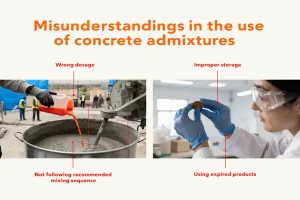
To ensure the dual mixing effect and eliminate performance loss, the production mixing processing sequence is unified, and it is strictly prohibited to arbitrarily change the feeding sequence and mixing duration:
Feeding sequence: Mix cementitious materials such as cement, fly ash, and mineral powder for a certain period of time → Add double admixtures in batches (first add the main water reducing agent, then add the auxiliary water retaining agent) → Mix thoroughly for a certain period of time before discharging.
Prohibited operation: It is forbidden to mix and store two types of additives in advance to avoid premature reaction and additive failure, which may affect the synergistic effect.
Dynamic adjustment: Before daily production, the tester adjusts the double mixing ratio based on the moisture content of sand and gravel, ambient temperature, and construction pumping distance, forming a daily exclusive mixing ratio ledger.
Relying on the performance advantages of dual doping technology, targeted optimization of the mix proportion, achieving precise cost reduction, and ensuring that the strength meets the standard throughout the process:
Reduce cement usage: By utilizing dual admixture synergy to enhance the activity of cementitious materials and reduce the water-cement ratio, the amount of cement used per cubic meter can be reduced by 5% -10% under the same strength. Low-cost fly ash and mineral powder can be used to replace some cement, significantly reducing the cost of main materials.
Reduce the total amount of admixtures: The dual-admixture synergistic effect can reduce unnecessary admixture dosage (such as water-reducing mother liquor with poor workability) compared to the single-admixture mode, avoiding material waste and concrete over-admixture caused by a single high dosage.
Adaptation to recycled aggregates: Dual mixing technology can effectively compensate for the shortcomings of large pores and strong water absorption of recycled aggregates, improve the workability of recycled concrete, expand the application range of solid waste materials, and further reduce raw material procurement costs.
Establish special acceptance standards for dual admixture, and all admixtures entering the site must provide testing reports. After entering the site, compatibility, water reduction rate, and slump retention performance sampling should be carried out to prevent inferior and poorly adapted additives from entering the site; Classify and store two types of additives separately in storage tanks with clear labeling, and strictly prohibit mixing, moisture exposure, and sun exposure; Establish an inventory ledger, implement limited usage, and eliminate waste.
Regularly calibrate the measuring equipment of the mixing plant to ensure that the measurement error of the double admixture is controlled within ± 1%, and to prevent performance non-compliance caused by dosage deviation; Before each batch of production, trial mixing is carried out to test the slump, workability, and setting time of the concrete. Only after meeting the standards can mass production be carried out; establish a dual-blending production ledger to record the daily labeling, temperature, ratio, blending amount, and performance indicators, achieving data traceability.
Utilize the advantages of dual mixing and anti-collapse, optimize transportation scheduling, and reduce vehicle waiting backlog; in high-temperature weather, relying on the dual mixing formula of retarding and plastic protection, the collapse and damage of long-distance transportation are prevented from exceeding the standard; Before on-site pouring, the workability of the concrete should be rechecked. Only when the performance meets the standards can pouring be carried out. Strictly implement standardized pouring, vibration, and maintenance processes, and leverage the advantages of dual mixing technology to minimize cracking and rework issues.
The experimental department conducts daily adaptation tests and dynamically updates the parameters of the dual mixing ratio; collects weekly data on the strength, slump loss, scrap rate, and cracking rate of concrete test blocks, and compares the performance and cost differences between single and double mixing modes; conducts special adaptation tests in advance for special working conditions and special grade concrete to avoid quality risks.
Select 2-3 commonly used concrete grades and conventional construction conditions to carry out dual mixing technology pilot projects, complete dual mixing formula adaptation tests, and record performance data and cost data; Compare the material loss, construction effect, and common quality problems of the traditional single mixing mode, screen the optimal suitable formula, and form a pilot summary report.
Organize special training for testers, mixing operators, material managers, and construction teams to explain the principles of dual mixing technology, formula selection, feeding process, control standards, and common problem rectification methods; establish unified operating procedures and quality standards to prevent human error from affecting the effectiveness of technical implementation.
Replace the traditional single mixing mode with full labeling and full operating conditions, and fully implement the application system of double mixing additives; Establish a daily inspection and weekly review mechanism to promptly address issues such as mismatched ratios, non-standard operations, and performance non-compliance; Improve the supporting management system and ledger system to achieve standardized operation.
Continuously iterate and optimize the dual blend formula, fine-tuning parameters for seasonal changes, raw material fluctuations, and new process conditions; establish a mature technology system and form an internal “Application Standard for Additive Dual Mixing Technology” within the enterprise.
By optimizing the mixing ratio through dual mixing technology, the amount of cement used per cubic meter is reduced by 5% -10%, the comprehensive material cost of concrete per cubic meter is reduced by 5-10 yuan, and the construction efficiency can be greatly improved. The compactness, impermeability, and crack resistance of concrete are significantly improved, and the solid quality qualification rate is greatly improved. The project acceptance rate is steadily increasing.

Preparation and Performance Study of EPEG 3000 Polycarboxylate Superplasticizer Liquid
Blog Preparation and Perf
Product information, specifications & applications — sent directly to your email.
*Your information is kept confidential and will only be used to contact you regarding our products.