Blog
Self-compacting concrete has high fluidity and can self-compact without mechanical vibration during pouring, making it suitable for complex structures such as large-span bridges and large equipment foundations. In contrast, ordinary concrete requires mechanical vibration during construction to achieve compactness, and uneven vibration can easily lead to insufficient compactness, making it difficult to meet the construction performance requirements of some projects.
The volume stability of self-compacting concrete is closely related to the amount of expansion agent added. Adding an appropriate amount of expansion agent can improve its volume stability and better utilize the performance of self-compacting concrete.
Scholars have studied the effects of different types of expansion agents on the basic properties and durability of self-compacting concrete. The results show that within a certain dosage range, calcium magnesium composite expansion agents and sulfoaluminate expansion agents can improve the 28-day compressive strength of concrete, but significantly reduce its mixing performance; The plastic expansion agent has little effect on the 28-day compressive strength of concrete, but has a significant impact on improving its mixing performance.
This article studies the influence of different expansion agent dosages (0%, 8%, 10%, 12%) on the workability, mechanical properties, and durability of C40 self-compacting concrete. It explores the mechanism of expansion agents in concrete to provide a reference for their application in engineering.
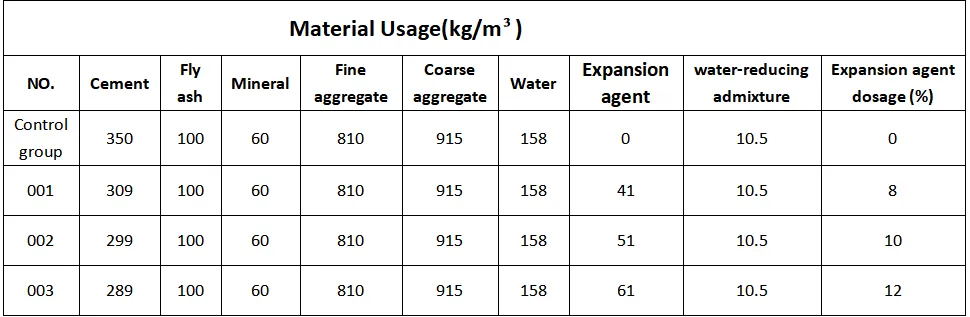
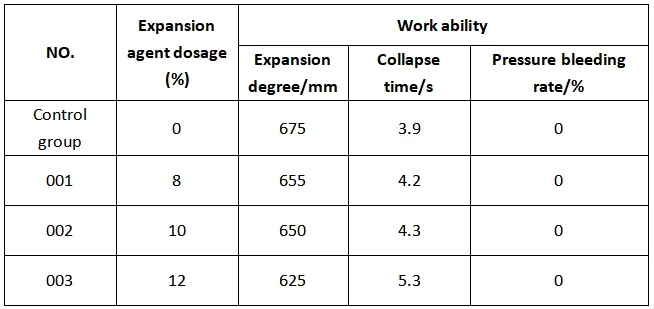
According to Table 2, the overall flowability of self-compacting concrete decreases after adding an expansion agent. When the expansion agent dosage exceeds 8%, the concrete’s expansion degree decreases significantly. The collapse-time test results show that as the expansion-agent dosage increases, the collapse time increases, indicating higher viscosity.
The pressure bleeding rate test results showed that the pressure bleeding rate of each concrete group was 0%, indicating good water-retention performance. This is mainly due to the expansion agent’s good overall filling effect and the reaction of its active components, which consumed free water in the system. The amount of free water used to improve the concrete’s flow performance decreased, resulting in a slight increase in concrete viscosity.
As the expansion agent dosage increases, the compressive strength of concrete at different ages first increases and then decreases.
When the dosage of expansion agent is 10%, the compressive strength of concrete is the highest, with compressive strengths of 50.1 and 58.7 MPa at 28 and 60 days, respectively; Compared with the control group, the 3D compressive strength of concrete with expansion agent dosages of 8%, 10%, and 12% increased by 2.4, 7.7, and 5.0 MPa, respectively.
The 28-day compressive strength increased by 1.9, 2.8, and -0.9 MPa, respectively, and the 60-day compressive strength increased by 3.1, -0.1, and -4.7 MPa, respectively. This indicates that after adding the expansion agent, the 3D early compressive strength of concrete increases, but strength decreases in the middle and late stages (28 and 60 days).
This is mainly due to the early filling effect and chemical reaction after adding the expansion agent, which can increase the internal compactness of concrete and lower overall porosity, thereby improving early strength.
However, as reaction time increases, the expansion agent continues to react and internal expansion stress in the concrete increases, which is not conducive to maintaining the cement-stone and interface transition zone structure. The formation of weak areas adversely affects the concrete’s compressive strength.
As the expansion agent dosage increases, the water-limited expansion rate of concrete increases at different ages.
When the dosage of expansion agent is 8%, the limited expansion rates of concrete in water at 3, 7, and 14 days are 1.80 × 10⁻⁴, 2.51 × 10⁻⁴, and 2.91 × 10⁻⁴, respectively;
When the dosage of expansion agent is 10%, the limited expansion rate in water at 3, 7, and 14 days increased by 10.0%, 12.0%, and 17.2% respectively compared to the dosage of 8%, indicating a significant increase;
When the dosage of expansion agent is 12%, the limited expansion rate in water at 3, 7, and 14 days increased by 11.1%, 15.2%, and 24.1% respectively compared to the dosage of 8%.However, the increase was relatively small compared with the 10% dosage.
This is mainly because the expansion agent reacts to form the hydration product ettringite, which increases in volume.
As the curing age increases, the drying shrinkage of concrete with different amounts of expansion agent shows an upward trend.
After adding expansion agent, the increase in shrinkage in the later stage of concrete is relatively small and basically flat.
When the curing age is 3 days, the drying shrinkage of concrete with expansion agent dosage of 8%, 10%, and 12% is 147 × 10-6, 74 × 10-6, and 108 × 10-6, respectively, which is 23.4%, 61.5%, and 43.8% lower than the control group;
When the curing age is 28 days, the drying shrinkage of the three groups of concrete is 418 × 10-6, 318 × 10-6, and 299 × 10-6, respectively, which are 9.5%, 31.2%, and 35.3% lower than the control group, respectively;
When the curing age is 60 days, the drying shrinkage of the three groups of concrete is 492 × 10-6, 364 × 10-6, and 334 × 10-6, respectively, which are 9.2%, 32.8%, and 38.3% lower than the control group, respectively.
Based on the trend, increasing the expansion agent dosage from 8% to 10% has a more significant effect on reducing concrete shrinkage; increasing the dosage from 10% to 12% does not significantly reduce concrete shrinkage. This indicates that an appropriate amount of expansion agent can moderately compensate for shrinkage in the concrete itself.
As the expansion agent dosage increases, the carbonation depth of concrete at each age first decreases and then increases.
At an expansion agent dosage of 10%, the carbonation depth of concrete at each age is the smallest. The carbonation depth at 3, 7, 14, and 28 days is 0.5, 1.5, 3.0, and 4.0mm, respectively, which is 2.5, 3.0, 3.5, and 4.0mm lower than the control group.
This is mainly due to the filling effect of the expansion agent added at an early stage, which reacts with water to generate products that fill the internal voids of the concrete, making the overall structure more compact, effectively hindering carbon dioxide infiltration, and improving carbonation resistance.
However, when the expansion agent exceeds 10.0%, the expansion rate increases, and internal expansion stress causes cracks to form inside the concrete, creating infiltration channels. Carbon dioxide infiltration becomes more difficult, and the carbonation rate accelerates.
The electrical flux of concrete at 28 days of age first decreases and then increases. When the dosage of expansion agent is 10%, the electrical flux of concrete at 28 days is the smallest, which is 502C; when the dosage of expansion agent is 8%, 10%, and 12%, the electrical flux of concrete is reduced by 16, 193, and 159C, respectively, compared to the control group.
This is mainly due to the effective filling of the internal structure of concrete with hydration products after adding an appropriate amount of expansion agent, reducing the internal porosity, decreasing the number of large internal pores and the probability of connected pore formation, improving the resistance to chloride ion penetration, and enhancing the anti-permeability performance of concrete.
This article compares changes in workability, mechanical properties, and durability of self-compacting concrete at expansion agent dosages of 0%, 8%, 10%, and 12%. It explores the expansion agent’s mechanism of action in concrete and analyzes the relationship between macroscopic performance changes and the underlying mechanisms. The following conclusions are drawn:

Preparation and Performance Study of EPEG 3000 Polycarboxylate Superplasticizer Liquid
Blog Preparation and Perf
Product information, specifications & applications — sent directly to your email.
*Your information is kept confidential and will only be used to contact you regarding our products.