Blog
In the global concrete admixture market, polycarboxylate ether (PCE) superplasticizers are widely used because of their low dosage, high water reduction, and tunable molecular structure. They play a key role in major projects such as high‑speed rail foundations and cross‑sea bridges. Polyether macromonomers are the essential raw materials for making PCE, and their properties directly affect the performance of the superplasticizer. HPEG and VPEG are two mainstream types of macromonomers. However, many professionals are still unclear about the differences between them.
This article provides a factual, in‑depth comparison of HPEG and VPEG from multiple angles – chemical structure, synthesis process, common features, performance, applications, and market trends – to help technicians and purchasing decision‑makers choose the right monomer for their needs.
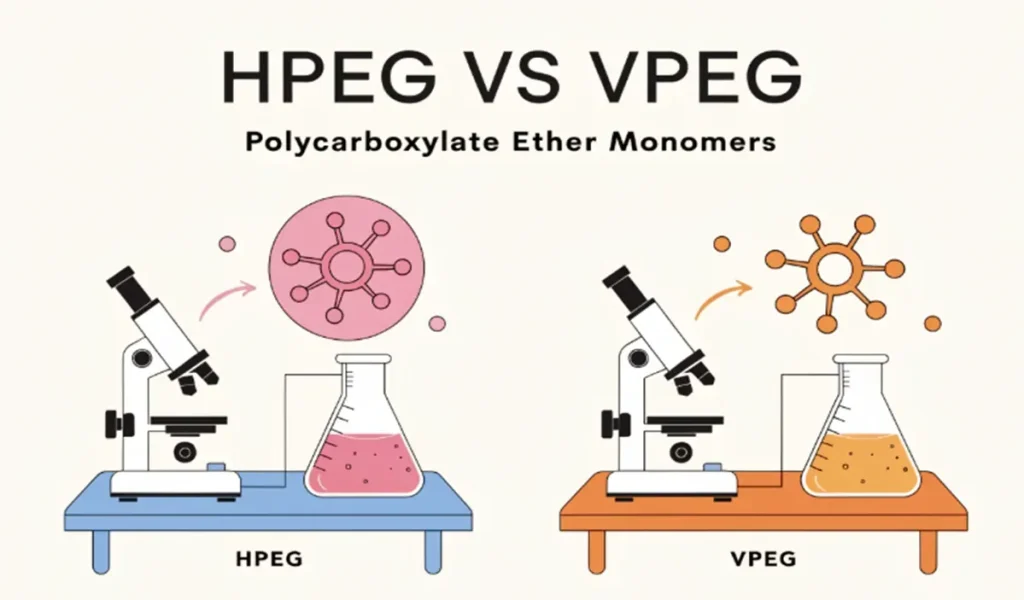
HPEG 2400 (isobutenol polyoxyethylene ether, also called methallyl polyoxyethylene ether) is a polyether macromonomer made by polymerizing methallyl alcohol with ethylene oxide (EO). HPEG is currently the most widely used macromonomer for PCE. It is non‑toxic, non‑irritating, water‑soluble, and chemically stable. It has a high double‑bond retention rate and good reactivity. HPEG‑based PCE offers low dosage, good slump retention, low concrete shrinkage, and high molecular design flexibility. The production process does not use formaldehyde, making it environmentally friendly.
VPEG 2400 (4‑hydroxybutyl vinyl polyoxyethylene ether) is a newer six‑carbon macromonomer. Unlike HPEG’s four‑carbon backbone, VPEG has a vinyl ether structure where the double bond conjugates with the oxygen atom, giving it higher polymerization activity than conventional monomers. VPEG‑based PCE belongs to the vinyl ether family and is gradually entering the market. Its overall performance is still being evaluated in practice.
The key difference between HPEG and VPEG is the number of carbon atoms in the backbone and the functional group. HPEG has a four‑carbon backbone, starts from methallyl alcohol, and belongs to the allyl ether family. VPEG has a six‑carbon backbone (hence often called a six‑carbon macromonomer), starts from 4‑hydroxybutyl vinyl ether, and has a vinyl ether structure. Because of the conjugation between the double bond and oxygen, VPEG shows significantly higher polymerization reactivity than HPEG.
Due to the difference in reactivity, the synthesis processes differ. HPEG‑based PCE is typically made at around 60 °C (either room‑temperature or heated), with a reaction time of 3 to 5 hours. VPEG, however, can be polymerized at lower temperatures (15–25 °C) and the reaction finishes in only 1 to 1.5 hours.
This cuts energy consumption and production time, making VPEG more efficient for industrial production. That said, VPEG‑based PCE technology is still at an early stage. Only a few admixture manufacturers in China can produce it, while some international chemical companies have already developed a series of VPEG‑based products.
Despite their structural and synthetic differences, HPEG and VPEG share many important features.
First, both are polyether macromonomers made by adding ethylene oxide to a starter molecule. Both contain a hydrophilic polyoxyethylene long chain. This common structure gives PCE molecules sufficient steric hindrance from the side chains, which provides good dispersing and slump‑retaining ability.
Second, both are used in free‑radical polymerization to make PCE. Whether it is the allyl double bond in HPEG or the vinyl ether double bond in VPEG, each can copolymerize with unsaturated carboxylic acids (such as acrylic acid or methacrylic acid) in the presence of an initiator, forming the typical comb‑shaped polymer. That is why both can serve as macromonomers for PCE.
Third, both are highly water‑soluble. Thanks to the polyoxyethylene chain, HPEG and VPEG dissolve quickly in water, which is convenient for subsequent polymerization and for actual use in concrete.
Fourth, both are environmentally friendly. Neither uses formaldehyde during production or during the synthesis of the superplasticizer. The resulting PCE does not release formaldehyde, aligning with the trend toward greener concrete admixtures.
Fifth, both show good adaptability to different cements. Although VPEG is often said to have better cement adaptability, HPEG also works well with most cement types and aggregates. By adjusting the acid‑to‑ether ratio and the initiator system, both can perform satisfactorily in conventional concrete applications.
Finally, PCEs made from HPEG or VPEG share the same common advantages: low dosage, high water reduction, low concrete shrinkage, and high structural design flexibility. These shared features make both monomers dominant in the PCE field and jointly drive the development of concrete admixture technology.
Studies show that HPEG and VPEG each have their own strengths. HPEG gives slightly better water‑reducing ability, but the initial water reduction of the two is roughly comparable. For slump retention, VPEG performs better. VPEG‑based PCE provides better flow retention and slump‑holding ability.
A study by Guo Jintang’s team at Tianjin University, published in an SCO international journal, systematically compared PCEs made from four macromonomers – HPEG, IPEG, EPEG, and VPEG – focusing on concrete viscosity and workability. The results show that at higher water‑to‑cement ratios (≥0.35), the four PCEs behave similarly in flow velocity and viscosity. At low water‑to‑cement ratios (≤0.3), the concrete with a specific VPEG‑based PCE had a V‑funnel flow time of 8.5 seconds, the fastest flow and the lowest viscosity among the four. VPEG‑based PCE showed excellent workability across all water‑to‑cement ratios.
Another study on ultra‑high performance concrete (UHPC) found that the influence of polyether side‑chain type on slump flow and emptying time ranked as EPEG > HPEG > TPEG > VPEG.
Research indicates that VPEG‑based PCE has better adaptability to different cements. Using VPEG’s unique structure to develop a product series can help reduce the sensitivity and compatibility issues of PCE.
Test results show that VPEG‑based PCE gives higher early strength in concrete. Supplier literature indicates that VPEG macromonomers are designed to produce PCE with greater strength development than HPEG‑based high‑water‑reducing PCE.
HPEG is one of the most cost‑effective PCE macromonomers available, giving it a clear economic advantage for large‑scale commercial use. VPEG is newer and still has a relatively higher production cost, but as the technology matures and production scales up, its cost is expected to gradually fall.
Based on the above performance differences, HPEG and VPEG suit different applications.
HPEG is better for general concrete projects where water reduction is key and cost matters – for example, large‑scale commercial concrete, precast concrete, and ready‑mix concrete.
VPEG has advantages in applications that demand good slump retention for long‑distance transport, high‑strength or high‑performance concrete (including UHPC), projects requiring high early strength, and difficult conditions where cement adaptability and sensitivity are concerns.
In practice, product performance can vary slightly from one monomer manufacturer to another. You cannot judge a monomer simply by its code. By adjusting the acid‑to‑ether ratio and the redox system, PCEs made from different monomers can all meet the required performance. The key is to optimize the formulation based on the local raw materials and production conditions to achieve the best cost‑performance ratio.

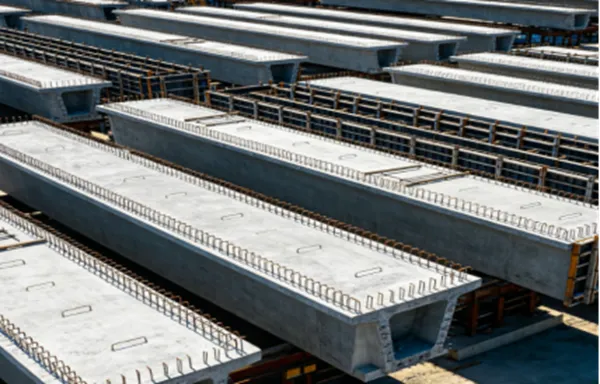
The global market for PCE macromonomers is growing steadily. HPEG and VPEG are mainly used in precast concrete units and commercial concrete. Major players in the industry include Shandong Zhuoxing Chemical, LOTTE Chemical, Jiangsu Dynamic Chemical, and Liaoning Kelong Chemical.
Several trends are shaping the PCE macromonomer field.
Product iteration is accelerating. From the early allyl polyether (APEG) to the more mature isopentenyl polyether (TPEG) and isobutenyl ether (HPEG), and then to the newer six‑carbon monomers like VPEG and EPEG, the technology keeps evolving. New vinyl ether‑type PCEs are being introduced, further expanding the VPEG family.
Demand continues to grow. Over the next five years, PCE macromonomer production capacity in China is expected to increase modestly, with new capacity planned in East China and Northwest China.
Green development is a clear direction. PCE is moving toward more environmentally friendly, high‑performance formulations. The advantages of newer macromonomers in both environmental impact and production efficiency will drive continued progress in the industry.
To sum up, here are some practical guidelines for choosing between HPEG and VPEG.
If cost is your top priority, HPEG is the most cost‑effective choice for large‑scale conventional use. If you need excellent slump retention (e.g., for long‑distance transport or hot‑weather concreting), VPEG is better. If early strength is critical, VPEG has an edge. If you want fast production with lower energy consumption, VPEG’s short synthesis time is an advantage. If you prefer a well‑established, low‑risk technology, HPEG is more mature. If you work with special high‑performance concrete, VPEG performs better in high‑strength mixes.
No monomer is the absolute best for every situation. The right choice depends on the specific project requirements. As concrete admixture technology continues to improve, HPEG and VPEG will each play to their strengths in different applications, jointly advancing concrete construction practices.