
Blog
How to deal with the mildew of polycarboxylate superplasticizer
Blog How to deal with the
Blog
The soluble alkali in cement is usually expressed as Na2O equivalent, which mainly comes from the clay and admixtures used in cement production. An appropriate amount of soluble alkali promotes cement hydration and supports early strength development in concrete. Experimental results have shown that the fluidity of cement concrete increases with increasing alkali content. However, once a certain amount is reached, cement hydrates rapidly, and the fluidity of the cement slurry significantly decreases. The plasticizing effect is also significantly reduced after adding water-reducing agents. Using water-reducing agents in the construction of commercial concrete and pumped concrete increases the rate of slump loss over time.
The reason for the above phenomenon is generally believed to be that the alkali in cement promotes the dissolution of tricalcium aluminate (C3A). At this time, the cement quickly forms certain AFt crystals with the participation of the setting agent CaSO4. It wraps around the surface of C3A, inhibiting its direct hydration to form calcium aluminate and improving the fluidity of the cement slurry. However, if the alkali content in cement is too high, the initial formation of a large number of AFt crystals will decrease flowability, and the effectiveness of water-reducing agents in the above-mentioned cement will inevitably decrease. This is mainly manifested in an insufficient water-reduction rate, poor plasticizing effect, and a high slump loss rate over time.
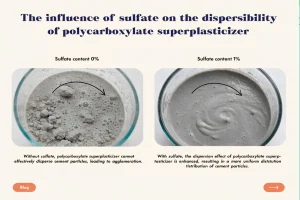
When using high-alkali cement, low-sulfate-content water reducers are ineffective. However, if a water-reducing agent with a high sulfate content (sodium sulfate content over 20%) is used, effectiveness improves significantly. This is mainly because the CaSO4 in low-concentration water-reducing agents is generated during synthesis and neutralization and is highly soluble in water. When gypsum is not yet dissolved in cement, it dissolves in water in large quantities. When higher alkali accelerates C3A dissolution, a large amount of SO3 is already present in the water, reacting with C3A to form AFt and preventing the decrease in fluidity caused by calcium aluminate formation, thereby reducing slump loss. Water-reducing agents with high sodium sulfate content are more suitable for high-alkali cement.
Many polycarboxylate superplasticizers have low pH values, making them difficult to use with high-alkali cement when paired with acidic retarders such as citric acid. The main reason is that when acidic additives are added to high-alkali cement, a rapid, exothermic acid-base neutralization reaction occurs, and the temperature rises sharply. This not only promotes rapid cement hydration but also creates a vicious cycle of large heat release during hydration. The prepared concrete not only has poor fluidity, but the slump is also likely to disappear in a very short period of time. However, if other alkaline retarders are used, this phenomenon can be avoided.
The optimal soluble alkali content in cement is generally believed to be 0.4%-0.6%. Cement with an alkali content below 0.4% is usually referred to as low alkali cement. Water-soluble alkali mostly exists as alkali sulfate, so low-alkali cement is also called sulfur-deficient or under-sulfur cement.
Adding water-reducing agents to sulfur-deficient cement usually results in poor flowability, and increasing the amount of water-reducing agent may have some effect, but it will also increase concrete bleeding. The resulting concrete has poor uniformity and rapid slump loss, making it difficult for commonly used water-reducing agents to adapt. Even if the retarder dosage is doubled, it will have no effect.
The fundamental reason for this unsuitability in sulfur-deficient cement is insufficient SO3, which reduces C3A’s hydration-inhibiting effect. The rapid, large adsorption of C3A onto external additives also reduces the plasticizing function of the water-reducing agent. Therefore, only supplementing soluble alkali (sulfate) effectively solves the adaptability problem of low-alkali and sulfur-deficient cement. The commonly used method of increasing the retarder dosage is not very effective.
The main components of cement are C3S, C2S, C3A, and C4AF. The adsorption activity order of these mineral components is generally believed to be C3A > C4AF > C3S > C2S, with C3A having the highest adsorption capacity for water-reducing agents. Therefore, when the dosage of water-reducing agents is constant, concrete fluidity decreases as C3A content increases. The slump loss rate over time also increases. This is mainly because most of the added water-reducing agents are adsorbed by C3A. At the same time, the main mineral component, C3S, does not have enough water-reducing agents to adsorb and disperse, resulting in decreased cement slurry fluidity. Multiple experiments have shown that if the C3A content in cement exceeds 8%, it adversely affects concrete fluidity.
Experimental results have shown that using water-reducing agents with high sulfate content to supplement SO3 in cement slurry has a certain effect. Adding a certain amount of hydroxycarboxylic acid salt retarder can also inhibit C3A adsorption and hydration. In contrast, the effect of using polyols and other retarders is not significant. Low-cost water-reducing agents can also be used, and the dosage can be appropriately increased to reduce C3A adsorption and leave more residual water-reducing agents to improve the fluidity of mineralized components such as C3S. Due to the low price of this type of water-reducing agent, it will not increase the cost of use.
According to China’s cement standards, a large amount of admixtures can be added to cement. Currently, the most commonly used materials are fly ash, volcanic ash, slag, and finely ground limestone. These materials differ significantly in activity, water demand, mineralogical composition, and additive adsorption performance, which affects how well additives adapt to cement.
High-quality fly ash should have strong activity (i.e., a high content of active SiO2 and Al2O3), low loss on ignition, low fineness, and low water demand. The loss on ignition has the greatest impact on the solubility of external additives.
Loss on ignition refers to the amount of unburned carbon in fly ash. The greater the loss on ignition, the higher the unburned carbon content, and the poorer the compatibility with additives. Higher carbon content further deteriorates concrete performance. Unburned carbon is mostly porous particles that are prone to water absorption. It requires a high amount of water in concrete, and excess water can increase bleeding and shrinkage deformation. It can also affect bonding performance at the cement slurry-aggregate interface. After carbon encounters water, it may also form a hydrophobic film on particle surfaces, hindering further water penetration and affecting fly ash activity. Research has also found that carbon in fly ash has strong adsorption capacity. When water-reducing agents are added, they compete with cement for adsorption, affecting the fluidity of the cement slurry.
A commonly used method to address the high loss of fly ash, volcanic ash cement, and admixture compatibility is to increase the admixture dosage and mix it with a certain amount of high-quality air-entraining agent.
Due to the high aluminum salt content in slag, more gypsum setting agents are required, and slag cement produced using ordinary Portland cement technology is more prone to sulfur deficiency. Therefore, using water-reducing agents with high sulfate content is more suitable. When mixed with high-quality air-entraining agents, even small, fine bubbles can reduce the adsorption effect of aluminum salts on water-reducing agents, but the dosage must be increased.
Gypsum is used as a setting agent for cement, and its dosage is generally matched to the C3A content in the cement. After adding water, gypsum forms a certain amount of ettringite in cement, which adsorbs onto C3A to control its hydration and regulate the cement’s setting time. The commonly used gypsum is dihydrate gypsum (CaSO4 · 2H2O), which has the best water solubility, so it is often used in cement production. However, gypsum is often ground together with cement clinker in cement production. Excessive grinding temperature can cause a large amount of dihydrate gypsum to transform into hemihydrate gypsum (CaSO4 · 1/2H2O) or anhydrous gypsum (CaSO4), also known as hard gypsum.
Some cement plants also directly use anhydrous gypsum or industrial waste gypsum such as fluorogypsum, desulfurization gypsum, phosphogypsum, etc. Hard gypsum and the aforementioned waste gypsum have poor water solubility and dissolve slowly. Therefore, cost-effective retarding and water-reducing agents such as wood ash or sugar ash are usually added to the additives, and adding these water-reducing agents can further affect gypsum solubility. Due to the inability of gypsum to dissolve quickly, C3A in cement will rapidly hydrate, producing a large amount of calcium aluminate crystals, resulting in false setting of concrete (i.e. a small amount of cement has already set while a large amount of cement particles have not yet hydrated and set, causing the cement slurry to lose fluidity).
To prevent false setting of cement mixed with hard gypsum or other poorly water-soluble gypsum, it is best not to use water-reducing agents such as wood calcium, wood sodium, and sugar calcium, which affect gypsum dissolution. Experimental results have shown that controlling the dosage of the above-mentioned water-reducing agents has a certain effect. It is also possible to add a large amount of additives that can supplement SO3 in cement and control false setting.
The storage time and specific surface area of cement outside the kiln can also affect the adaptability of additives. We usually refer to cement that has a shorter storage time after production as “fresh cement”. Due to the short storage time and high temperature of the cement mentioned above, the hydration rate of cement is extremely fast. In addition, the electric charge generated during the cement grinding process affects the dispersion of the water-reducing agent through mutual adsorption between particles, increasing the slump loss rate of concrete.
Extending the storage time of cement until the temperature drops below 50 ℃ can improve its compatibility with additives. If it is not possible to extend the storage time of cement, increasing the dosage of retarder can also have a certain effect.
The specific surface area of cement affects the adaptability of external additives. Cement with a larger specific surface area requires more water, and more additives are needed to achieve a certain fluidity. It is generally believed that cement with a suitable specific surface area is around 5000CM ²/g. Cement with a larger specific surface area develops early strength faster, but it will adversely affect the later strength and slump retention performance of concrete. When using cement with a larger specific surface area, the admixture dosage should be increased. To avoid increasing costs, low-cost water reducers can be used, and the dosages of water reducers and retarders should be appropriately increased. This can still achieve good technical and economic benefits.
Due to the complex mineralogical composition and morphology of cement clinker and admixtures, many factors affect the compatibility of water reducers. It is difficult to adapt all water reducers to cement in a simple way. Research has shown that although polycarboxylate high-performance water reducers, which are currently being vigorously promoted and applied, have relatively better adaptability to cement than commonly used high-efficiency water reducers, certain adaptation problems still exist. Commonly used changes in the timing and method of adding water reducers, both domestically and internationally, help improve adaptability. However, for certain special cement compatibility problems, research on water reducer adaptability to cement remains complex and requires in-depth study.
How to deal with the mildew of polycarboxylate superplasticizer
Blog How to deal with the
6 major challenges to be solved in the research of polycarboxylate superplasticizers
Blog 6 major challenges t
The influence of sulfate on the dispersibility of polycarboxylate superplasticizer
Blog The influence of sul
Product information, specifications & applications — sent directly to your email.
*Your information is kept confidential and will only be used to contact you regarding our products.