
Blog
How to adjust cement when encountering abnormal situations with water-reducing agents?
Blog How to adjust cement
Blog
As a third-generation, high-performance water reducer, polycarboxylate superplasticizer is often used with small amounts of retarding components, air-entraining components, defoaming components, viscosity-modifying components, etc., to meet different concrete performance requirements. However, high summer temperatures can cause water-reducing agents with added retarding components (such as sodium gluconate and sucrose) to deteriorate, seriously affecting their effectiveness. How to deal with the mildew of polycarboxylate superplasticizer?
At the initial stage of deterioration of polycarboxylate superplasticizer, there are light colored fuzzy or cotton like bacterial spots on the liquid surface, which then develop into discrete island shaped floating objects, and occasionally string-shaped bubbles emerge; When the deterioration is severe, the plaque will cover the entire liquid surface, and the solution will present suspended solids in dark green, brown, and black colors, accompanied by the generation of rancid and foul-smelling gases. This kind of deterioration is mainly caused by mold growth.
The deterioration of polycarboxylate superplasticizer is mainly caused by the compounded sodium gluconate. In industrial production, Aspergillus niger fermentation is commonly used to produce sodium gluconate. After Aspergillus niger fermentation is completed, a large amount of Aspergillus niger residue is produced, with a wet weight of 2%- 3% of the total amount of sodium gluconate solution. Black mold residue contains nutrients and various components.
In the production of sodium gluconate, if production control is not strict, residues of glucose and Aspergillus niger are inevitable; these residues also provide nutrients for microorganism reproduction. Under suitable natural conditions (nutrients, temperature, humidity, oxygen, pH), microorganisms have an astonishing reproduction rate and can reproduce one generation in about 20-30 minutes. When extremely rare breeding conditions overlap, the phenomenon of “mold explosion” occurs. The blackening of deteriorated water-reducing agents is caused by black mold fermentation in unqualified sodium gluconate products.
On the other hand, the mold growth of polycarboxylate superplasticizers is also related to their storage environment. Higher temperatures will intensify the movement of large molecular chains. Once the dissociation energy of chemical bonds is exceeded, chain decomposition, irregular breakage, and thermal decomposition occur, accelerating polymer degradation. Similarly, the higher the temperature, the greater the activity of microorganisms and the faster the mold growth rate of water-reducing agents.
There is also literature showing that improper storage conditions, such as severe temperature rise in storage space, lack of ventilation, and humidity, can lead to the melting of large monomers, and the local temperature of monomers is too high, accelerating the rearrangement reaction of related monomers, resulting in a serious decrease in the double bond amount of large monomers and severe performance degradation.
Mold growth in polycarboxylate superplasticizers can affect their quality and, in severe cases, lead to concrete quality accidents. The following measures are suggested.
There are currently many sodium gluconate manufacturers on the market. Manufacturers with strict production control systems can effectively control residual glucose levels and Aspergillus niger during production, thereby reducing the risk of spoilage in polycarboxylate superplasticizers compounded with sodium gluconate.
In the production process of polycarboxylate superplasticizers, compounding a certain amount of preservatives can effectively prevent spoilage and deterioration. At present, the main preservatives on the market are sodium nitrite, sodium benzoate, and isothiazolinone. Among them, isothiazolinone is a widely used, efficient, low-toxicity, non-oxidizing fungicide effective over a wide pH range. It is ideal for use as a water-reducing agent for mold prevention and sterilization. The amount of preservative added is 0.5-1.5 kilograms per ton of polycarboxylate superplasticizer.
Store polycarboxylate superplasticizer in a cool, ventilated place away from direct sunlight. I conducted a test in which one portion of polycarboxylate superplasticizer was placed in a cool storage bottle without direct sunlight, and the other portion was placed in a storage bottle with direct sunlight. It was found that the superplasticizer placed in the storage bottle with direct sunlight quickly became moldy and blackened.
In addition, non-metallic materials should be used as storage containers for polycarboxylate superplasticizers whenever possible; otherwise, metal corrosion can cause discoloration or even deterioration of the superplasticizer. Stainless steel cans can turn stored water-reducing agents red, iron cans can turn stored water-reducing agents green, copper cans can turn stored water-reducing agents blue, and so on.
In some engineering projects, due to factors such as project progress and weather conditions, the speed of use of polycarboxylate superplasticizers is often difficult to control. Some polycarboxylate superplasticizers used in engineering projects may be left on construction sites for more than 3 months, or even longer, and may spoil. Therefore, it is recommended that the manufacturer communicate with the engineering project department about the progress and product-use cycle before delivery to achieve planned use and ensure that the consumption and replenishment of polycarboxylate superplasticizer are in dynamic balance.
Currently, some water-reducing agent manufacturers use formaldehyde, sodium benzoate, and highly oxidizing nitrites for corrosion prevention. Although they are relatively low-cost, they are not very effective. At the same time, formaldehyde can escape with changes in time, temperature, pH, and other factors, and still exhibit decay and deterioration. Use high-quality fungicides in combination. For water-reducing agent storage tanks that have already decayed, they should be cleaned before adding new polycarboxylate water-reducing agents.
In addition, for polycarboxylate superplasticizers that have already become moldy but have relatively mild mold contamination, related processing and recycling methods include heat treatment or adding hydrogen peroxide or liquid alkali. Research conclusions in the relevant literature show that after treatment, moldy polycarboxylate superplasticizer can restore its original performance, with a color similar to the original product, and the odor can be removed.
How to adjust cement when encountering abnormal situations with water-reducing agents?
Blog How to adjust cement
6 major challenges to be solved in the research of polycarboxylate superplasticizers
Blog 6 major challenges t
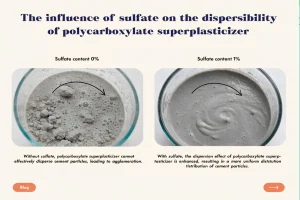
The influence of sulfate on the dispersibility of polycarboxylate superplasticizer
Blog The influence of sul
Product information, specifications & applications — sent directly to your email.
*Your information is kept confidential and will only be used to contact you regarding our products.