Blog
As commonly used admixtures in engineering, retarders can prolong the setting time of concrete, improve the flowability of the concrete mixture, delay the heat release rate of the cement hydration reaction, effectively reduce the bleeding rate of concrete, and thus suppress concrete cracking to a certain extent when added to concrete.
Concrete retarders are mainly divided into two categories: organic retarders and inorganic retarders. Among them, citric acid and sucrose are two commonly used organic retarders, and many researchers have studied their effects on the properties of cement-based materials.
Research has found that adding an appropriate amount of citric acid can delay cement hydration. However, as the citric acid content increases further, the peak time of hydration heat remains almost unchanged. Adding an appropriate amount of citric acid can effectively improve the compressive strength of concrete, while adding sucrose reduces it. Adding an appropriate amount of sucrose can prolong the setting time of concrete. Still, when the dosage exceeds 0.2%, the setting time is rapidly shortened, and the net slurry strength is significantly reduced.
To achieve the extension of concrete setting time while maintaining good mechanical properties of concrete, this paper combines sucrose and citric acid and studies the effects of water-cement ratio, sand ratio, fly ash content, and sucrose-citric acid composite retarder (hereinafter referred to as composite retarder) content on concrete slump, final setting time, and compressive strength through orthogonal experiments. The aim is to provide a reference for applying composite retarders in concrete engineering.
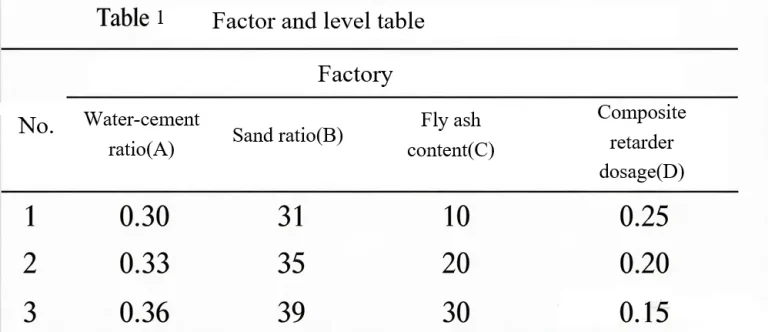
This article adopts an L9 (34) orthogonal experiment. The factor level table is shown in Table 1, and the orthogonal table and concrete mix ratio are shown in Table 2. The dosage of fly ash and composite retarder is expressed as a percentage of their mass in the cementitious material.
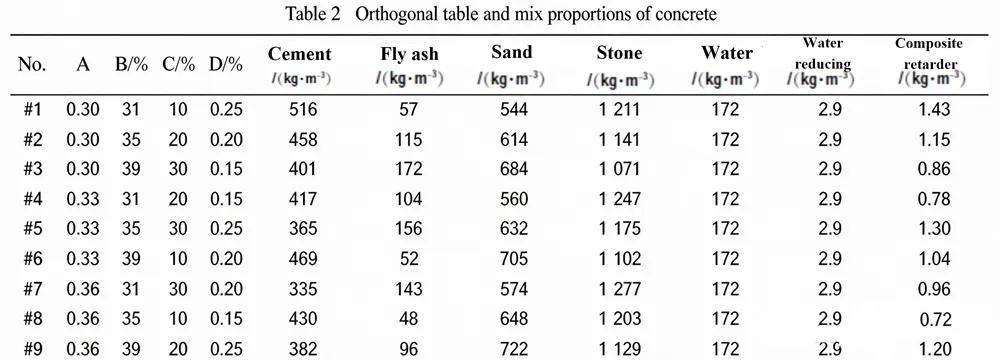
Slump: tested according to GB/T50080-2016 “Standard Test Method for Performance of Ordinary Concrete Mixtures”. Final setting time: tested according to GB8076-2008 “Concrete Admixtures”.
28-day compressive strength: tested according to GB/T50081-2019 “Standard Test Methods for Physical and Mechanical Properties of Concrete”, with a specimen size of 100mm × 100mm × 100mm.
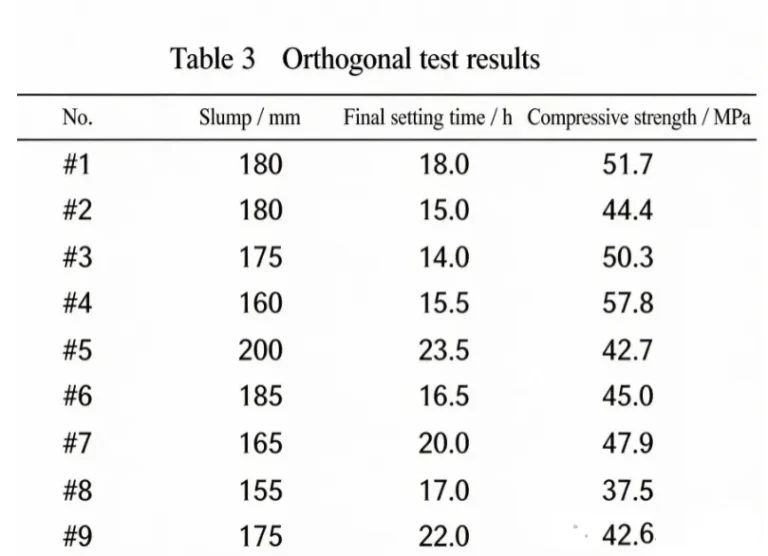
The results of the orthogonal experiment are shown in Table 3.
The range analysis results of concrete slump are shown in Table 4.
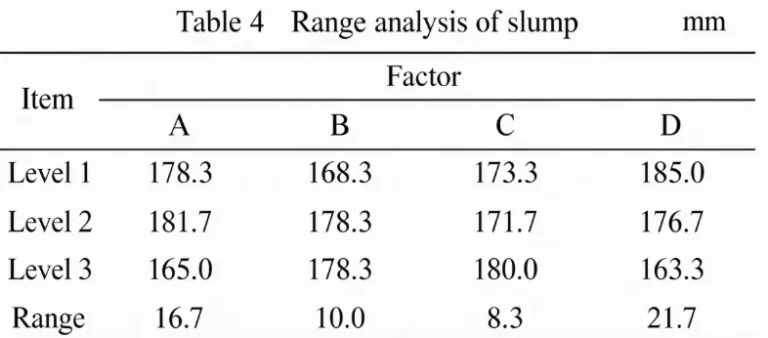
According to Table 4, the order of influence of the various factors on slump is as follows: the dosage of composite retarder, the water-cement ratio, the sand ratio, and the dosage of fly ash. It can be seen that the dosage of composite retarder has the greatest impact on slump, followed by the water-cement ratio, while the dosage of fly ash and the sand ratio have relatively small effects on slump. Among them, as the dosage of composite retarder increases, the concrete slump increases.
When the dosage of composite retarder increases to 0.25%, the slump is 185.0mm, indicating that adding an appropriate amount of composite retarder can improve the fluidity of concrete. As the water-cement ratio increases, the slump of concrete first increases and then decreases. According to Table 4, the optimal combination for maximizing slump is A2B2 (B3) C3D1, with a water-cement ratio of 0.33, sand ratio of 35% or 39%, fly ash content of 30%, and composite retarder content of 0.25%. At this point, the concrete has the highest slump and the best fluidity.
The range analysis results of the final setting time of concrete are shown in Table 5.
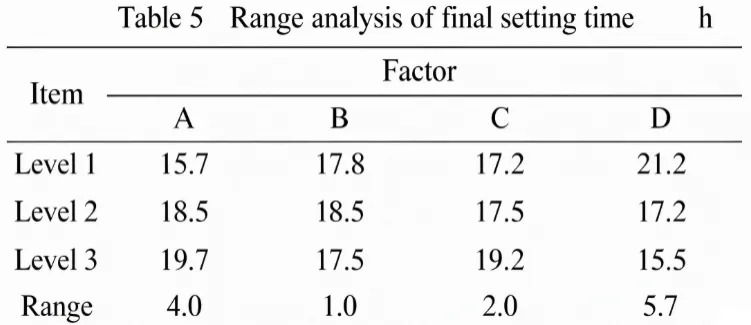
According to Table 5, the order of influence of the various factors on the final setting time is as follows: the dosage of composite retarder, the water-cement ratio, the dosage of fly ash, and the sand ratio. It can be seen that the dosage of composite retarder has the greatest impact on the final setting time, followed by the water-cement ratio. In contrast, the fly ash dosage and sand ratio have a relatively small impact on the final setting time. Among them, as the water-cement ratio and the dosage of the composite retarder increase, the final setting time of concrete increases. According to Table 5, the optimal combination that maximizes the final setting time is A3B2C3D1, with a water-cement ratio of 0.36, a sand ratio of 35%, a fly ash content of 30%, and a composite retarder content of 0.25%. At this point, the concrete has the longest final setting time.
The range analysis results of concrete compressive strength are shown in Table 6.
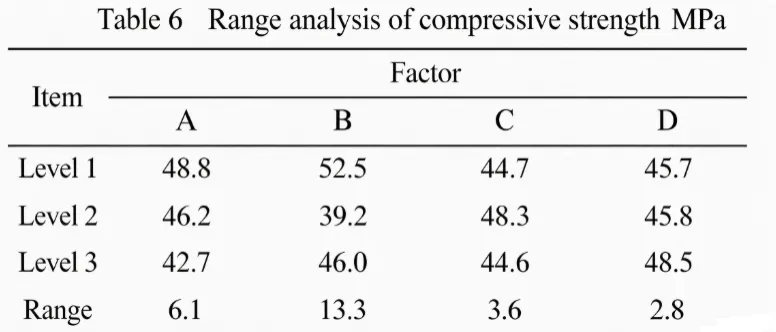
According to Table 6, the order of the influence of various factors on compressive strength is: sand ratio, water-cement ratio, fly ash content, and composite retarder content. It can be seen that the sand ratio has the greatest impact on the compressive strength of concrete, followed by the water-cement ratio. The influence of fly ash and composite retarder dosage on the compressive strength of concrete is relatively small. Among them, as the sand ratio increases, the compressive strength first decreases and then increases.
When the sand ratio is 31%, the compressive strength is highest at 52.5 MPa. As the water-cement ratio increases, the compressive strength decreases. According to Table 6, the optimal combination for maximizing compressive strength is A1B1C2D3, with a water-cement ratio of 0.30, a sand ratio of 31%, a fly ash content of 20%, and a composite retarder content of 0.15%.
(1) As the water-cement ratio increases, the slump of concrete first increases and then decreases, the final setting time is prolonged, and the compressive strength decreases. In practical applications, the appropriate water-cement ratio can be determined according to engineering requirements. For example, for projects with low strength requirements but a long final setting time, a concrete water-cement ratio of 0.36 can be chosen. Conversely, a water-cement ratio of 0.30 can be chosen.
(2) The influence of sand ratio on the slump and final setting time of concrete is relatively small, but it has a significant impact on the compressive strength of concrete. In this experiment, the compressive strength of concrete is highest when the sand ratio is 31%.
(3) When the fly ash content is between 10% and 30%, its effect on the slump, final setting time, and compressive strength of concrete is not significant. Therefore, a higher fly ash content can be selected to reduce the amount of cement used and lower the project cost.
(4) The dosage of composite retarder has a significant impact on the slump and final setting time of concrete. As the dosage of composite retarder increases, the slump of concrete increases and the final setting time is prolonged. However, the dosage of composite retarder has a relatively small effect on the compressive strength of concrete. Therefore, for projects with high liquidity requirements and the need to extend the final setting time appropriately, it is recommended to use a composite retarder dosage of 0.25%.

How to deal with the mildew of polycarboxylate superplasticizer
Blog How to deal with the

How to adjust cement when encountering abnormal situations with water-reducing agents?
Blog How to adjust cement
Product information, specifications & applications — sent directly to your email.
*Your information is kept confidential and will only be used to contact you regarding our products.