
Blog
Blog
Concrete is widely used in various engineering construction projects, and its quality is crucial to the safety of the overall structure; therefore, it is particularly important to thoroughly investigate and effectively control the quality of concrete. The primary cementing material in concrete is cement, the properties of which have a significant impact on all aspects of concrete. Factors such as the composition, temperature and fineness of the cement all influence its compatibility with admixtures.
Cement fresh from the warehouse is typically at a relatively high temperature, generally above 60 °C and sometimes reaching as high as 80 or 90 °C; it must therefore be left to stand and cool before use. In actual concrete production, however, factors such as project schedules, transport conditions and storage often result in the cement arriving on site at a high temperature, whilst during summer construction, the cement cools slowly.
Owing to the numerous factors mentioned above, concrete is sometimes produced using high-temperature cement. This results in excessively high admixture dosages and significant slump loss, whilst also leading to a series of construction issues such as shrinkage cracking. This paper prepares multiple cement specimens at temperatures ranging from 20 to 90 °C and conducts simulation tests on the performance of polycarboxylic acid-based water-reducing admixtures from various perspectives, thereby providing a reference for practical production applications.
Using 300 g of cement, 8 g of water and an admixture dosage of 1.2 per cent, flow tests were conducted on cement slurry at different cement temperatures whilst maintaining the same admixture dosage; the results are shown in Figure 1.
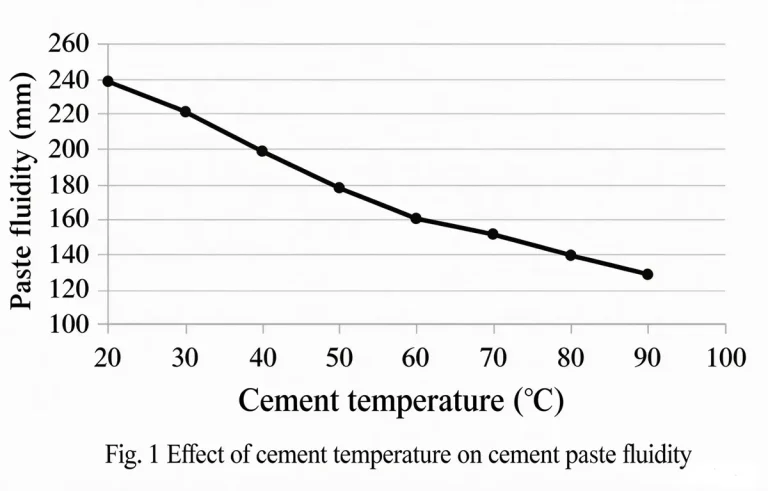
It is clearly evident from Figure 1 that when tested at a cement temperature of 20 °C, the flowability of the cement paste was 240 mm, whereas at a cement temperature of 90 °C, it was only 128 mm. The difference between the two is 112 mm, indicating that the paste has essentially lost its flowability; as the cement temperature rises, the flowability of the cement paste shows a decreasing trend.
As the temperature of the cement rises, the rate of hydration increases, leading to a greater demand for water. This increases the flow resistance of the cement paste, whilst simultaneously reducing its flowability; this is the principle by which the flowability of the cement paste is affected. The faster the early-stage hydration of the cement, the more water is involved in the hydration process, leaving less water available to facilitate the flow of the paste.
Maintaining good concrete workability is key to ensuring the smooth progress of construction. Currently, concrete workability is increasingly dependent on initial flowability and the ability to retain slump over time, which is particularly important for pumped concrete at sites requiring long-distance transport. Therefore, in accordance with the mix proportions of the various materials outlined above, tests were conducted to assess the effect of cement at different temperatures on concrete performance; the results are shown in Table 1.
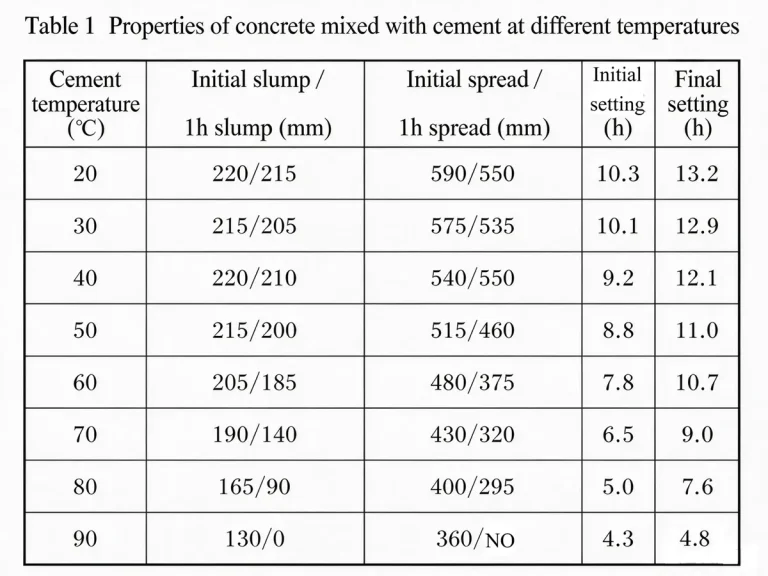
As can be seen from Table 1, the initial slump and spread of concrete decrease to varying degrees as the cement temperature rises; at the same time, the workability of the concrete deteriorates after 1 hour. When the cement temperature is below 40 °C, mechanical mixing using a mixer allows heat to be dissipated through the mixing of different materials, thereby minimising the loss of slump and spread in the concrete when the same dosage of water-reducing agent is used. As the cement temperature continues to rise, the hydration reaction of the cement accelerates, with a large amount of water participating in the reaction.
At the same time, the charge density of the water-reducing agent on the surface of the cement particles decreases, generating repulsive forces in the same direction and increasing the potential energy released by the water; this results in a rapid decline in the concrete’s workability upon discharge from the mixer. When the cement temperature reaches 90 °C, the concrete’s slump upon discharge drops to 130 mm, its flowability is extremely poor, and it loses its ability to retain slump.
Corresponding to the behaviour of the concrete’s workability, the setting time of the concrete also gradually decreases as the cement temperature rises. When the cement temperature reaches 90 °C, the concrete’s final setting time drops to 6.8 hours. Concrete setting is accompanied by the hydration of cement. Polycarboxylic acid superplasticiser molecules, by adsorbing onto the surface of cement particles, slow down the rate of the cement hydration reaction, thereby enhancing the concrete’s ability to retain plasticity. At the same time, the ability of polycarboxylic acid superplasticisers to regulate cement hydration weakens as the cement temperature rises, thereby shortening the setting time of the concrete.
During its service life, concrete is subjected to certain loads; the compressive strength of the cement is directly related to the workability of the concrete, and good workability is essential for ensuring the mechanical properties of the concrete. Therefore, tests were carried out to investigate the effect of cement at different temperatures on the compressive strength of concrete; the results are shown in Figure 2.
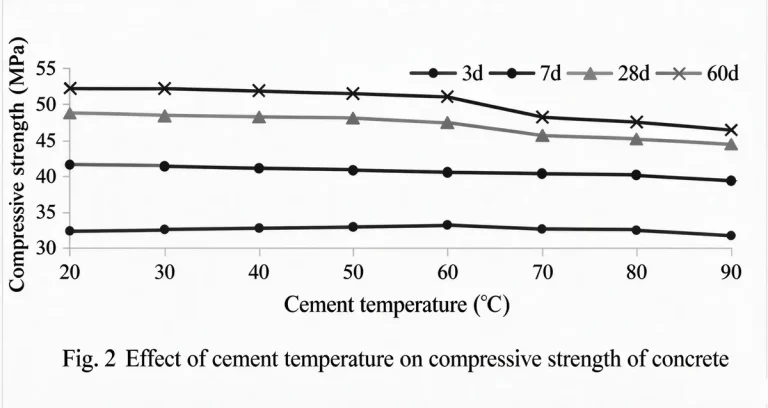
It can be seen from Figure 2 that when the cement temperature is 30 °C, the compressive strength values of the concrete at the specified ages are all higher than those for cement at 20 °C. The 3-day compressive strength of the concrete first increases and then decreases as the cement temperature rises. When the cement temperature ranges from 20 to 60 °C, an increase in temperature accelerates the cement hydration process, producing more hydration products and thereby increasing the early-age strength of the concrete. However, when the cement temperature exceeds 60 °C, the hydration products generated by the rapid short-term hydration reaction form in a disordered arrangement; this leads to an increase in defects within the concrete’s internal structure, such as microcracks and voids, resulting in a reduction in the concrete’s 3-day strength.
The strength of concrete after 7 days is also adversely affected by an increase in cement temperature. When the cement temperature exceeds 30 °C, the 7-, 28- and 60-day compressive strengths of the concrete decrease; when the cement temperature exceeds 60 °C, the impact on the concrete’s later-stage compressive strength is particularly significant, resulting in a marked reduction in compressive strength.
At a cement temperature of 90 °C, the 60-day strength of the concrete was 5.7 MPa lower than at 20 °C.
When a concrete structure is exposed to the air, under certain humidity conditions, the calcium hydroxide produced by cement hydration reacts with gases such as CO₂ in the air, leading to a decrease in the internal alkalinity of the concrete. Carbonation results in a reduction in the durability of the concrete structure and also affects the assessment of the concrete’s strength during rebound hammer testing. A study was conducted on the effect of different cement temperatures on the depth of carbonation in concrete; the results are shown in Figure 3.
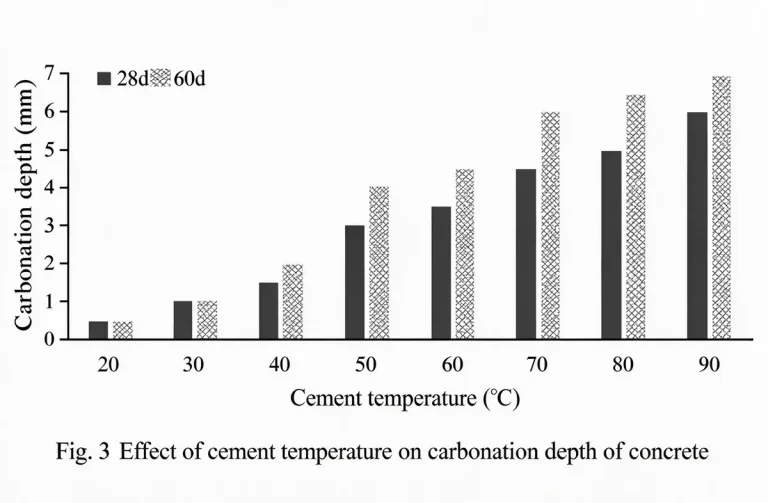
Figure 3 shows the results of a study on the carbonation depth of concrete at 28 days and 60 days, using concrete mixed with cement at different temperatures. The tests revealed that the higher the cement temperature, the greater the carbonation depth at both 28 days and 60 days. Furthermore, when the cement temperature exceeded 60 °C, the carbonation depth at both 28 days and 60 days increased significantly, and the concrete’s resistance to carbonation decreased.
Concrete mixed with high-temperature cement exhibits an increased number of internal structural defects due to the excessively rapid hydration reaction of the cement, thereby creating conditions conducive to CO₂ erosion and consequently leading to an increase in the carbonation depth of the concrete.
(1) As the temperature of the cement rises, the compatibility between the water-reducing agent and the cement tends to deteriorate; the higher the cement temperature, the more pronounced the decline in the flowability of the cement slurry. When the cement temperature reaches 90 °C, the flowability of the cement slurry is reduced by nearly half, causing it to lose its fluidity.
(2) Both the initial slump and spread of concrete decrease to varying degrees following the addition of high-temperature cement during mixing, and the loss of workability over time is also accelerated in concrete after one hour. However, when the cement temperature is below 40 °C, the loss of concrete workability is relatively minor due to heat dissipation during the mixing process. Concrete workability is essentially lost when the cement temperature reaches 90 °C.
(3) As the internal temperature of the cement rises, the hydration reaction accelerates, thereby reducing the slump retention and retarding effects of polycarboxylic acid superplasticisers. This leads to accelerated initial and final setting of the concrete, with the effect being particularly pronounced when the cement temperature exceeds 60 °C.
(4) The compressive strength values of concrete at various ages develop most favourably when the cement temperature is 30 °C. As the cement temperature rises further, the 3-day compressive strength of the concrete initially increases before decreasing. However, from 7 days onwards, the compressive strength decreases when the cement temperature exceeds 30°C; in particular, when it exceeds 60°C, the compressive strength of the concrete decreases significantly.
(5) An increase in cement temperature causes defects in the internal structure of the concrete, leading to a greater or lesser increase in the carbonation depth at both 28 and 60 days, thereby reducing the concrete’s resistance to carbonation.

Concrete retarding accidents caused by improper dosage of admixtures
Blog Concrete retarding a
Product information, specifications & applications — sent directly to your email.
*Your information is kept confidential and will only be used to contact you regarding our products.