Blog
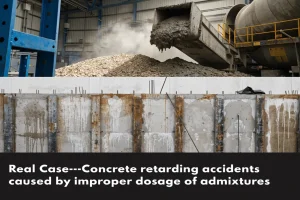
Concrete retarding accidents caused by improper dosage of admixtures
Blog Concrete retarding a
Blog
The construction of concrete engineering is affected by seasons and temperatures, with significant differences between summer and winter construction. When the ambient temperature is below 0 ℃, corresponding measures such as insulation, windproofing, and water loss prevention should be taken for all aspects of the construction process, in order to create a positive temperature curing environment for concrete engineering as much as possible, in order to achieve the goal of continuous solidification, hardening, and strength growth of concrete.
This article focuses on the curing of commercial concrete mixed with antifreeze during winter construction. Through experimental methods, the development trend of bolt strength and the degree of frost damage under different curing conditions are compared, providing direct reference for ensuring project quality and preventing concrete frost damage during winter construction.
According to the general principles of JGJ/T104-2011 “Winter Construction Regulations for Building Engineering”, the winter construction period is divided as follows: “According to local meteorological data for many years, winter construction measures should be taken when the outdoor daily average temperature remains below 5 ℃ for 5 consecutive days; when the outdoor daily average temperature remains above 5 ℃ for 5 consecutive days, winter construction measures should be lifted.
The early frost damage of concrete refers to the negative effects caused by freezing during the curing and hardening period of the poured concrete before it undergoes hydration reaction. The freezing effect during this period is similar to the situation of saturated clay freezing and swelling, where the mixing water freezes and causes the volume of concrete to expand, and the setting process of concrete is interrupted due to the freezing of the mixing water. At this point, the strength loss of frozen concrete is the greatest, as the expansion associated with capillary water freezing will severely damage the internal structure of the concrete, resulting in irreversible strength loss. It will reduce a series of physical and mechanical properties of concrete, resulting in concrete not meeting design requirements, thereby affecting engineering applications and reducing durability. The most significant impact is on the compressive strength of concrete.
It can be seen that the occurrence and degree of development of early frost damage to concrete are related to the following conditions:
The commercial concrete mixture is sampled from the same tank truck, and the mold is assembled, vibrated, and formed using a flow operation mode, striving for uniform specimen structure. The molding test mold is a cubic plastic test mold with a specification of 100x100x100mm.
Simulation condition 1: After the specimen is made, it is placed in an uncovered natural environment while monitoring the ambient temperature.
Simulation condition 2: After the specimen is made, a layer of wooden board is laid on the bottom surface, and the surface of the specimen is sequentially covered with a layer of PVC plastic film and a layer of cotton felt. Surface temperature measurement is taken on the specimen under the covering layer for the first 7 days to ensure that it is at a positive temperature for curing. After 7 days, the insulation measures are removed, and then the simulation conditions are the same.
According to the industry standard “Winter Construction Code for Building Engineering” (JGJ/T104-2011), the early frost critical strength is divided into two types: ordinary concrete without admixtures and concrete with admixtures. For concrete with admixtures, when the lowest outdoor temperature is below -15 ℃, the early frost critical strength shall not be lower than 4MPa.
Simulation condition 1: The specimen is not insulated. The critical strength for freezing was reached in 3 days, with the lowest ambient temperature measured being -5 ℃ in the first 3 days, 12.4MPa at 7 days, 17.7 MPa at 28 days, and 21.6 MPa at 60 days. The strength growth at each critical age was slow. From the perspective of strength design, the strength at 60 days no longer meets the design requirements. Based on the measured strength of the bolt itself, the strength growth is relatively slow with the increase in ambient temperature in the later stage. The strength of the specimen only increased by 3.9 MPa from 28 days to 60 days. This indicates that before reaching the critical strength for freezing in 3D, the bolt has already suffered local freezing damage, resulting in significant loss of strength in the later stage.
Simulation condition 2: Insulation measures are taken on the specimen to ensure that the surface temperature of the specimen is above the normal temperature (this test temperature is 0.7 ℃~11.8 ℃). At 2 days, the critical strength for freezing is reached; at 7 days, it reaches 16.8 MPa; at 28 days, it reaches 28.5 MPa; and at 60 days, it reaches 3O.8MPa. The strength increases rapidly at each critical age, meeting the design strength requirements. In natural environments, temperatures below -5 ℃ were encountered on the 11th day, and the lowest temperature encountered (-5.8 ℃) was on the 15th day. However, the strength still met the measured strength requirements of concrete in the later stage. After curing the specimen to the critical strength of freezing, further strengthening by positive-temperature curing for 7 days can resist frost damage at around -5 ℃, and the later strength can meet the quality requirements of the concrete itself.
In winter construction of concrete engineering in cold regions, corresponding insulation and curing measures must be taken. Anchors that are severely affected by freezing cannot recover a large amount of lost strength through later heating. On the other hand, spending a lot of workforce, material resources, and funds to completely prevent concrete from freezing during the molding process is also not in line with practical engineering needs.
Therefore, for winter construction, sufficient preparation should be made, and appropriate maintenance plans should be designed to reduce maintenance consumption while ensuring the quality of concrete engineering.
I hope this article can provide some reference for concrete curing work in engineering construction in the Xi’an area, allowing early freezing of concrete at a certain age and strength without damaging its performance, and meeting the design and use requirements.
Concrete retarding accidents caused by improper dosage of admixtures
Blog Concrete retarding a

Exploration of compatibility between polycarboxylate superplasticizer and retarding components
Blog Exploration of compa
Product information, specifications & applications — sent directly to your email.
*Your information is kept confidential and will only be used to contact you regarding our products.