
Blog
Blog
Underwater non-dispersed concrete is the most commonly used material for quick repairs to bridges, port engineering, hydraulic engineering, and other water-related projects. Compared with traditional concrete, it mainly improves the viscosity of concrete mixtures by adding coagulants, which helps ensure that concrete does not separate when in contact with water and that cement does not lose its properties, enabling direct pouring in water with strong anti-dispersion properties.
In addition, due to its vibration-free, self-compacting, and self-leveling characteristics, underwater non-dispersing concrete can meet the requirements of underwater construction, greatly simplifying the technical process and significantly shortening the construction period. This material offers significant advantages for repairing underwater concrete structures, as it can address challenges in special underwater structures, such as irregular shapes, narrow sections, and thin walls that ordinary methods cannot repair.
Extensive practice has shown that this type of concrete has rapid slump loss, and that mix design and raw material selection significantly affect self-compaction and self-leveling. Its mechanical properties are unstable, its strength is low, and its durability and volume stability are poor. There are also many defects in engineering use. To further improve the performance of underwater non-dispersive concrete, many scholars have conducted extensive research, such as HORSZCZARUK, who added a large amount of fly ash to underwater non-dispersive concrete. The results show that adding 40% fly ash has minimal strength loss and good workability;
MUNOZ et al. found that adding appropriate amounts of silicon powder and other admixtures can enhance the strength and anti dispersion of underwater non dispersive concrete; SAKUTA et al. believe that adding ammonium polyacrylate, glutaraldehyde, and flocculants to concrete can reduce the amount of polymer by 0.8%, improve the dispersibility of the mixture, and not have adverse effects on strength; Feng Aili et al. found through comprehensive comparison of the effects of different coagulants on the performance of underwater non dispersive concrete that the 28 day strength of concrete with cellulose based coagulants is lower than that of concrete with acrylic based coagulants, but it has better flowability;
Feng Shiming and others believe that anti-dispersants such as propylene and cellulose series, which have retarding effects, are beneficial for improving the construction performance of large volume concrete; Chen Guoxin et al. compared the effects of different types of water-reducing agents on the water consumption, compressive strength, flowability, and retention capacity of concrete. The results showed that concrete with a polycarboxylate superplasticizer performed better in all aspects. At present, domestic and foreign research mainly focuses on strength and anti-dispersion ability. Due to the inability to meet the minimum requirements for self-compaction in terms of fluidity, underwater pouring usually requires the use of pipe-pumping construction, and the strength of concrete formed and hardened underwater fluctuates with changes in the thickness of the permeable layer and pouring method. Practical engineering promotion and application are limited, and underwater construction of large-section concrete, such as horizontal long-distance flow and channel lining plates, cannot be carried out.
In view of this, this article will add an admixture composed of a retarder, a high-efficiency aminosulfonate water reducer, and a water-soluble polymer to underwater non-dispersing concrete. The effects of the admixture on the flowability loss, cohesion, and pumpability of the mixture over time will be tested and analyzed, providing technical support for the preparation of non-vibrating, self-compacting, and self-leveling water-entering concrete, effectively solving the problems of rapid loss, easy segregation, and dispersion in underwater construction of concrete.
Cement: Huaxin P·O 42.5 grade cement
Aggregate: Granite artificial sand and gravel aggregate, artificial sand fineness modulus 2.8, stone powder content 12.0%, apparent density 2660kg/m3, water absorption rate 1.05%, gravel particle size 5- 20 mm, water absorption rate 0.81%, apparent density 2680kg/m3, crushing index 7.2%, needle-like content 4.6%. After testing, the main performance indicators of the sand and gravel meet the relevant requirements of the “Test Specification for Hydraulic Concrete”.
Admixtures: The experiment uses chemically pure sodium tripolyphosphate, an aminosulfonate high-efficiency water-reducing agent, and a water-soluble polymer as a composite admixture, and the mixing water is tap water.
Conduct tests on cement mortar flowability, concrete slump, and expansion in accordance with the “Test Code for Underwater Undispersed Concrete” and the “Technical Code for Hydraulic Self-Compacting Concrete”. According to the “Test Code for Hydraulic Concrete”, the main process for determining the compressive strength of specimens is as follows:
Place the 150mm × 150mm × 150mm pre formed test mold into a 600mm × 600mm × 1600mm water tank in a standard curing room with a relative humidity of ≥ 90% and a temperature of (20 ± 2) ℃, control the distance between the test mold and the water surface to be about 100mm, and the water temperature to be (20 ± 1) ℃. Pour the uniformly mixed, non-dispersing concrete underwater into the water test mold from the water surface. Maintain continuous feeding, adding slightly more material than the mold volume. Remove it from the water and let it sit for 5-10 minutes. After self-compacting and self-leveling, the mixture should be stable.
To speed up drainage, lightly tap both sides of the trial mold and then place it in water. Before initial setting, use a spatula to scrape off the excess, let it stand for 48 hours, remove the mold, and place it in water for standard curing until the specified age for strength testing.
The pH value method is used to determine the dispersibility of concrete. The test procedure is as follows: take two beakers and add the same mass of water to each. Pour the same mass of underwater non-dispersing cement mortar onto the water surface to allow it to fall freely and slowly. After the beakers have stood for 30 minutes, use a straw to collect an appropriate amount of water and immediately test the pH value with an acidimeter. Starting from another beaker, place cement mortar as the starting time, and test the pH of the water at 2/3 depth every 5 minutes using an acidity meter. The total testing time is 30 minutes, and observe the pH change pattern of the cement mortar aqueous solution.
Time loss and liquidity. Transportation and pumping are essential steps in constructing and pouring freshly mixed underwater non-dispersing concrete, and flowability directly determines the degree of pumpability. Practice has shown that the flow state of concrete is mainly reflected in the flowability of cement mortar. Using the flowability of cement mortar to determine the dosage of thickening agents, water-reducing agents, and the water consumption of mortar can scientifically and accurately describe the mixture’s flow performance. Therefore, flowability testing not only reflects the anti-dispersion, cohesion, and water retention of admixtures, but also guides the rational design of underwater non-dispersing concrete mix proportions. The mix proportion and initial flowability of the adhesive sand test are shown in Table 1, and the characteristics of loss changes over time are shown in Figure 1.
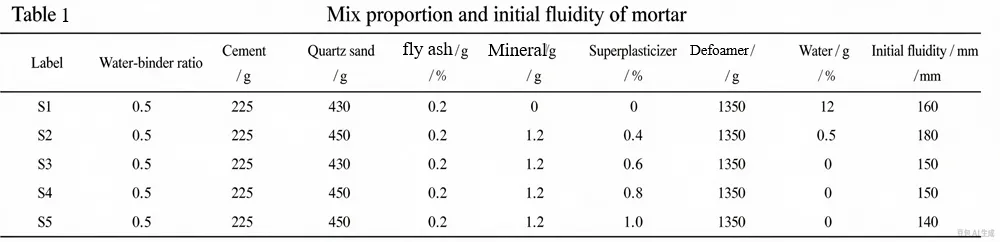
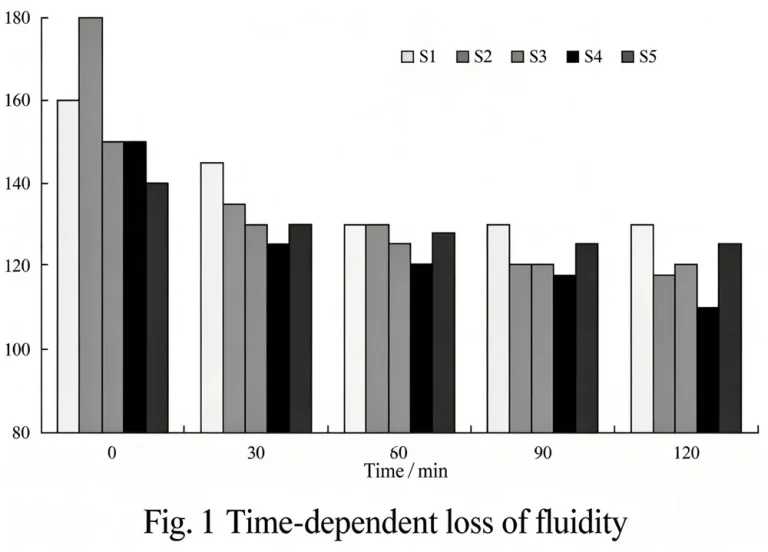
The results showed that the S2 group cement mortar had the highest initial flowability, indicating that adding a certain amount of thickening agent can improve flowability; however, this group also showed a significant loss of flowability. The initial flowability gradually decreases as the amount of thickening agent increases, indicating that the thickening agent can effectively improve the dispersibility and cohesiveness of the adhesive sand.
The slowest loss over time from uniform mixing to within 2 hours is observed in the S5 group of cement mortar, indicating that adding an appropriate amount of thickening agent can reduce flowability loss in non-dispersed water mortar over time. This is because adding thickening agents improves mortar cohesiveness, which increases with increasing dosage. Due to the binding effect of the water-soluble polymer on mixing water, it helps ensure that the cement slurry does not disperse, segregate, or bleed underwater. The synergistic effect of adding a certain amount of thickening agent, retarder, and aminosulfonate water reducer reduces loss of flowability over time, improves flowability, and increases cohesiveness.
Anti-dispersibility. Anti-dispersibility is an important indicator that reflects whether the cement slurry can disperse into water and measures the bonding ability of the thickening agent; it is also known as anti-water-washing ability. A thickener is a non-ionic polymer with a long chain structure that can connect or overlap cement particles, causing significant changes in the contact surface between particles. By combining with mixing water and hydrogen bonding, polymer molecules disperse in water to form a highly viscous slurry that wraps around aggregates and cement particles, thereby ensuring anti-dispersion and cohesion of the cement slurry. The pH value change characteristics of mortar after entering water were tested using an acidity meter, as shown in Figure 2.
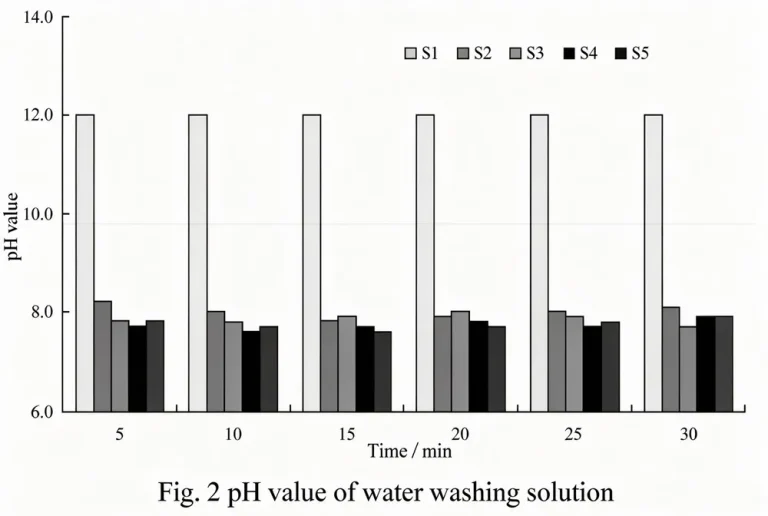
The results showed that the S1 group of cement mortar without water-reducing agent and thickening agent had the highest pH value in the environmental water. At 5 minutes into the experiment, this group’s pH was 12, indicating faster hydration and dispersion. This suggests that concrete without a thickening agent is generally not suitable for underwater engineering pouring. The pH value of the environmental water in the S2-S5 groups of cement mortar mixed with non-dispersing agents was maintained below 9, and the pH value did not change significantly over time. This indicates that the amount of cement dispersed from the mortar to the environmental water is relatively small, and the solution pH is less affected by cement hydration. This result clearly shows that the compounded additive has a good cohesive effect. When the viscosity enhancer is increased from 0.4% to 1.0%, the pH value of the environmental water remains basically unchanged, and the dosage range meets the relevant specifications.
Considering factors such as cohesiveness, flowability, and the cost of underwater non-dispersive concrete, the optimal dosage range for the thickening agent is determined to be 0.6% to 0.8%.
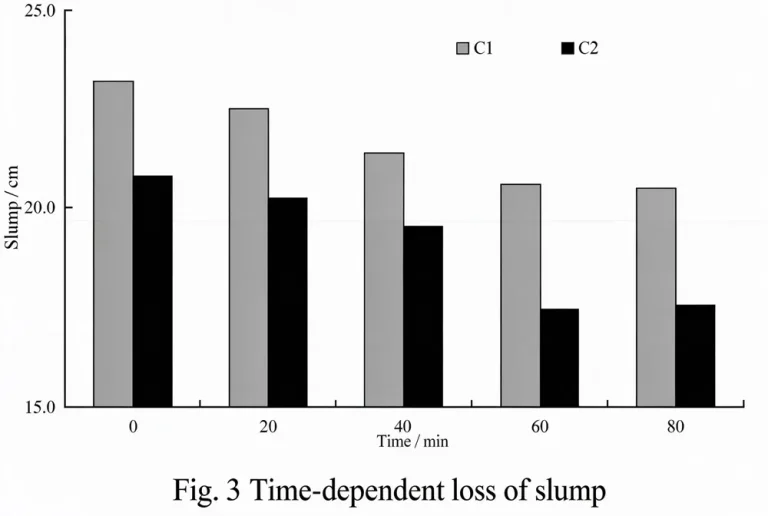
The water-to-cement strength ratio refers to the strength ratio of the same-component concrete formed underwater and in air at the corresponding age, which is the main parameter reflecting the performance of hardened concrete. The slump loss, water-to-cement strength ratio, and test mix of underwater non-dispersive concrete are shown in Table 2, Table 3, and Figure 3.

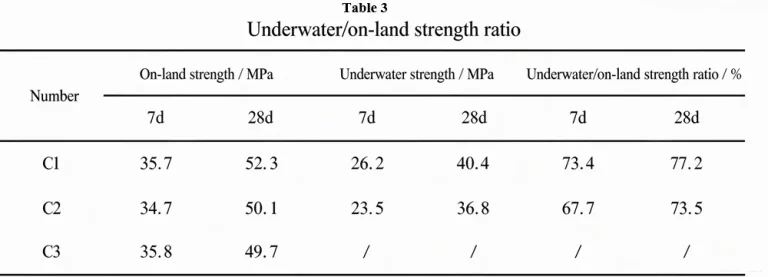
The results showed that the 7-day compressive strength of the C1 and C2 groups with added thickening agents was basically the same as that of the C3 group without added thickening agents, and the 28-day compressive strength slightly increased, indicating that the water retention effect of thickening agents is beneficial for improving the strength of underwater non-dispersive concrete. The 7-day strength ratios of C1 and C2 concrete poured underwater and above water are 73.4% and 67.7%, respectively, and the 28-day strength ratios are 77.2% and 73.5%, respectively, which comply with current regulatory requirements. Through comparative analysis, it can be concluded that adding an appropriate amount of thickening agent can improve the strength of underwater poured concrete.
According to the time-loss and flowability test data, the C1 group concrete, with better expansion, also has lower slump loss over time and can meet the requirements for transporting and pumping underwater non-dispersing concrete. Moreover, the 7-day and 28-day strength of the C1 group concrete poured underwater is higher than that of the C2 group, indicating that the C1 group mix proportion can be prioritized when preparing underwater non-dispersing concrete.
The main difference between water pouring and underwater pouring is whether the surrounding water disperses the mixture during the forming process, which also affects concrete compactness. Underwater pouring can cause significant strength loss. In this experiment, scanning electron microscopy was used to analyze the pore structure of C1 group concrete after 28 days of standard curing for both above-water and underwater pouring methods, as shown in Table 4.
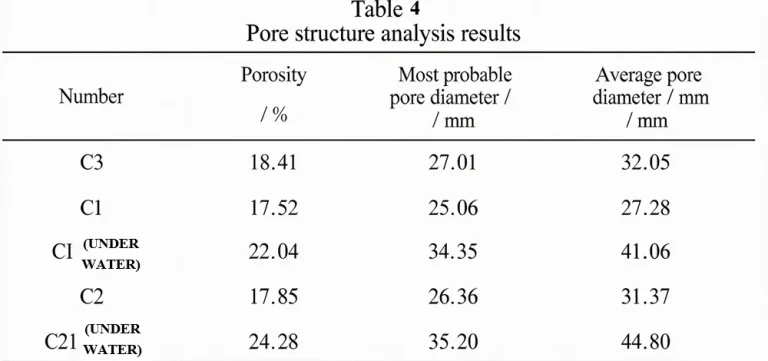
The results indicate that although the addition of admixtures can significantly reduce concrete dispersion during underwater pouring, the porosity of underwater-poured concrete is much higher than that of concrete poured above water, and the addition of compound admixtures also significantly increases the most frequent pore size. From a micro perspective, concrete poured above water is fully hydrated, with more gel distributed inside and a relatively dense cement-based structure. In contrast, the gel content in underwater-poured concrete is relatively small. Needle-like columnar ettringite crystals are distributed in the pores with a loose structure. The addition of additives increases the porosity of concrete, providing space for the growth of Ca(OH)2 crystals, and adversely affects the development of concrete strength.

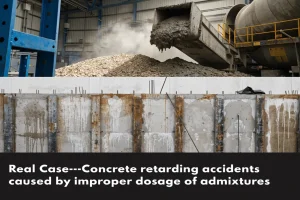
Concrete retarding accidents caused by improper dosage of admixtures
Blog Concrete retarding a
Product information, specifications & applications — sent directly to your email.
*Your information is kept confidential and will only be used to contact you regarding our products.