Blog
Blog
The polycarboxylate superplasticizer is a third-generation, high-performance water reducer developed after the first-generation water reducer represented by wood ash and the second-generation water reducer represented by the naphthalene series. It has excellent properties, such as high water reduction, high slump retention, and super dispersibility and super stability. Its characteristics include low slump loss at high temperatures, good flowability, no need to increase the amount of water-reducing agent significantly at lower temperatures, a certain amount of air intake, and environmental friendliness. It basically meets the performance requirements of water-reducing agents for concrete engineering, especially high-performance concrete. It has become an updated replacement for second-generation high-efficiency water-reducing agents, such as the naphthalene and melamine series.
However, polycarboxylate superplasticisers also have some application problems, such as adaptability issues with cement, relatively high application costs, and difficulty or even insolubility with other types of superplasticisers. Therefore, compounding retarders into polycarboxylate superplasticizers can reduce the application cost of high-performance polycarboxylate superplasticizers while maintaining their high water reduction rate, improving their adaptability to cement, and further reducing slump loss; this determines the compounding ratio of polycarboxylate superplasticisers.
Polycarboxylate superplasticizer themselves can maintain fluidity and do not require auxiliary effects. However, to meet concrete setting time requirements in engineering, a combination of polycarboxylate and retarder is generally used to achieve the desired effect. Mixing an appropriate amount of retarding components into polycarboxylate superplasticiZers can effectively prolong the setting time of concrete, reduce slump loss, and help ensure that normal concrete construction meets the required setting time while improving work efficiency.
The chemical test reagents and various raw materials used in this experiment are as follows:
Cement slurry flowability test: conducted in accordance with GB/T 8077-2000 “Test Method for Homogeneity of Concrete Admixtures”.
The determination test of retarding time shall be conducted in accordance with GB 8076-1997 “Concrete Admixtures”.
The above experiments were conducted at room temperature (22 ℃, 72% RH).
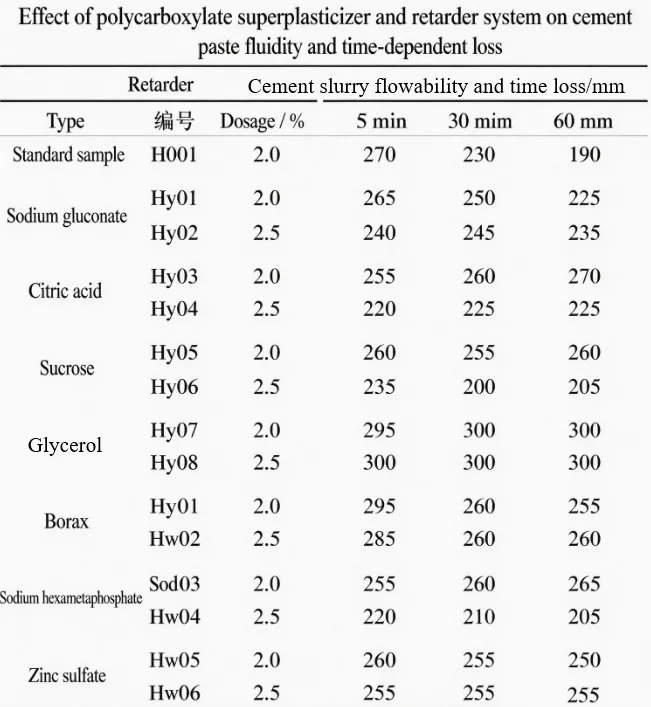
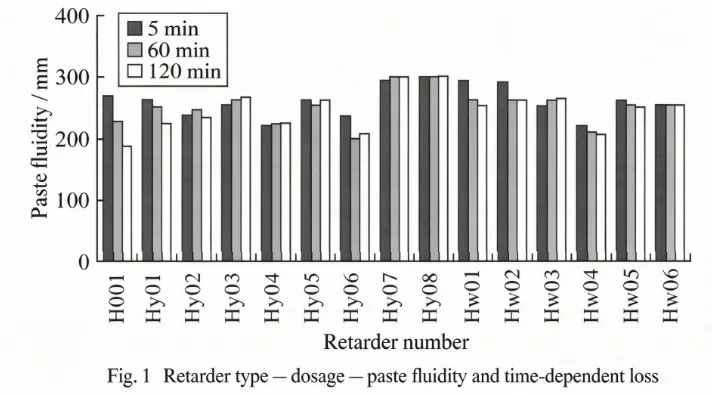
To test the compatibility of polycarboxylate superplasticisers with different retarders, a test was conducted. Following the flowability test method for cement slurry, the water-cement ratio was set to 0.29. The experiment used the Southern Cement Code N to test the effects of different types and dosages of retarders (calculated as percentages of cement mass) on the flowability and time loss of different cement slurries. The results are shown in Table 1 and Figure 1.
The standard sample in the experiment is polycarboxylate water reducer, and the rest is mixed with polycarboxylate water reducer mother liquor at different dosages. Among them, the solid content of polycarboxylate water reducer is 40%, and the dosage of polycarboxylate water reducer mother liquor and retarder after compounding is 0.25% of the cement mass.
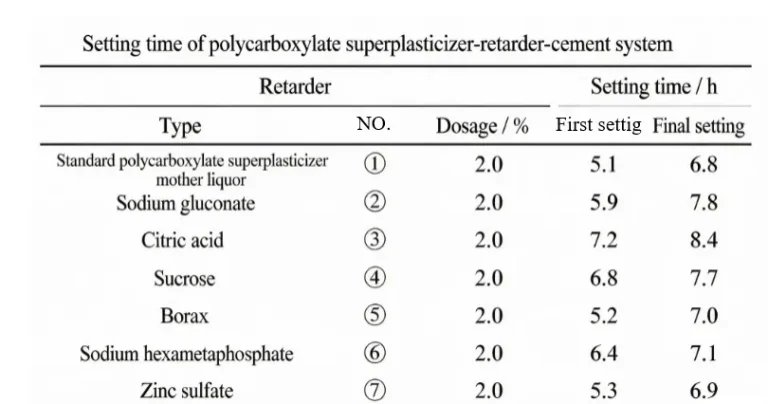
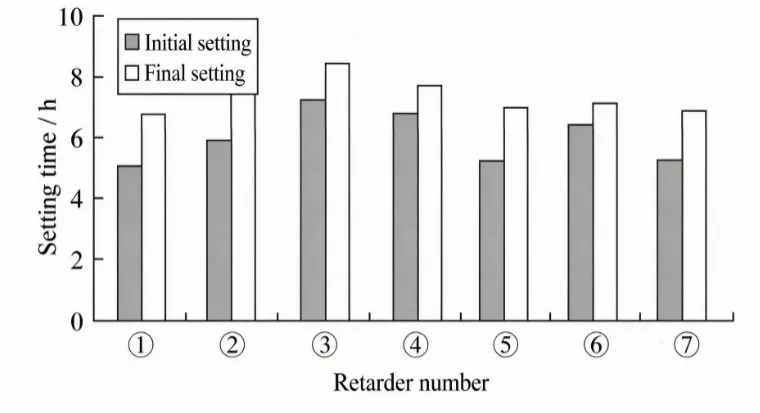
The effects of different retarder components combined with polycarboxylate superplasticiser on cement setting time are shown in Table 2 and Figure 2, with a dosage of 0.25% polycarboxylate superplasticiser and dosages of 2.0% and 2.5%, respectively.
The effect of organic retarders on the flowability and loss over time of polycarboxylate superplasticizer slurry
From Figure 2, it can be seen that adding polycarboxylate superplasticiser alone to N cement gives high initial flowability and relatively small loss over time, indicating good compatibility between the two. Adding 2.0% sodium gluconate improved the net slurry flowability and time loss of the cement slurry. As the dosage increased, the loss decreased, but flowability decreased significantly. The trends for citric acid and sucrose are basically consistent with those of sodium gluconate.
The effect of inorganic retarders on the flowability and loss over time of polycarboxylate superplasticizer slurry
From Figure 2, it can be seen that changes in the dosage of borax, zinc sulfate, and sodium hexametaphosphate are similar to those of organic retarders, which improve flow and reduce cement slurry loss. However, as the dosage increases, the flowability decreases.
This indicates that, in terms of improving slurry flowability and reducing flowability loss, the compatibility between citric acid, zinc sulfate, and polycarboxylate superplasticiser is poor when using P·O42.5 grade cement in the experiment. However, retarders such as sodium gluconate, sucrose, sodium hexametaphosphate, and borax show good compatibility with the polycarboxylate superplasticiser. After adding a retarder composite, not only can the initial flowability of the slurry be improved, but the 1-hour loss of the slurry is also reduced, which helps improve the workability of concrete.
However, as the retarder dosage increases, the loss decreases, and the slurry flowability decreases; there is an optimal dosage range for each retarder. Sodium gluconate and borax have better effects, while sucrose has a certain retarding effect and is sensitive to dosage. However, due to its wide range of raw materials and low price, it is widely used. The retarding effect of propylene glycol is very strong, significantly affecting cement hydration and even causing it to stop hydrating.
According to Figure 2, the addition of polycarboxylate superplasticiser can significantly prolong the setting time of cement slurry, with an initial setting time extension of 115% to 142% and a final setting time extension of 56%; after adding a retarder to polycarboxylate superplasticiser, the extension of cement setting time is greater.
Different types of retarders have varying degrees of extension in the setting time of cement slurry. Among them, the combination of sucrose, citric acid, and sodium hexametaphosphate in organic retarders with polycarboxylate superplasticizer has a significant retarding effect. Compared with samples containing only polycarboxylate superplasticizer, the initial setting time is extended by about 2 hours.
However, the retarding effect of the borax-polycarboxylate superplasticiser composite is not significant. Compared with the sample containing only polycarboxylate superplasticizer, the initial setting time is extended by 0.2 hours. This indicates that, in terms of delaying the setting time of cement slurry, the compatibility between borax and polycarboxylate superplasticiser is poor when using P·O42.5 grade cement in the experiment. In contrast, the compatibility between sodium gluconate, sodium hexametaphosphate, sucrose, and citric acid and polycarboxylate superplasticiser is ideal.
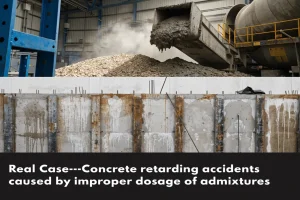
Concrete retarding accidents caused by improper dosage of admixtures
Blog Concrete retarding a
Product information, specifications & applications — sent directly to your email.
*Your information is kept confidential and will only be used to contact you regarding our products.