Blog
Continuously graded concrete mixes different particle sizes in proportion, providing a strong, workable mix that is less prone to bleeding and segregation. Large-particle sand acts as a skeleton, while fine-particle sand fills the gaps. When bonding materials work together, concrete performance improves. The higher the fineness modulus, the more likely segregation and bleeding are; conversely, it can make water control harder and affect strength.
Research shows that the larger the fine aggregate’s fineness modulus, the smaller its specific surface area and the lower the concrete’s water retention. Studies also indicate that the appearance and texture of fine aggregate particles significantly affect concrete workability. As mud content increases, cement mortar flowability decreases.
This article investigates how sand with different fineness moduli affects the flowability of adhesive sand under continuous grading. Further, it determines the influence law of fineness modulus on the water reduction rate.
Sand with different fineness moduli significantly affects concrete, and its binding state with water differs significantly. As the fineness modulus of sand increases, the specific surface area of particles decreases. Without changing other materials, the amount of cement slurry required to wrap these sands decreases, resulting in a higher and thinner flowability of the binder sand. By reducing water consumption appropriately, the mortar can reach the benchmark flowability of (180 ± 5) mm.
In this article, we conducted experiments using river sand with fineness moduli of 1.9, 2.6, and 3.4 at a sand-to-cement ratio of 3:1. We kept the water reducer type, dosage, and cement content constant. We classified the types of water reducers as W1-W7.
After mixing these 7 water-reducing agents with cement C1, the cement paste reached a significant saturation point. After 30 minutes, the minimum loss of flowability of the cement slurry is 0, and the maximum is 25mm for the W4 water reducer. After 60 minutes, the minimum loss of flowability of the cement slurry is 0, and the maximum is 30mm for the W4 water reducer. This indicates that the compatibility between the W4 water reducer and cement C1 is relatively poor compared to other water reducers.
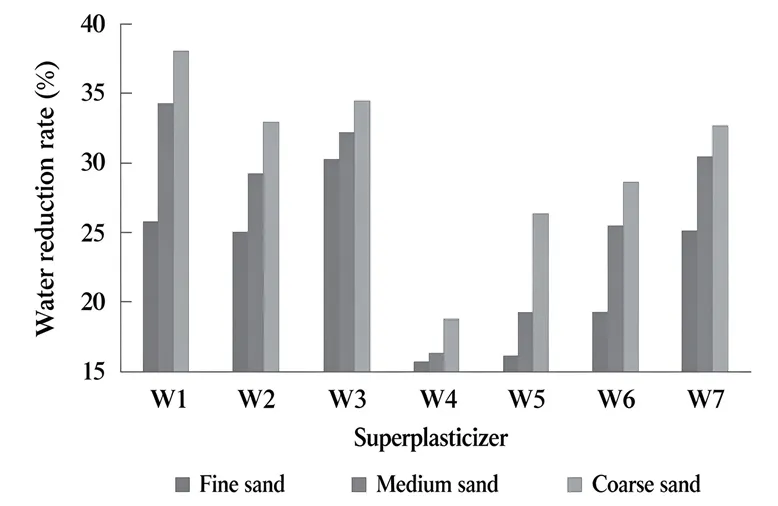
Figure 1 shows the influence of sand thickness on the water reduction rate, and the W4 water reducer achieves a very low water reduction rate. This is due to the poor compatibility between the W4 water reducer and C1 cement shown in Table 1. This indicates that compatibility between water-reducing agents and cement also significantly affects mortar water reduction.
At the same sand-to-cement ratio (3:1), as the sand fineness modulus increases, the water reduction rate generally increases, but the magnitude of the increase varies. As the sand fineness modulus increases, water consumption decreases continuously when the binder flowability reaches (180 ± 5) mm.
As the ratio of sand to cementitious material (i.e., sand-cementitious ratio) increases, the amount of cementitious material used to wrap sand particles tends to decrease, and the thickness of the cement slurry on the surface of the sand particles becomes thinner. When it exceeds a certain limit, these slurries are not sufficient to isolate the sand particles and cannot fully exert their lubricating effect, which will lead to a decrease in the fluidity of the mortar. The results showed that flowability decreased as the sand-cementitious ratio increased. There are also studies showing that when the amount of cement used changes, the measured water reduction rate of the water reducing agent will also undergo significant changes. These research results are consistent with those obtained in this experiment.
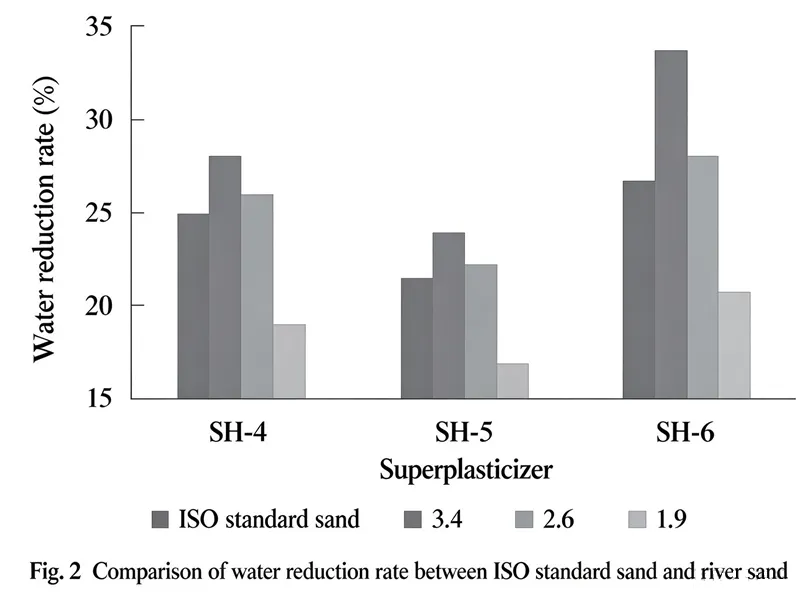
Figure 2 shows that when the fineness modulus of river sand is 2.6, the measured water reduction rate of the water-reducing agent is close to that obtained using standard sand. When the fineness modulus of river sand is less than or greater than the standard sand fineness modulus (1.9 and 3.4), the measured water-reduction rate of the water-reducing agent differs from that of the standard sand mortar group. Accordingly, in this experiment, other raw materials were kept unchanged, and sand-cement ratios were adjusted to match the fineness modulus of the different sands. The measured water-reduction rate of the water-reducing agent was generally consistent with that for ISO standard sand.
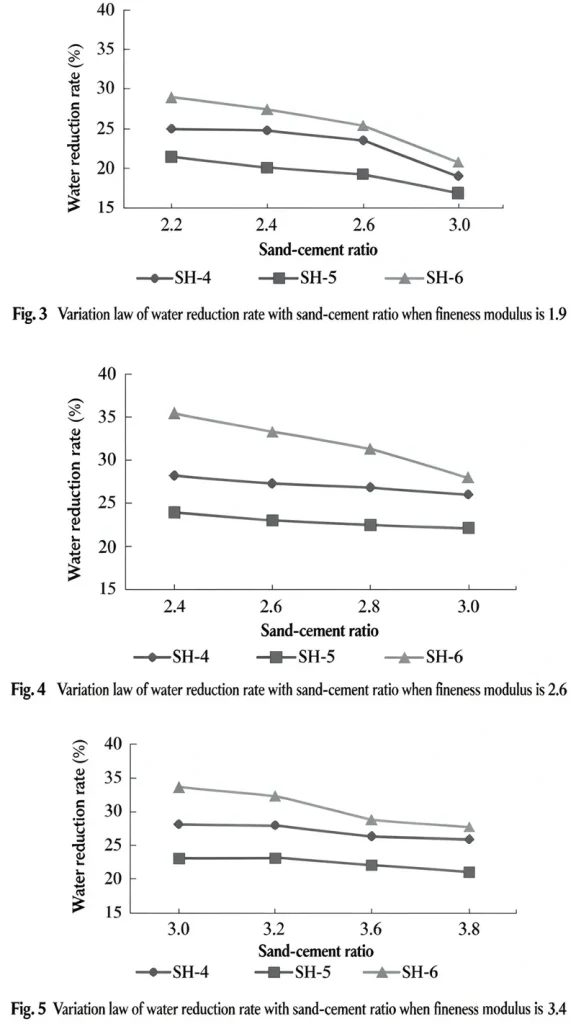
Figures 3-5 show how the water reduction rate varies with sand-cement ratio for sands with different fineness moduli. Among them, the water reduction rate of river sand with a fineness modulus of 1.9 was measured at sand-cementitious ratios of 2.2:1, 2.4:1, 2.6:1, and 3.0:1; The water reduction rate of river sand with a fineness modulus of 2.6 was measured at sand-cementitious ratios of 2.4:1, 2.6:1, 2.8:1, and 3.0:1; The water reduction rate of river sand with a fineness modulus of 3.4 was measured at sand-cementitious ratios of 3.0:1, 3.2:1, 3.6:1, and 3.8:1.
As the sand-cementitious ratio increases, the water reduction rates of SH-4, SH-5, and SH-6 water reducers decrease by 6.0%, 4.6%, and 8.2%, respectively, when the fineness modulus is 1.9; When the fineness modulus is 2.6, the water reduction rates decrease by 1.9%, 1.8%, and 7.5%, respectively; When the fineness modulus is 3.4, the water reduction rates decrease by 1.9%, 2.0%, and 5.9%, respectively. From this, it can be concluded that at the same fineness modulus, SH-6, which has a higher water reduction rate, has a higher change in water reduction rate than the other two water reducing agents as the sand cementitious ratio changes.
When the fineness modulus is 1.9, 2.6, and 3.4, the water reduction rate of SH-4 water reducer decreases by 6.0%, 1.9%, and 1.9% respectively with the increase of sand cementitious ratio; SH-5 water reducing agent reduced by 4.6%, 1.8%, and 2.0% respectively; The water reduction rates of SH-6 water reducer decreased by 8.2%, 7.5%, and 5.9%, respectively. Thus, under the same water-reducing agent, the fineness modulus of 1.9 shows a greater change in water reduction rate with changes in the sand-to-cement ratio than the other two fineness moduli. When the fineness modulus is 3.4, the change in water reduction rate is minimal.
The experimental results show that as the sand-cementitious ratio increases, the water reduction rate of the water-reducing agent changes. Overall, the water reduction rate decreases as the sand-cementitious ratio increases.
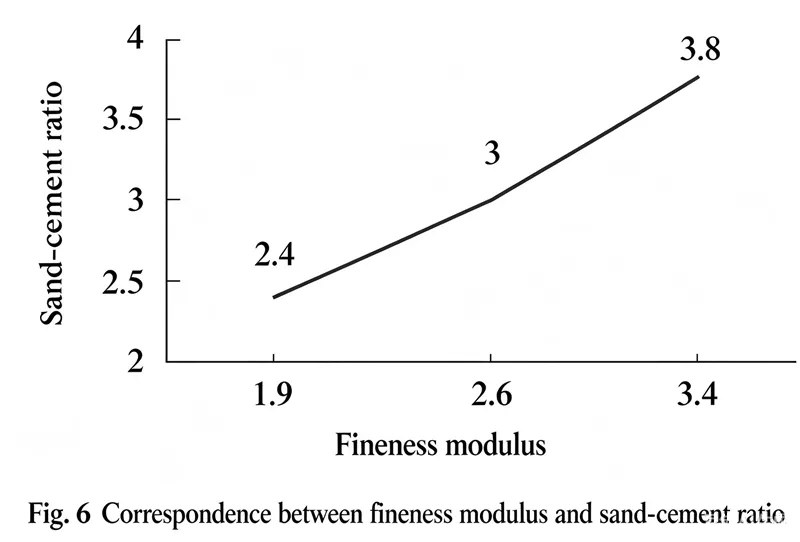
By comparing these experimental results with the water-reduction rate determined by the national standard sand-cement method, the optimal sand-cementitious ratio for different fineness moduli of river sand can be obtained. The line in Figure 6 represents the optimal sand-cementitious ratio for river sand with different fineness moduli. The water reduction rate determined using river sand at this sand-cementitious ratio is consistent with the water reduction rate determined by the national standard sand-cement method, within the project’s allowable error range.
The line in Figure 6 can provide a reference for estimating the appropriate cementitious sand ratio for river sand with different fineness moduli. When using river sand to determine the water reduction rate, use only the sand’s fineness modulus to determine the required sand-to-cementitious ratio for that fineness modulus, thereby quickly and accurately determining the water-reducing agent’s water reduction rate.
As the construction industry continues to develop, demand for sand in concrete is increasing. Mechanized sand has been widely used. Processing and screening stone chips produce mechanized sand with particle sizes less than 75 μm. Research shows that partially replacing cement with stone powder in concrete can improve strength, workability, and compactness.
In the experiment, the sand used was machine-made, and the sand-cement ratio was set to the optimal machine-made sand ratio of 2.2.
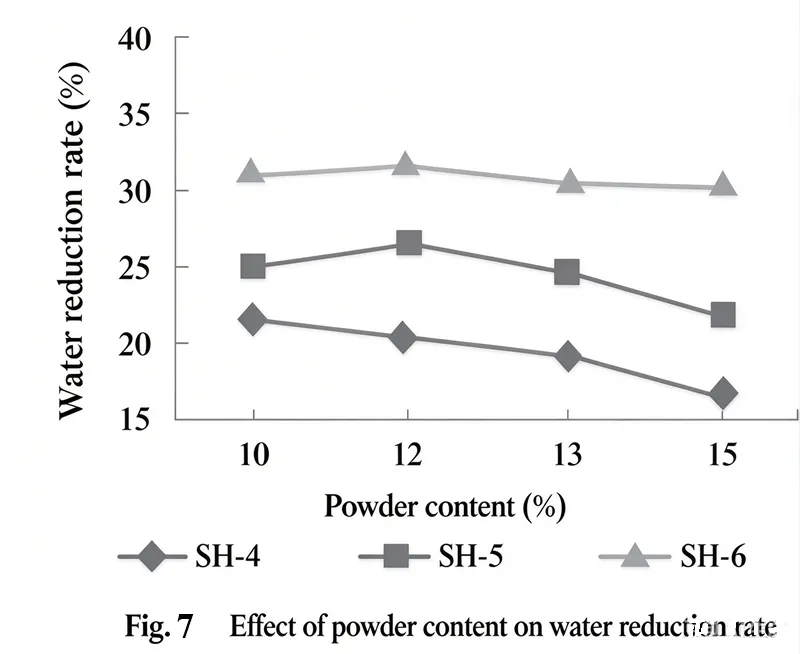
Figure 7 shows that, for water-reducing agents with different water reduction rates, the water reduction rate trend changes with increasing stone powder content in the sand. When the water reduction rate is high, stone powder content has little effect; when it is low, the water reduction rate gradually decreases as stone powder content increases.
Because mud has a stronger adsorption effect on polycarboxylate superplasticizer than cement, its influence on polycarboxylate superplasticizer is very sensitive. In practice, if the mud powder content in sand is high, it may deteriorate the concrete’s initial workability, sharply reduce workability retention, and compromise the concrete’s mechanical properties and volume stability. Therefore, the standard requires that the mud content in sand used to determine water-reducing agents not exceed 1%, and cement mortar flowability decreases as mud content increases.
In this experiment, we used machine-made sand and determined the optimal sand-to-cement ratio in Section 2.2.
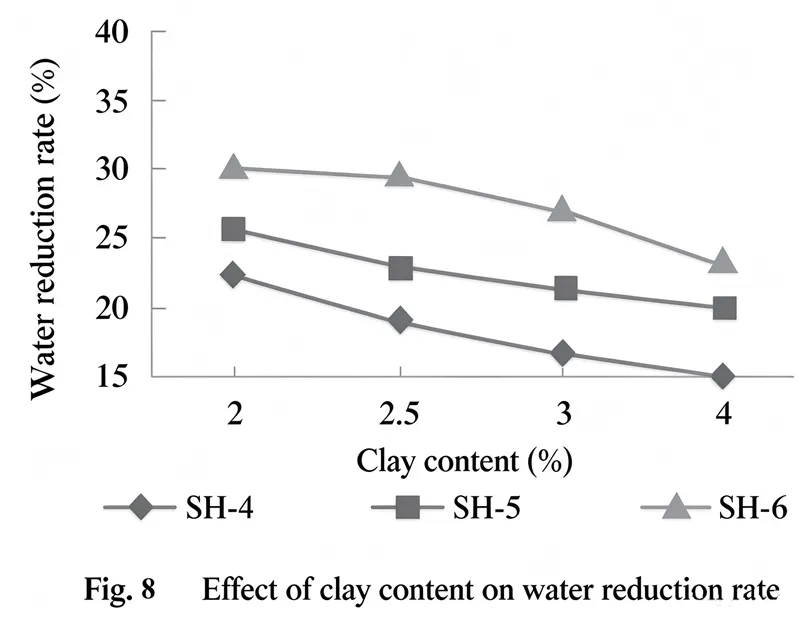
As shown in Figure 8, as the clay content in the fine aggregate increases, the measured water reduction rate decreases continuously for different water-reducing agents. However, when the mud content is below 2.5%, this trend is weak, whereas above 2.5%, it becomes more significant. Therefore, in practical engineering, when testing the water-reduction rate for the actual sand used, the sand’s mud content should be controlled not to exceed 2.5% to avoid excessive deviation from the benchmark sand.
Mortar can replace concrete to quickly determine the water-reduction rate of water-reducing agents on actual construction sites. This article examines changes in the water-reduction rate of water-reducing agents, measured by the mortar method, by considering sand type, fineness modulus, stone powder content, and mud content. The following conclusions can be drawn.

Study on the Effects of Water Reducing Agents and Expanding Agents on Concrete Shrinkage
Blog Study on the Effects

The main reasons and countermeasures for the unsuitability of concrete admixtures
Blog The main reasons and
Product information, specifications & applications — sent directly to your email.
*Your information is kept confidential and will only be used to contact you regarding our products.