Blog
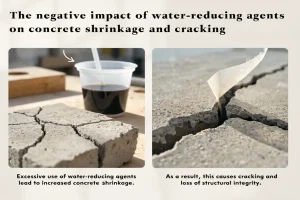
The negative impact of water reducing agents on concrete shrinkage and cracking
Blog The negative impact
Blog
Polycarboxylate superplasticizers(PCE) represent the pinnacle of modern concrete chemical admixtures. By drastically reducing water demand and lowering system viscosity, PCEs enable high-performance concrete (HPC), self-consolidating concrete (SCC), and ultra-high-strength structural designs.
While liquid PCE formulations dominate ready-mix batching plants, solid powder PCE has emerged as a high-growth sector in global construction chemicals. Solvent-free and 100% active, powder PCE offers exceptional advantages:
However, the performance of solid PCE synthesized via bulk polymerization depends fundamentally on the molecular weight and molecular architecture of the starting polyether macromonomers. Recent research demonstrates that transitioning from traditional 5-carbon macromonomers (TPEG) to higher-molecular-weight 6-carbon macromonomers (EPEG), coupled with a staged thermal synthesis process, unlocks superior cement dispersion, optimal rheology, and outstanding paste fluidity.
Early first-generation PCE synthesis relied on methoxypolyethylene glycol (MPEG). Synthesizing MPEG-based PCE required a complex, two-step process involving esterification followed by polymerization. This approach suffered from incomplete esterification, high energy consumption, and batch instability, leading the industry to transition toward direct free-radical copolymerization using ether-based macromonomers.
Modern ether-type macromonomers are synthesized by ethoxylating unsaturated small-molecule alcohol initiators, yielding polyoxyethylene ethers with terminal double bonds. They are classified based on the carbon chain backbone of the initiator:
Polycarboxylate superplasticizers can be manufactured via two primary routes: traditional aqueous solution polymerization and solvent-free bulk polymerization.
Unlike solution polymerization, which yields a 40%–50% liquid mother liquor, bulk polymerization reacts pure macromonomers directly with comonomers (such as acrylic acid) in the presence of an initiator (such as AIBN) and a chain transfer agent (such as mercaptopropionic acid).
The molten reaction mass is cast, cooled, and sliced into solid flakes or crushed into powder. This process provides three major operational benefits:
Bulk polymerization reactions generate intense exothermic heat. Without water as a heat sink, uncontrolled exotherms can trigger thermal runaway, molecular chain scission, and broad polydispersity, degrading the admixture’s performance.
To overcome this challenge, advanced synthesis uses a “high-temperature initiation followed by low-temperature propagation” staged temperature profile:
| Reaction Stage | Temperature Range | Holding Duration | Function & Chemical Objective |
|---|---|---|---|
| Stage 1: High-Temperature Initiation | 75°C – 85°C | 1 – 2 Hours | Rapidly decomposes the initiator (AIBN) into free radicals to initiate vinyl copolymerization. |
| Stage 2: Low-Temperature Polymerization | 40°C – 70°C | 4 – 10 Hours | Suppresses excessive exothermic spikes, stabilizes chain propagation, and ensures uniform side-chain grafting. |
Experimental data reveals that initiating the bulk copolymerization at 80°C for 1 hour, followed by lowering the temperature to 60°C for 8 hours, delivers the highest monomer conversion rate and polymer uniformity. At this optimal processing condition, the resulting PCE powder achieves a peak cement paste fluidity of 235 mm (at standard 2.4% dosage of a 10% solution on PO 42.5 cement).
The working mechanism of polycarboxylate superplasticizers in cementitious systems is governed by a dual-action synergistic model: electrostatic repulsion from the backbone and steric hindrance from the grafted polyether side chains.
The polycarboxylic backbone contains abundant polar carboxylic acid groups (-COOH). In the alkaline cement pore solution, these groups ionize into carboxylate anions (-COO-), which readily adsorb onto the positively charged hydration sites of cement particles. This creates a negative surface zeta potential, generating electrostatic repulsion between neighboring particles.
While electrostatic repulsion provides initial dispersion, the extended non-ionic polyoxyethylene (PEO) side chains extending into the liquid phase provide the primary dispersion mechanism—steric hindrance.
When two cement particles approach each other, the overlapping polyether side chains cause localized osmotic pressure and elastic conformational resistance, physically preventing cement grains from flocculating and releasing trapped mixing water.
The molecular weight of the macromonomer directly defines the physical length and density of these grafted side chains:
Structural characterization via Fourier-Transform Infrared Spectroscopy (FT-IR) and Gel Permeation Chromatography (GPC) confirms the precise grafting of saturated C-H bonds, ester/carboxyl carbonyl groups, and dialkyl ether linkages in both polymers. However, their physical performance profiles demonstrate marked differences:
| Parameter & Property | 5-Carbon TPEG (Mw ~2400 g/mol) | 6-Carbon EPEG (Mw ~3000 g/mol) | Technical & Practical Impact |
|---|---|---|---|
| Macromonomer Chemistry | Isopentenyl Polyethylene Glycol Ether | Ethylene Glycol Monovinyl Polyoxyethylene Ether | 6C vinyl ether exhibits higher copolymerization reactivity in solvent-free bulk systems. |
| Side-Chain Molecular Weight | Standard (Approx. 2400 g/mol) | High (Approx. 3000 g/mol) | Longer polyether chains provide a larger steric hindrance radius in aqueous cement matrix. |
| Monomer Conversion Rate | Moderate to High | High to Complete | Higher conversion ensures lower unreacted monomer residues and higher effective polymer content. |
| Cement Paste Fluidity | Good (~210 – 220 mm) | Superior (Up to 235 mm) | EPEG provides greater initial spread and enhanced water-reducing efficiency at equal dosage. |
| Rheological Behavior | Standard Plastic Viscosity | Significantly Reduced Viscosity | EPEG-based PCE produces lower yield stress, making pumpable and self-compacting concrete easier to place. |
| Target Applications | General Ready-Mix, Standard Dry Mortars | High-Flow SCC, UHPC, Non-Shrink Grouts, Self-Leveling Compounds | Ideal for high-end dry-mix mortars and high-durability infrastructure projects. |
For chemical engineers, admixture formulators, and procurement teams producing or utilizing powder polycarboxylate superplasticizers, the experimental findings yield three key operational conclusions:
Solution polymerization carries out the reaction in water, producing a 40%–50% active liquid solution commonly used in local ready-mix concrete plants. Bulk polymerization reacts pure molten macromonomers with comonomers without adding water or solvents. The resulting solid mass is cooled and flaked into 100% active powder PCE, which saves significant freight costs and is ideal for dry-mix mortars.
Polycarboxylate superplasticizers disperse cement particles primarily through steric hindrance. Higher molecular weight macromonomers (such as EPEG at ~3000 g/mol compared to TPEG at ~2400 g/mol) form longer polyoxyethylene side chains that extend further into the water phase, creating a larger physical barrier that prevents cement particles from clumping together.
Ether macromonomers are categorized by their carbon initiator structure: 3-carbon (APEG), 4-carbon/5-carbon (HPEG and TPEG), and 6-carbon (EPEG and VPEG). While TPEG and HPEG are widely used in traditional liquid admixtures, 6-carbon EPEG is rapidly gaining preference for high-performance powder PCE synthesis.
Because bulk polymerization lacks water to absorb heat, the reaction can easily overheat due to exothermic energy. Using a two-stage process—high temperature (80°C) for 1 hour to initiate radicals, followed by a lower temperature (60°C) for 8 hours—controls the reaction rate, ensures high monomer conversion, and prevents polymer chain degradation.
The negative impact of water reducing agents on concrete shrinkage and cracking
Blog The negative impact

Discussion of the room temperature process and precautions for PCE in case studies
Blog Discussion of the ro
Product information, specifications & applications — sent directly to your email.
*Your information is kept confidential and will only be used to contact you regarding our products.