Blog
2400 and 3000 are the two most mainstream molecular weight specifications for full-series HPEG, TPEG and EPEG polyether macromonomers in the R&D and industrial production of polycarboxylate superplasticizers. Many admixture enterprises and formula engineers have vague understanding of the performance differences and applicable scenarios of the two molecular weight monomers. Blind selection easily leads to defective finished product performance including insufficient water reduction, unbalanced slump retention, failed early strength and poor working condition adaptability. 2400 and 3000 molecular weight monomers have significant differences in molecular structure, activity strength, performance focus and application scenarios, and accurate selection is the basic premise to guarantee the quality of superplasticizer finished products.
2400 molecular weight monomers feature simple synthesis process, high conversion rate, stable finished products and low raw material cost, suitable for mass production of universal and early-strength superplasticizers. Their only shortcoming is limited long-term slump retention performance with slight slump attenuation after 2 hours. 3000 molecular weight monomers have high raw material cost and strict synthesis process requirements, suitable for producing high-end slump-retaining, anti-mud and ultra-stable superplasticizers. Their disadvantage is slow initial water reduction speed, and excessive dosage will slightly delay early hydration, which is not conducive to rapid mold release construction.
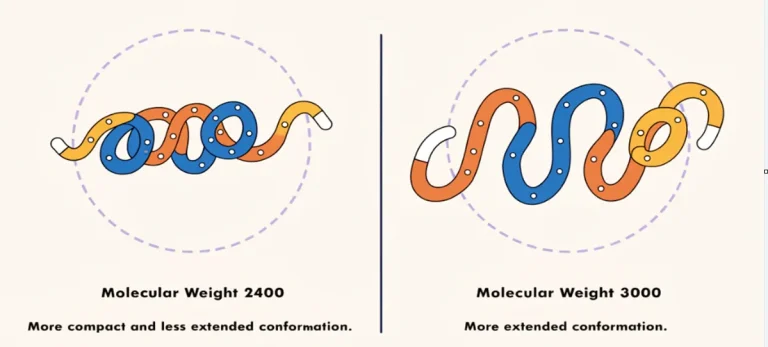
The molecular weight of polyether macromonomers is determined by the polymerization degree of hydrophilic polyoxyethylene chain segments, which directly controls the molecular chain length and functional characteristics. 2400 molecular weight monomers have shorter polyoxyethylene chain segments and compact overall molecular structure, with extremely high unsaturated double bond activity, fast polymerization reaction rate, uniform grafting with small monomers and stable conversion rate. They have low requirements for synthesis process precision and are suitable for large-scale mass production.
3000 molecular weight monomers are equipped with longer hydrophilic polyoxyethylene side chains with better molecular stretchability and more hydrophilic groups, which can form a thicker steric hindrance hydration layer. However, their polymerization activity is relatively mild with slow reaction rate, requiring higher precision in synthesis temperature, auxiliary agent ratio and reaction time, bringing greater mass production control difficulty as high-end functional special monomers. The fundamental structural differences create completely different performance advantages and application directions of the two monomers.
The core advantages of 2400 molecular weight polyether monomers are high activity, high water reduction, fast early strength development, high cost performance and wide adaptability, making them the most mature and lowest-cost universal monomer for industrial mass production.
The short molecular chain structure ensures uniform polymerization and grafting. The synthesized superplasticizers have regular molecular structure and extremely fast initial adsorption and dispersion speed, which can quickly disperse cement flocculent particles and release free water to achieve ultra-high initial water reduction rate in a short time.
In addition, this monomer will not excessively wrap cement particles or inhibit the early hydration reaction of cement, effectively accelerating the early strength growth of concrete without retarding side effects, perfectly adapting to various rapid forming and rapid mold release construction scenarios. In low-temperature construction environments, its high-activity advantage compensates for the reaction rate attenuation caused by low temperature, stabilizes superplasticizer performance and avoids poor concrete workability and slow strength growth.
Based on its performance characteristics, 2400 molecular weight (TPEG 2400/HPEG 2400) monomers are the preferred raw material for rigid-demand scenarios, mainly including four types of engineering applications.
First, precast component production such as pipe piles, fabricated wall panels, box girders and floor slabs to meet the needs of rapid mold release and high early strength.
Second, winter low-temperature construction projects to ensure dispersion and hydration enhancement effects at low temperatures.
Third, high-strength early-strength concrete projects to guarantee steady growth of early and later concrete strength.
Fourth, ordinary civil commercial concrete and conventional road and bridge projects with universal working conditions and high cost performance for large-scale mass production.
3000 molecular weight (EPEG 3000) monomers focus on long-term effectiveness, high stability and complex working conditions, covering four major engineering scenarios.
First, long-distance pumped urban commercial concrete to solve the problems of concrete dryness and pump blockage during transportation.
Second, summer high-temperature construction projects to resist workability attenuation caused by accelerated hydration under high temperature.
Third, high-end projects such as mass concrete, water conservancy dams and long-span bridge box girders requiring long-term layered continuous pouring to avoid construction cold joints.
Fourth, complex working conditions with excessive aggregate mud content and fluctuating raw materials to stabilize concrete performance through strong anti-interference ability.
2400 molecular weight monomers feature simple synthesis process, high conversion rate, stable finished products and low raw material cost, suitable for mass production of universal and early-strength superplasticizers. Their only shortcoming is limited long-term slump retention performance with slight slump attenuation after 2 hours.
3000 molecular weight monomers have high raw material cost and strict synthesis process requirements, suitable for producing high-end slump-retaining, anti-mud and ultra-stable superplasticizers. Their disadvantage is slow initial water reduction speed, and excessive dosage will slightly delay early hydration, which is not conducive to rapid mold release construction.
Engineering and production selection can follow standardized rules. Prioritize 2400 molecular weight polyether monomers for scenarios requiring early-strength mold release, low-temperature adaptation and cost-effective mass production. Prioritize 3000 molecular weight polyether monomers for scenarios requiring long-term slump retention, high-temperature stability, complex working condition adaptation and high-end engineering quality.
For composite construction scenarios with ultra-high requirements, the compound formula of 2400 and 3000 monomers can balance early water reduction strength and long-term slump retention performance, which is the mainstream technical solution for high-end admixture enterprises to optimize formulas and improve comprehensive product adaptability.
Product information, specifications & applications — sent directly to your email.
*Your information is kept confidential and will only be used to contact you regarding our products.