The influence of cement particle adsorption performance on chemical additives
Concrete construction cannot be separated from water reducers, lotions, and asphalt modifiers. It is difficult to pump the cement when the amount of cement is insufficient. It is difficult to pump the cement when the amount of cement is excessive, and the setting is retarded seriously. The source of all performance changes is hidden in the microscopic adsorption behavior on the surface of cement particles.
Many students remember only the conclusion of “electrostatic dispersion” but cannot distinguish the differences in the adsorption of monomers, homopolymers, and comb-shaped water reducers. This article starts from the surface charge of particles and clarifies the underlying logic of adsorption.
Cement particles in contact with water: possessing a dual identity of positive and negative electricity
Dry cement particles generate intrinsic charges only through grinding; after encountering water, minerals dissolve and differentiate into charges: the silicate phase leaches out ions with negative charges, while aluminate and early ettringite carry positive charges.
Water-cement and alcohol-water ratios can regulate surface potential: the potential of pure water systems first decreases and then increases, and low water-cement ratios result in a higher proportion of positive charges, providing a large number of adsorption sites for anionic additives. This is also the fundamental reason why most mainstream water reducing agents on the market are anionic.
Monomer vs Polymer: Why Small Molecules Cannot Adsorb?
At the same charge density, acrylic acid and sulfonic acid small-molecule monomers hardly adhere to cement, while corresponding linear homopolymers adsorb a large amount.
The key is the difference in adsorption entropy change: the adsorption of small molecules causes a greater entropy reduction in the system, which is thermodynamically difficult to occur spontaneously; long-chain polymers have smaller adsorption entropy loss and are more likely to bind to cement surfaces stably. This explains why only polymer additives have a dispersing effect, and monomers have no practical water-reducing value.
Differences in adsorption pathways between two types of anionic polymers
Carboxyl-type polymers have dual adsorption channels: electrostatic binding to positive sites of aluminum salts, while carboxyl groups complex with liquid-phase calcium ions and anchor on the surface of negatively charged silicates; sulfonic acid-type polymers rely solely on electrostatic adsorption of the aluminum phase and have no chelating effect.
Under the same dosage, the total adsorption capacity of carboxyl polymer is higher, but the charge density of sulfonic acid groups is higher, which can significantly reduce the Zeta potential of particles and have stronger electrostatic repulsion.
Cationic polymers can only adsorb a small amount of negative silicate sites in cement, and the total adsorption amount is much lower than that of anions. After addition, it will increase the Zeta potential of the slurry, weaken the particle repulsion, only slightly improve the flowability, and have an extremely weak retarding effect. It is rarely used alone as a water reducing agent and is often compounded to adjust the charge balance of the system.
Adsorption directly determines the strength of cement hydration inhibition
The adsorption layer blocks the exchange channels between cement minerals and water/ions; the larger the adsorption capacity, the higher the ion diffusion resistance and the longer the hydration induction period. Carboxyl polymer has a dual retarding effect of coverage barrier and calcium ion complexation, which can lock in surface ions of particles and consume Ca²⁺ required for liquid-phase nucleation, significantly delaying the generation of C-S-H; Sulfonic acid relies solely on physical barriers, with limited buffering amplitude. Cationic polymers adsorb thinly and hardly affect the hydration process.
Extension: Adsorption layering logic of comb-shaped polycarboxylates
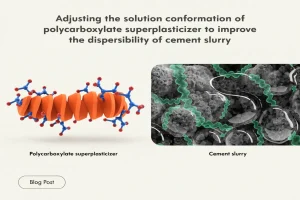
The mainstream comb-shaped polycarboxylates in industry exhibit double-layer adsorption: the first layer is composed of main-chain carboxyl groups electrostatically and complexly anchored particles; liquid-phase calcium ions form calcium bridges on the surface of the first layer, adsorbing the second layer of polymer. The first layer completely disperses and flocculates, determining the initial flowability; The second layer does not change the particle potential and only continuously consumes calcium ions to prolong the collapse time.
The adsorption behavior is jointly controlled by three factors: charge, molecular chain length, and functional group type, and is the source of all macroscopic properties of additives.