Blog
To meet the demand for concrete in the development of the modern economy, concrete admixtures have been developed. This article analyzes the performance of concrete admixtures, their application in concrete construction, and the selection of admixtures to research the impact of concrete admixtures on concrete performance in construction.
With the continuous development of the economy, the demand for concrete, cement, and products in basic industrial construction and the construction industry has increased, thereby promoting the development of the cement, product industry, and concrete industry. But with the continuous advancement of technology in the construction industry, people’s requirements for cement concrete are also increasing. To meet people’s needs, concrete admixtures were born.
Concrete admixtures are generally divided into early strength agents, water-reducing agents, air-entraining agents, retarders, and so on. The characteristics of admixtures are low dosage and wide variety, which can improve or enhance the hardening of concrete. It is very important to study the influence of concrete admixtures on concrete properties and the adaptability of concrete admixtures to cement, to utilize concrete admixtures better and fully utilize their role in construction projects.
Each type of concrete admixture has its unique function, and adding this admixture can improve one or several aspects of concrete performance.
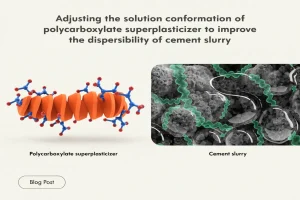
Adding polycarboxylate superplasticizer can increase the fluidity of concrete while maintaining the same water consumption, or reduce the unit water consumption while maintaining the same fluidity, thereby improving the strength and durability of concrete. According to the technical specifications for the application of concrete admixtures, a certain admixture that has been tested and meets relevant standards is added to the concrete prepared with cement that can be used with this admixture according to regulations. If it can produce the desired effect, the cement is suitable for this admixture.
There are adaptability issues between almost all types of additives and cement. Still, currently, water-reducing agents are the most commonly used. When they become incompatible with cement, they can be quickly and intuitively reflected (such as poor fluidity, low water reduction rate, or heating of the mixed material, rapid loss of fluidity, etc.).
In short, the adaptability issue between additives and cement is a complex and unavoidable practical problem in engineering, which affects its application effect and sometimes leads to serious engineering accidents and incalculable economic losses.
The compatibility between cement and admixtures is a meaningful scientific issue, but also a practical engineering problem, which arises from engineering accidents. Therefore, it must be highly valued by production units and engineering application departments.
Due to the different types of concrete additives, their effects also vary. The general function is to improve the flowability of the corresponding concrete without changing the water consumption per cubic meter of concrete or the amount of cement used; Under the condition of constant cement dosage or concrete slump, a reduction in water consumption can be achieved, increasing concrete strength and durability; By keeping the design strength and concrete slump constant, it is possible to save cement usage and reduce costs, among other things.
Early strength agent is used to improve the early strength of concrete and is commonly used in emergency repair projects and winter construction of concrete; Water reducing agent has a water reducing and reinforcing effect while maintaining the consistency of concrete; Air entraining agents are mainly used to reduce the occurrence of air bubbles during the concrete mixing process, which can cause bleeding and segregation, and improve the workability of concrete; Retarders can delay the setting time of concrete and have both retarding and water reducing effects. They are mainly used for large volume concrete, concrete constructed under hot weather conditions, or concrete transported over long distances.
The main component of concrete admixture water reducer is composed of surfactants. This surfactant belongs to anionic surfactants. In essence, the concrete alkali water agent does not chemically react with cement. Its effect on concrete mainly manifests in the plasticization of fresh concrete, which includes wetting, adsorption, dispersion, and lubrication.
The adsorption, dispersion, lubrication, and wetting effects of admixtures and water reducers make it easy to mix concrete evenly with a small amount of water, improving the workability of freshly mixed concrete. This is the plasticizing effect of admixtures and water reducers on freshly mixed concrete.
Admixtures and air entraining agents can introduce a large number of small and independent bubbles into concrete, which can greatly improve the workability of concrete. In terms of the effect of air entraining agents on the performance of hardened concrete, from the analysis of water-reducing efficiency, the strength of concrete will also be correspondingly improved; however, from the perspective of air entrainment, the strength of concrete generally shows a decrease.
So, concrete mixed with air-entraining agents or air-entraining water-reducing agents has a lower amount of elastic modulus than concrete without air-entraining agents, and the decrease is greater than the change in strength. This is because a large number of tiny bubbles in the cement slurry reduce the elastic modulus of the slurry.
Concrete is an essential building material in modern society. Its variety, large production quantity, and wide application range are among the largest in the world today. But the development of concrete construction technology requires admixtures. It can be said that the emergence and development of additives have promoted the development of concrete construction technology, shifting concrete technology from plastic concrete to fluidized concrete, dry hard concrete, and high-performance concrete.
The newly developed high-efficiency water-reducing agent combines the high construction performance, high strength, and high durability of concrete, improving the water reduction rate under low water-cement ratio and meeting the requirements of certain concrete projects. Not only does it offer high performance, but it also meets the requirements. It can also produce high-performance, non-vibrating concrete with high fluidity, low water consumption, and good performance in penetrating steel mesh without separation. These are all positive effects of concrete admixtures on concrete construction.
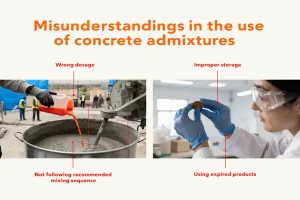
Before using concrete admixtures, it is necessary to understand the performance and corresponding usage conditions of different admixtures, consult the factory product manual, and strictly follow the current specifications for the variety and dosage of admixtures according to the concrete performance requirements, construction, and climate conditions. The quality of admixtures must meet the relevant national standards.
The adaptability of concrete and cement varies depending on the type, production process, dosage, and formula of corresponding additives that are compatible with cement and meet design and construction requirements. Therefore, it should be determined through experiments to select additives with good adaptability and stable quality; at the same time, select corresponding additives according to different design and construction requirements. Based on the actual use of materials on site, conduct trial mixing to determine the appropriate additive dosage and reasonable construction coordination.
With the widespread application of pumping technology and high-strength concrete, the increase in pouring workload and the demand for pouring workload cannot meet the requirements of long-distance transportation for construction. Therefore, the requirement for the dosage of high-efficiency external water reducing agents is gradually increasing.
Research has also shown that high-dosage, high-efficiency water reducing agents enable concrete to have greater fluidity even at low water-cement ratios, forming high-performance, high-strength concrete with good production strength and durability. At the same time, under the condition of using a large amount of high-efficiency water agent, the loss rate of fresh concrete is also reduced.
The reason is that in freshly mixed concrete, the form of cement and the content of calcium sulfate affect the concentration of SO4 in the liquid phase. Due to the relatively low water content of SO4 ions produced by the dissolution of sulfates in low-water gel, a large amount of C3A needs to be controlled, resulting in a need for hydration.
There is a combination of sulfonic acid groups and C3A on the molecules of high-efficiency external water reducing agents, and the amount of high-efficiency water reducing agent in the liquid phase also decreases, gradually losing its effect on cement dispersion and increasing losses. To achieve this, the dosage of high-efficiency external water reducing agent should be increased, so that the amount of SO4 ions in the liquid phase also increases, and the loss rate caused during operation will be reduced.

Preparation and Performance Study of EPEG 3000 Polycarboxylate Superplasticizer Liquid
Blog Preparation and Perf
Product information, specifications & applications — sent directly to your email.
*Your information is kept confidential and will only be used to contact you regarding our products.