Blog
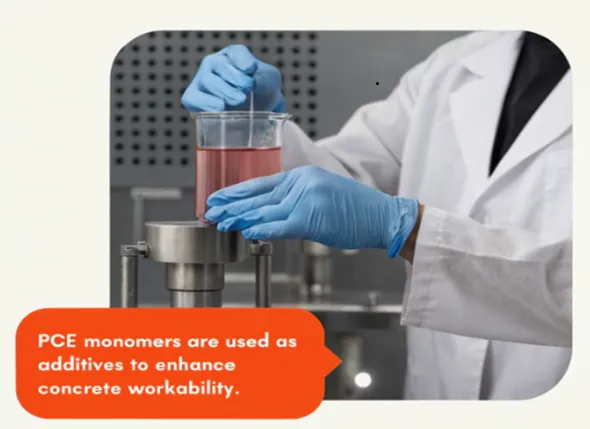
In the synthesis and production of polycarboxylate superplasticizers, the mixing ratio of PCE macromonomers and functional small monomers is the core parameter that determines the key performance of finished superplasticizers and the key and difficult point of formula debugging. An unreasonable mixing ratio will directly cause a series of problems such as insufficient water reduction rate, unbalanced slump retention, poor early strength, severe retarding and concrete bleeding and segregation, which are the main reasons for unstable performance, poor adaptability and high cost of products for most admixture enterprises.
There is no universal fixed ratio for polyether monomer dosage. It needs to be accurately adjusted according to monomer type, molecular weight, construction scenario, working condition and quality of sand, stone and cement. Combined with industry general standards and front-line production experience, this article clarifies the standardized optimal mixing ratio and formula debugging logic for different application scenarios.
The monomer mixing ratio commonly referred to in the industry specifically means the mass ratio between polyether macromonomers (HPEG 2400/TPEG 2400/EPEG 3000) and acrylic functional small monomers. It is matched with the dosage of auxiliary agents such as chain transfer agents, initiators and reducing agents. The complete ratio system determines the grafting density, molecular chain length and steric hindrance effect of superplasticizer molecules.
For complex working conditions such as high mud content aggregates, low-temperature construction and ultra-high-strength concrete, EPEG new anti-interference monomers are widely used in the industry, with the optimal ratio range of 3.8:1 to 4.2:1. EPEG monomers have high polymerization activity and strong anti-mud and anti-low-temperature interference capabilities, and this balanced ratio can balance the initial water reduction speed and long-term slump retention effect.
In practical debugging, if the sand and stone mud content exceeds the standard, the proportion of polyether monomers can be slightly increased to enhance the anti-interference ability of steric hindrance and avoid performance attenuation caused by effective component consumption by sediment. Under low-temperature construction environment, the benchmark ratio can be maintained with fine adjustment of initiator dosage to ensure sufficient polymerization reaction and stable performance of finished superplasticizers.
The core demands of precast component production are rapid mold release, high early strength and no retarding side effects. The formula needs to focus on improving the initial water reduction rate and accelerating early hydration. HPEG 2400 monomer is the mainstream choice for this scenario, with the optimal mixing ratio adjusted to 4:1 to 5:1 by appropriately increasing the proportion of polyether macromonomers.
Increasing the proportion of polyether monomers effectively enhances the steric hindrance effect of superplasticizer molecules, improves the initial dispersion and water reduction efficiency, quickly disperses cement flocculent particles, accelerates early hardening and strength growth of concrete, and reduces the retarding problem caused by excessive acrylic acid, adapting to low-temperature curing and rapid mold release requirements.
In practical application, the standard ratio of 4.5:1 is preferred for normal-temperature rapid mold release formulas, and the limit ratio of 5:1 is adopted for steam-cured high-strength precast components to balance high water reduction efficiency and stable early strength.
For cast-in-place commercial concrete, long-distance transportation and large-scale infrastructure projects, the core requirements are low slump loss, long workability retention and stable long-term performance. TPEG-2400 slump-retaining monomers are adopted for this scenario, with the optimal mixing ratio of 3:1 to 3.5:1.
Appropriately increasing the proportion of acrylic small monomers within this ratio range enhances the carboxyl adsorption density on the main chain of superplasticizers and improves the adsorption stability of superplasticizers on cement particles. The polyether side chains can continuously exert dispersion effect to effectively inhibit slump loss during concrete standing and transportation.
Superplasticizers synthesized by this formula can maintain basically zero slump loss for 2 to 3 hours, perfectly adapting to working conditions such as long-distance transportation of urban commercial concrete, high-temperature summer construction and layered pouring of mass concrete, and avoiding construction cold joints and uneven pouring problems.
For complex working conditions such as high mud content aggregates, low-temperature construction and ultra-high-strength concrete, EPEG new anti-interference monomers are widely used in the industry, with the optimal ratio range of 3.8:1 to 4.2:1. EPEG monomers have high polymerization activity and strong anti-mud and anti-low-temperature interference capabilities, and this balanced ratio can balance the initial water reduction speed and long-term slump retention effect.
In practical debugging, if the sand and stone mud content exceeds the standard, the proportion of polyether monomers can be slightly increased to enhance the anti-interference ability of steric hindrance and avoid performance attenuation caused by effective component consumption by sediment. Under low-temperature construction environment, the benchmark ratio can be maintained with fine adjustment of initiator dosage to ensure sufficient polymerization reaction and stable performance of finished superplasticizers.
The core PCE monomers ratio must be matched with standardized auxiliary agent dosage to ensure complete polymerization reaction and stable finished product performance. The conventional dosage of initiators (hydrogen peroxide, ammonium persulfate) is 2.0% to 3.0% of the polyether monomer mass to ensure qualified monomer conversion rate. The dosage of reducing agents (ascorbic acid) is 0.2% to 0.5% to accurately control the reaction rate. The dosage of chain transfer agents is 0.3% to 0.8% to control molecular chain length and avoid excessive polymerization.
Two common ratio mistakes must be avoided. Excessively increasing the proportion of polyether monomers will lead to high superplasticizer viscosity and excessive air entrainment, resulting in reduced later strength and increased surface pores of concrete. Excessively high acrylic acid proportion will cause severe retarding, delayed mold release and insufficient early strength of precast components. In addition, the ratio of 3000 molecular weight macromonomers with longer molecular chains needs to be increased by 0.3 to 0.5 compared with 2400 molecular weight monomers to avoid dispersion lag.
The optimal dosage ratio of PCE monomers follows the core logic of determining demand by scenario, monomer by demand, and ratio by monomer. Adopt the benchmark ratio of 3.5:1 to 4.5:1 for general working conditions; increase the polyether monomer proportion for precast early-strength scenarios; increase the acrylic acid proportion for commercial concrete slump retention scenarios; and adopt a balanced ratio for complex harsh working conditions. Fine adjustment according to raw material quality and construction temperature can produce high-quality polycarboxylate superplasticizers with stable performance and strong adaptability.
How to Distinguish and Select 2400 and 3000 Molecular Weight Polyether Macromonomers?
Blog How to Distinguish a
Product information, specifications & applications — sent directly to your email.
*Your information is kept confidential and will only be used to contact you regarding our products.