Blog
With the rapid development of commercial concrete, both the supply and demand sides increasingly argue that structural concrete is too weak. Because the commercial concrete industry is a buyer’s market, to recover payments on time and continue cooperating with the demand side, most enterprises must make concessions and passively bear some economic responsibilities.
Current status of concrete curing
Hidden dangers brought by poor maintenance to concrete
Insufficient curing in newly poured concrete can reduce concrete strength by 25% to 35%, creating hidden safety risks to the structure. In addition, the concrete surface is less dense, carbonation occurs faster, and the carbonation depth is greater. In some projects, when the structure rebounds, the carbonation depth of C30 concrete poured for less than half a year has already reached 6- 10 mm. This indicates that the area has not cured. Excessive carbonation depth reduces the concrete’s protective capacity for steel bars and shortens the durability of concrete structures.
When using the “Technical Specification for Rebound Testing of Concrete Compressive Strength” to test structural concrete, the estimated strength of C20~C40 concrete is about 10% lower; The estimated strength of C50 and above concrete is about 20% lower. The qualified range of the rebound gauge calibration is 80 ± 2, which is too wide and should be controlled within 80-82. When using a rebound tester with a higher fixed value for structural testing, the estimated compressive strength value of the structural concrete is more than 3MPa higher than the estimated strength value detected by a rebound tester with a fixed value of 78-80. This value is closer to the compressive strength value of the structural concrete detected by the drill core.
Some testing units cannot strictly follow the requirements of the “Core Drilling Regulations” during core drilling, cutting core samples without processing or conducting pressure tests, resulting in a 20% to 50% decrease in the core concrete’s compressive strength compared to the actual strength. Some units’ grinding machines do not meet regulatory requirements. The grinding machine lacks a device to clamp the core sample and requires two hands to hold the core sample while grinding it on the grinding wheel. How can such a grinding machine grind the core sample’s compressed surface?
The better the maintenance, the less likely concrete structural components are to crack. Impact on concrete carbonation: better curing slows the carbonation rate and reduces the carbonation depth.
Enhance the maintenance awareness of supervisory personnel, so that each on-site supervisor attaches the same importance to supervising maintenance as supervising the construction of steel bars. If concrete curing is not in place, do not allow the next process to proceed. If excessive carbonation depth during structural rebound reduces concrete strength, the on-site supervisor should also be held responsible.
Determine the limit value of carbonation depth within one year: If newly poured concrete can meet the specification requirements in early curing, the carbonation depth of C40 and above concrete shall not exceed 1.5mm within one year, and the carbonation depth of standard curing (after 28 days of standard curing, it shall be transferred to outdoor natural curing) shall not exceed 1mm; The carbonation depth of C30 and C35 concrete shall not exceed 2.5mm, and the standard curing shall not exceed 1.5mm; The carbonation depth of C20 and C25 concrete shall not exceed 4mm, and the standard curing shall not exceed 2.5mm.
It is recommended that the country establish a one-year carbonation depth limit when revising relevant concrete specifications or regulations. When conducting rebound acceptance of the structure, if the concrete carbonation depth exceeds the limit, it indicates poor early curing, and construction and supervision personnel must be held responsible. Reduce mutual shirking and buck-passing between the demand side and the supply side due to inadequate structural strength.
Considering the unreasonable human factors at the construction site and the difficulty in ensuring that construction personnel can properly maintain the concrete in the near future, it is necessary to increase the surplus factor of the production mix ratio. The compressive strength of concrete after 28 days of standard curing should exceed 1.2 times the design strength.
In fact, the compressive strength of pre-mixed concrete after 28 days of standard curing accounts for only about 70% of its final strength, leaving a strength surplus of about 30% after 28 days. If early curing is poor, this 30% strength surplus will be wasted. Because ready-mix concrete is delivered to the demand side as a semi-finished product, the other half requires active cooperation from the demand side to produce qualified finished concrete.
Reasonable vibration and curing are important steps in producing qualified concrete. Because the supplier cannot control the demand side, the construction administrative department and supervision company must increase supervision over the construction units so they can carry out construction according to specifications and promote the development of ready-mixed concrete toward durability, environmental protection, and a green direction.
Construction personnel are prohibited from adding water to the concrete mixture and using admixtures to adjust the slump of the mixture. Because of the long transport time to the construction site, the concrete slump can drop significantly, making it difficult to pour. In addition, construction personnel often request an unnecessarily high slump. Even if the delivered slump meets the required demand, pump workers and pouring personnel still add water to the pump bucket. They focus only on pumping and ease of operation and never consider the concrete’s future strength and durability.
To prevent construction personnel from adding water to the mixture at will, concrete production enterprises should change their mindset and find problems in their own services: if the concrete we deliver to the construction site can be easily pumped and poured without rapid collapse; If our transport vehicle encounters special circumstances and waits for too long at the construction site, resulting in a small slump of the mixture, and our driver can actively add an appropriate amount of admixture to the mixing drum to increase the slump of the mixture, can the construction personnel still add water to the concrete mixture?
Therefore, do not blame only the construction personnel for adding water to the mixture; instead, replace them with concrete production enterprises that do not require construction personnel to add water to the concrete mixture. This requires our concrete production enterprises to increase training for transport vehicle drivers so that every driver can learn to add additives to the concrete mixture in a reasonable, moderate way to increase the mixture’s slump.

Study on the Effects of Water Reducing Agents and Expanding Agents on Concrete Shrinkage
Blog Study on the Effects
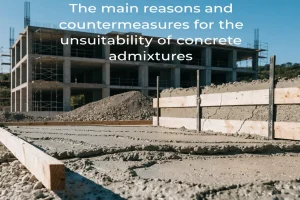
The main reasons and countermeasures for the unsuitability of concrete admixtures
Blog The main reasons and
Product information, specifications & applications — sent directly to your email.
*Your information is kept confidential and will only be used to contact you regarding our products.