Blog
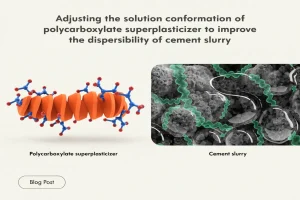
Polycarboxylate superplasticizer agents have hydrophilic groups such as ether bonds, hydroxyl groups, carboxyl groups, and ester groups in their molecular structure. These functional groups bind well to cement particles, allowing water-reducing agents to quickly adsorb onto the cement particle surface. By introducing these hydrophilic groups into the molecular backbone, polycarboxylate superplasticizers can form a stable dispersion system on the surface of cement particles, prolonging dispersion time and improving slump retention.
In some polycarboxylate superplasticizers, carboxylic acid salts and alcohols with dispersibility are produced through chemical modification or chemical reactions, such as hydrolysis of ester groups under alkaline conditions. These small-molecule polymers can slowly release onto cement particle surfaces, continuously dispersing and maintaining concrete fluidity and workability.
Polycarboxylate slump protectants are usually used not alone, but in combination with water-reducing polycarboxylate mother liquor. In the initial mixing stage, ordinary polycarboxylates provide concrete fluidity; in later stages, polycarboxylate superplasticizers provide the slump-retention performance needed to ensure the concrete maintains good workability for a certain period.
Principle of action: By adjusting the dosage and molecular structure of polycarboxylate superplasticizer with a low acid ether ratio, the retention time and setting time of concrete can be flexibly controlled to meet the needs of different projects. This slowsThis slows the consumption of water-reducing agents adsorbed on the surface of cement hydration products/unhydrated cement particles, increasing the retention time of concrete fluidity.
To achieve good or even better fluidity after 1-2 hours, we need to add more residual water-reducing agent in the liquid phase, which is our slow-release slump protection. The two are often used together and adjusted when material loss is fast.
Principle of action: The adsorption capacity of polycarboxylate superplasticizer is lower than that of ordinary polycarboxylate superplasticizer (with a lower water-reduction rate), and it has no adsorption capacity in the early stage of hydration, so it remains in the liquid phase. The hydration time is prolonged, and under alkaline conditions, ester groups undergo ester bond hydrolysis, converting to carboxyl COOH) and producing adsorption. As the polycarboxylate superplasticizer is continuously released, the concrete slurry still maintains good fluidity after 2-3 hours.
The commonly used formula for mercaptopropionic acid is mercaptopropionic acid itself. The mercaptoacetic acid market is generally in Japan or France, and it costs two-thirds as much as mercaptopropionic acid. Because of its different stability, mercaptoacetic acid can be used in high-frequency situations. In terms of molecular chain, both mercaptoacetic acid and mercaptopropionic acid are considered chain transfer agents for controlling the molecular weight of polycarboxylate superplasticizers.
The chain transfer effect of mercaptoacetic acid is weaker than that of mercaptopropionic acid. Thioglycolic acid: the product has a wide molecular weight distribution and good adaptability; thiopropionic acid: a relatively concentrated molecular weight and outstanding product performance. It can be used in combination if conditions permit.
Sodium hypophosphite: also known as sodium hypophosphite
Chemical formula: NaH2PO2
Molecular weight: 87.98; CAS login number: 7681-53-0
Appearance: Colorless crystals with a pearly luster or a white granular powder; easily soluble in hot water, ethanol, and ether. It dissolves in cold water. When heated to 130 ℃, it decomposes into orthophosphate and phosphine (highly toxic), which are strong reducing agents. It is prepared by treating sodium hypophosphite with an ion-exchange resin, then adsorbing, desorbing, filtering, evaporating, and concentrating.
By using its reducibility to regulate the degree of polymerization, the molecular weight of polycarboxylate superplasticizer can be adjusted during synthesis; adding base material or adding dropwise at low concentration yields a more stable reaction and is generally not used. After use, it increases the formula’s water-reduction rate but is more sensitive. It is generally used for high-concentration formulas or the EPEG 3000 process.
For example, hydrogen peroxide is a common initiator (to trigger free radicals) in the hydrogen peroxide/vitamin C system. This is because hydrogen peroxide initiates acrylic acid and some functional monomers more readily. For small-amount polymerization reactions using maleic anhydride as a small monomer, ammonium persulfate is a more suitable initiator. Of course, combining the two is not ruled out (such as in a high-reduction-water solution). The initiator choice is not fixed across different polymerization reactions. In polycarboxylate synthesis, the initiator is, in principle, mainly an oxidant.
The initial water reduction rate of the mother liquor is 8-12%, peaks at 2 hours, and remains around 20% at 4 hours. Suitable for long-distance transportation, prestressed concrete, and roller-compacted concrete. The initial slump is 8-12 cm, and the required concrete mix ratio is maintained for two hours.
Thioglycolic acid and mercaptoethanol are commonly used chain transfer agents in synthesizing polycarboxylate superplasticizers, especially for high water-reduction rates and slump-retention performance.
Thiomercaptoethanol: It can effectively control the molecular weight of polycarboxylate molecules, helping synthesize high-performance slump protectants. The disadvantage is that it is toxic, so safety precautions are needed when using it. However, because it is prone to deterioration and can affect product quality, some small manufacturers do not recommend it.
Thioglycolic acid: It performs well in controlling molecular weight, significantly improving the water reduction rate and slump retention performance of concrete, and it has lower toxicity than mercaptoethanol. The disadvantage is that it may be relatively expensive, but its stable performance makes it the preferred choice for most manufacturers.
Lipid-based slump protection achieves its characteristics through its unique molecular structure and chemical properties, forming a stable dispersion system in concrete and continuously exerting its dispersion effect through sustained release, thereby effectively controlling the slump protection time and setting time of concrete and improving overall performance.
Comprehensive (model 50% slump protector): High water reduction rate, mainly for adjustment and ease, slightly slow-release; this type does not require excessive control, and the post-release in concrete is not obvious;
Low water-reduction type: The initial water-reduction rate is 6-8%, which is relatively low, and the post-release effect is good. When combined with the water-reduction mother liquor in the early stage, the water-reduction demand is not high, and it has a low water-reduction rate, making the post-release mild and easy to control;
Pure slow-release type: Initially, the water reduction rate is basically zero. In the early stage, it mainly relies on water reduction to open, and the later release starts after 30-60 minutes under normal conditions. When the material is poor and water loss is fast (within 30 minutes), the later release may not be significant, and the effect may not be obvious.
A: Increase the proportion of water-reducing agent mother liquor to improve the initial water reduction rate.
B: Replace the mother liquor of the water-reducing agent with a comprehensive anti-collapse agent. At this time, use it in combination with a comprehensive solution. Remember this plan and control the dosage, as significant changes in sand can cause post-separation.
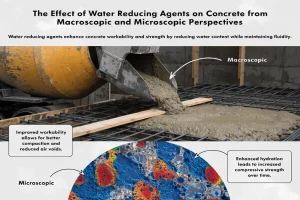
The Effect of Water Reducing Agents on Concrete from Macroscopic and Microscopic Perspectives
Blog The Effect of Water
Product information, specifications & applications — sent directly to your email.
*Your information is kept confidential and will only be used to contact you regarding our products.