Blog
The main purpose of using antifreeze in winter concrete construction is to prevent freezing damage, allowing the poured concrete to continue hardening at negative temperatures and achieve the required design strength. In winter construction, the negative temperature method is used to mix antifreeze with concrete. Compared with the heating method commonly used in winter construction, it requires simpler equipment, lower investment, saves energy, and is easier to use.
Concrete is a porous material that is susceptible to freezing damage under three important conditions: temperature, Water, and the condition of the pores in the internal structure of the concrete. Without any of these three conditions, it cannot cause damage. During and after hardening, concrete forms many pores of different sizes and interconnected capillary channels. These pores and capillary channels are filled with Water. When the temperature drops below zero, the water phase transforms into ice, expands in volume, and causes frost damage.
Composite antifreeze generally consists of antifreeze, an early-strength agent, a water-reducing agent, and an air-entraining agent. Among them, antifreeze lowers the freezing point of the liquid phase in concrete, allowing some non-freezing water to remain at a certain negative temperature, ensuring the concrete does not suffer freezing damage and achieves the expected strength within a certain period of time.
Early strength agent promotes the generation of early strength of concrete, enabling it to reach critical strength early to prevent frost damage.
Water-reducing agents not only maintain the workability required for concrete and reduce water consumption, but also have a dispersing effect, making cement into small, separated individual particles that are evenly distributed in Water. This improves the pore structure of concrete, reduces the amount of Water that freezes in concrete, and makes the frozen grain size smaller and more dispersed, thereby reducing the destructive effect of ice.
The air-entraining agent introduces air into the concrete during the mixing process, forming many closed micropores to alleviate the stress damage caused by ice frost heave and improve the early frost resistance of the concrete.
Commonly used antifreeze agents include NON-F concrete composite antifreeze admixture and MN-F concrete composite antifreeze admixture.
The compressor foundation pile for a certain company’s 480k t/a cracking and renovation project is a drilled pile type. The C40 concrete is mixed with a composite early-strength antifreeze agent, NON-F, at a dosage of 10% (based on cement mass). The test pile requires a 30-day curing period before static load testing can be carried out. Construction can only be carried out after the test is qualified. Winter construction will begin in early March, with outdoor temperatures ranging from 12-29 ℃. The freezing depth is only 1.6m due to the microclimate in the device area.
Because the heat-absorbing concrete strength is reduced in frozen soil, large drilling tools are used to drill through the frozen soil into the concrete piles, increasing the pile diameter by 20 cm compared to the original pile. For some frozen-soil piles, wooden molds separate the concrete from the frozen soil. When the ground temperature below the frozen layer is 6-7 ℃, concrete piles cannot suffer from freezing damage.
Using the NON-F composite antifreeze agent ensures that concrete construction is not affected by freezing damage at temperatures above 15 ℃, supporting the construction period and delivering good quality and economic benefits.
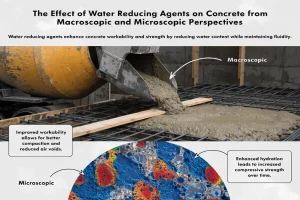
The Effect of Water Reducing Agents on Concrete from Macroscopic and Microscopic Perspectives
Blog The Effect of Water
Product information, specifications & applications — sent directly to your email.
*Your information is kept confidential and will only be used to contact you regarding our products.