Blog
In the fields of infrastructure engineering and construction, concrete is undoubtedly the cornerstone of infrastructure. Many people focus on the quality of cement, sand, gravel, and aggregates, but overlook the core auxiliary material of concrete: water reducers(like polycarboxylate superplasticizer).
As the core product of concrete admixtures, water reducers may seem to have a very low proportion of usage. Still, they can completely change the workability, mechanical strength, and service life of concrete in two dimensions: microstructure reshaping and macroscopic engineering quality improvement. They are essential materials in modern high-standard concrete construction.
Today, we will take you through a comprehensive understanding of why water-reducing agents have become the “invisible core” of high-end construction, road and bridge infrastructure, and commercial concrete engineering.
The performance shortcomings of concrete are essentially internal structural defects. Concrete without water-reducing agents will aggregate cement particles due to molecular gravity after mixing, forming a dense flocculent structure. A large amount of free water will be trapped in the gaps between the particles and unable to participate in flow.
This leads to the need for additional water to enhance the workability during construction, ultimately resulting in problems such as multiple internal pores, loose structure, insufficient strength, and susceptibility to cracking and water seepage in the concrete.
The core value of water-reducing agents is to crack the inherent defects of concrete at the micro-molecular level and accurately optimize the internal structure.
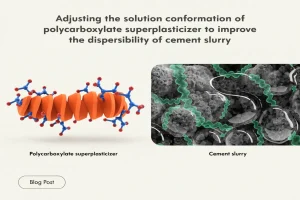
Water reducing agent molecules can be selectively adsorbed on the surface of cement particles, allowing all cement particles to carry the same negative charge and generate strong electrostatic repulsion, completely breaking up the cement coagulation and agglomeration structure. The free water that was originally locked by the package is completely released, without the need for additional water, allowing the concrete slurry to flow evenly and reducing the amount of mixing water from the source. Conventional high-efficiency water reducers can achieve a water reduction rate of 15% -30%.
In addition to electrostatic repulsion, polymer water reducers have their own steric hindrance effect, which can form a stable molecular protective film on the surface of cement particles, preventing secondary agglomeration of particles. Uniformly distribute cement, sand, gravel, and aggregates in the slurry to avoid layering, segregation, and bleeding of concrete, ensuring uniform material and structure of each concrete at the micro level.
The water-cement ratio is the core indicator that determines the strength of concrete. After significantly reducing the amount of mixing water, the use of water-reducing agents greatly reduces the capillary pores and honeycomb voids generated by the evaporation of excess free water during the concrete hardening process.
The micro porosity is significantly reduced, and the internal structure of concrete changes from “loose and porous” to “dense and compact”, effectively improving the efficiency of the cement hydration reaction, making the crystal structure of concrete more stable, and enhancing the compressive and flexural strength of the core.
Ordinary concrete is prone to microcracks due to water evaporation and shrinkage after hardening, which is the root cause of later water seepage, cracking, and corrosion. Adding professional water-reducing agents can optimize the hydration rate of cement, reduce the early and late shrinkage rate of concrete, suppress the occurrence of microcracks, and improve the compactness of concrete. It can also block the infiltration channels of external water vapor and acid-base media, greatly improving the internal corrosion resistance and freeze-thaw resistance of concrete.
The optimization of microstructure ultimately leads to a comprehensive upgrade of macro engineering. Whether it is civil buildings, high-rise buildings, bridges and tunnels, municipal roads, or large-scale infrastructure projects, water reducing agents can bring disruptive improvements to the entire construction process and solve the core pain points of the industry:
This is the most intuitive macro value of water-reducing agents. Under the premise of constant cement dosage and water-cement ratio, the addition of water-reducing agents can significantly improve the slump of concrete and significantly enhance the fluidity, encapsulation, and pumpability of the slurry.
For complex working conditions such as pumping in high-rise buildings, pouring in narrow tunnel spaces, and construction of densely reinforced steel beams and columns, high-flow concrete can easily fill the gaps in the formwork, wrap around the steel skeleton, eliminate common construction problems such as pump blockage, honeycomb, rough surface, and voids, greatly reduce construction difficulty, and meet the high standard construction needs of the entire site.
By relying on micro-dense internal structure optimization and adding water reducing agents to concrete, the 3-day early strength and 28-day standard strength can be improved by 20% -40%.
Early strength enhancement can shorten the concrete demoulding and curing cycle and accelerate the overall progress of the project. The standard strength is steadily increasing, which can make the building structure have stronger bearing capacity and fully adapt to the high standard load-bearing requirements of large factories, landmark buildings, heavy-duty roads and bridges, water conservancy projects, etc., building a solid safety bottom line for engineering structures from the material end.
Using water reducing agents can significantly reduce the water-cement ratio while maintaining the design strength standards, while also reducing the amount of cementitious materials such as cement and fly ash used.
Compared to traditional concrete formulas, adding high-efficiency water-reducing agents can save 10% -20% of cement usage. In large-scale commercial concrete production and infrastructure projects, it can greatly reduce raw material procurement costs. Meanwhile, stable slurry performance can reduce rework, repair, and waste loss, further reducing overall construction costs.
Ordinary concrete is prone to problems such as wall detachment, road damage, and steel corrosion due to its high porosity, easy water seepage, cracking, and poor frost and corrosion resistance. After long-term use, it is prone to problems such as wall detachment, road surface damage, and steel reinforcement corrosion, resulting in extremely high maintenance and renovation costs.
High-density concrete mixed with water reducing agents has excellent water resistance, freeze-thaw resistance, acid-alkali corrosion resistance, and carbonation resistance. It can effectively resist external environmental erosion such as rainwater erosion, temperature changes, and soil corrosion, greatly improving the service life of buildings, roads, and bridges and significantly reducing the cost of maintenance, renovation, and repair in the later stage of the project.
Good fluidity makes concrete pouring and vibration more convenient, significantly reducing vibration time and labor input; Early strength can be rapidly increased, enabling early demoulding and subsequent construction processes to be carried out in advance. In large-scale engineering projects, it can effectively compress the overall construction period, improve project delivery efficiency, and create higher economic benefits for the construction party.
Simply put, micro determines essence, macro determines value:
At the micro level, water reducers are the “structural optimizers” of concrete, reshaping the internal dense structure through molecular action and solving the inherent defects of concrete;
At the macro level, water-reducing agents are the “efficiency managers” of engineering construction, delivering five core values: improved quality, faster construction, lower costs, longer service life, and greater damage resistance.
As the infrastructure industry standardizes and advances, ordinary concrete without additives can no longer meet modern engineering needs. A specialized water reducing agent that precisely adapts to working conditions has long been a key material for distinguishing engineering quality, ensuring project compliance, and controlling construction costs.
Product information, specifications & applications — sent directly to your email.
*Your information is kept confidential and will only be used to contact you regarding our products.